 Breeds
Andalusian Rat Hunting Dog: Temperament, Care and Fun Facts
For generations, Bodegueros Andaluces earned their keep hunting rats among barrels of fino and manzanilla sherry. That leaves a mark. Understanding where this breed comes from is the key to understanding why he behaves the way he does at home and what he really needs to be happy day to day.
Origins of a genuinely Andalusian breed
The name already gives a lot away. Bodegueros Andaluces have been tied for centuries to the wine cellars (bodegas) of Jerez, where they had one job: hunting the rodents prowling among the barrels and putting the wine harvest at risk. The breed wasn't born in any kennel or from any selection plan on paper. It shaped itself, through pure survival logic, because in that environment only the most agile dogs thrived, the ones with the sharpest hearing, the ones who didn't back down from anything. Centuries of that leave a mark.
The foundation came from the sea. British wine merchants arriving through Andalusian ports during the 18th and 19th centuries brought their terriers with them, mainly smooth Fox Terrier types. Those dogs mixed with local individuals already adapted to the heat and terrain of the south, producing an animal small in size but with uncommon stamina and character. Animal behaviour researchers see in this process something similar to what happened with other Mediterranean working dogs, though with a very specific geographic imprint. For decades he was an almost unknown breed outside his home region, mentioned among cellar workers and local hunters but invisible to everyone else. Andalusian dog associations were the ones who pushed to standardise the breed and secure his official recognition as a native breed, a status protecting both the animal and the memory of the trade that created him.
Knowing this origin helps make sense of why the Bodeguero does what he does. The chase instinct, the constant alertness, the urge to explore every corner even when there's nothing to find — it all comes from centuries of real work. It doesn't matter if the dog grew up in a flat and never saw a wine cellar in his life. Those impulses are still there, and they're key to understanding a good deal of his behaviour, something we'll look at in more detail in the following sections.
Physical appearance: small but athletic
The Andalusian Rat Hunting Dog's proportions deceive at first glance. With a height at the withers generally ranging between 35-42 cm and a weight typically between 8-12 kg — with a height at the withers of 33 to 40 centimetres and a weight of 7 to 9 kilos — anyone might classify him as a modestly sized companion dog. However, his build reveals an athletic constitution designed for action: the chest is deep, the legs straight and muscular, and the topline firm, giving him an agile stride and a striking ability to turn on a dime. The morphological standard isn't after looks for their own sake; it responds to the demands of a hunter who had to slip between barrels, jump obstacles and hold up stamina-wise through long working days.
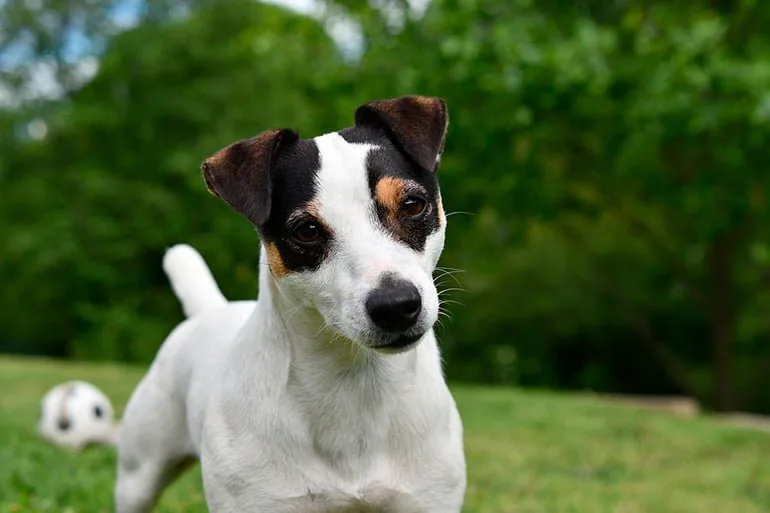
The coat is another of the breed's distinctive, functional traits. It's a short, dense coat lying close to the body, with a white base dominating the coat and black or brown patches appearing over it, often on the head and torso. This pigmentation isn't accidental: the predominant white let bodega workers easily spot their dogs in the dim light of the cellars, while the dark patches offer a slight camouflage out in the field. Maintenance is simple, but weekly brushing is worthwhile to remove dead hair and keep the skin in good condition, which also strengthens the bond during grooming sessions.
With proper veterinary care and diet and an active lifestyle, as happens in many small breeds, medial patellar luxation is one of the orthopaedic conditions that can show up, and surgical correction should be carried out as soon as possible to limit the development of abnormalities ‘Canine patellar luxation’ (1993). That's why regular check-ups and watching for any lameness or odd hop while walking are essential. A Bodeguero with controlled weight and well-developed musculature has good odds of reaching old age with excellent quality of life.
Senses pushed to the limit: how hearing and smell define the Andalusian Rat Hunting Dog
The Andalusian Rat Hunting Dog has sharper hearing than most dogs his size. It isn't genetic luck. Generations spent hunting rodents in dark wine cellars, among barrels and straw, sculpted that ability into something almost exceptional. A dog like that can hear a mouse on the other side of a wall or tell whether a rustle in the straw comes from vermin or the wind. Canine behaviour specialists rarely document that level of acuity in small breeds. At home, all that sharpness turns into hypersensitivity to the surroundings, and it's worth keeping firmly in mind from the very start of training if you don't want every slammed door to end in barking.
His sense of smell is also well above average for his size. Nothing like a scent hound specialised in tracking, but considerably above what you'd expect. You notice it right away on a walk. He works the ground in a zigzag, focused, nose down. His predatory instinct switches on at the scent of rodents, birds or reptiles, and in those moments the nose calls the shots more than the eyes. Building scent games into the daily routine, whether hiding treats around the house or using detection mats, burns off a lot of mental energy and stops boredom from turning into problem behaviours.
The combination of these two senses makes the Bodeguero a natural sentinel. He used to protect the barrels from pests; now he alerts you that someone's coming up the stairs or that there's a cat in the garden. Understanding that this alarm vocation has a very deep sensory root, and that it isn't whim or bad training, completely changes how you manage it. That's where positive reinforcement makes the difference, letting you redirect those behaviours without corrections that only make them worse.
A temperament that wins hearts
With the Andalusian Rat Hunting Dog there's no middle ground. He throws himself into his family with an intensity that can throw you off at first: he wants to be part of everything, involved in everything, and if you leave him alone too long without teaching him to handle it first, anxiety shows up. That need runs deep. For generations he worked right beside the bodega worker, literally at his side, and that's left a profound mark on the breed's temperament. That need for company he carries is part of what he is, not a flaw to fix.
Small, yes, but with plenty of ego. The Bodeguero has that terrier spark that leads him to stand up to a dog three times his size if he thinks it's called for. He defends what's his with barking that doesn't go unnoticed. That's why early socialisation matters so much. A puppy who sees the world from the start learns to channel that confidence without turning it into conflict; watch out for dogs who grow up without those experiences, since they can become reactive or highly territorial. Well guided, his playful, affable side ends up winning out.
There's something else striking about this breed: how easy he is to read. His tail never stops. His head tilts when he hears something new, and that fixed stare while he waits for a command says a lot about what's going on inside. Owners quickly learn to tell whether the dog is stressed, excited or simply frustrated, which makes living together far smoother than you'd expect.
Does he live well in a flat? Yes. But that doesn't mean he doesn't need to move. The Andalusian Rat Hunting Dog fits well in flats without a garden because he's small and his coat is low-maintenance. What he won't forgive is too few walks. Two or three outings a day with real time to run, sniff and play make the difference between a balanced dog and one who wrecks the cushions or barks non-stop because he doesn't know what to do with all that pent-up energy.
With children he generally gets on well. He has physical stamina and a love of play, so he can keep up with them for quite a while. Watch out with very young children, though, because when the dog gets worked up he can knock them over with no bad intention, or turn rough if he feels cornered.
The hunting instinct is there, and it needs accounting for. With other dogs, if introductions are handled well or they've grown up together, living together usually goes smoothly. With cats, rabbits or birds, it's another story. The urge to chase them can trigger in a split second, and he should never be left alone with them without a secure physical barrier. Some Bodegueros learn to respect the family cat, especially if they've been used to it since puppyhood, but that instinct doesn't disappear. Living with this breed means accepting that.
Outstanding intelligence
The Andalusian Rat Hunting Dog's mind never stops. He isn't the type to wait for instructions; he'd rather find the solution on his own. That autonomy runs deep. For generations, these dogs hunted rats among barrels with no human supervision, making decisions in real time. The instinct is still there, and today it shows in how quickly he links a gesture to a consequence, in how he figures out on his own that the cupboard drawer opens if he pushes from below, or in the satisfied look on his face when he empties a tricky Kong before you've even finished filling it.
That much capability comes at a cost. The Bodeguero gets bored fast, and once he's bored, he finds his own entertainment. A training session where you repeat the same exercise ten times is, to him, an invitation to switch off and go find something else to do. Puzzle toys, scent searches, new tricks, small homemade circuits — something needs to work his mind every day. Behaviourists have been stressing this for a while. A Bodeguero with enough mental stimulation is a balanced dog. One left without challenges gets nervous, starts barking for no apparent reason and ends up taking apart whatever he can get his teeth on.
This dog reads people. He picks up on your tone of voice before you finish the sentence, senses when someone's tense even if they're trying to hide it, and reacts before you've even processed what just happened. For anyone looking to genuinely connect with a dog, that's a huge advantage. But that same sensitivity makes him vulnerable to punitive training. With harsh methods he learns less and can end up with a fear that's very hard to shake. Positive reinforcement suits him far better. He learns more, faster, and the bond comes out stronger for it.
Training from puppyhood: the key to success
Something important happens in an Andalusian Rat Hunting Dog puppy's mind between three and sixteen weeks. It's the period when the puppy's brain is most open to filing the world as safe or threatening, and whatever he experiences then will shape him for a long time. People of varied appearance, calm dogs, the noise of a busy street, different textures underfoot, someone calmly touching his ears or opening his mouth — all of that should happen gradually, without forcing it. A Bodeguero who has a good run of those first months ends up developing an emotional stability that shows in everything later. One who grows up isolated or with frequent scares can become reactive, and that's far harder to fix.
Basic obedience also starts from day one, though with short sessions: three to five minutes several times a day work better than one long class that leaves him with no appetite for more. With this breed, recall, "stay" and "drop it" are especially critical. His hunting instinct is strong, and without those commands solidly in place, a cat crossing the street can turn into a serious problem. The key is using rewards that genuinely motivate him and gradually raising the difficulty, practising in places with more distractions as the dog consolidates what he's learned.
There's another front worth working on from the start that doesn't always get mentioned: teaching the dog to be alone. The Andalusian Rat Hunting Dog needs movement and mental stimulation, and if he doesn't learn to manage calm on his own as a puppy, he can end up a fairly demanding adult. Teaching him to stay in another room without drama, giving him fillable toys to keep him occupied, and not overdoing arrivals or goodbyes are simple things that make a real difference. Watch out for this: if everyone at home applies their own rules, the Bodeguero notices right away. They're clever, and they exploit inconsistency without a second thought.
The hunting heritage that can't be ignored
For centuries the Andalusian Rat Hunting Dog was the pest exterminator of the wine cellars of the south. Rats, mice, whatever moved among the barrels. That job sculpted his body, sharpened his senses and fixed a hunting pattern — what behaviourists call the complete predatory sequence — that remains intact in most individuals today, even though the context has changed considerably.
When a Bodeguero picks up on something — a smell, a movement in the grass — the transformation is instant. His body tenses, his head drops, his ears point forward. He freezes. In that state, calling him is nearly pointless: the dog is mentally somewhere else. If the prey escapes, he launches into a short, explosive chase, with sharp turns and jumps that don't cost him a step. Watch out for this, because the same thing happens in the park with a sparrow or in the garden with a mole. It isn't aggression, or at least not in the usual sense; what drives the dog is an instinct forged over generations that still responds exactly as it did in the wine cellars. Properly channelled — with throwing games or coursing — that energy has a great outlet.
Living with a Bodeguero means accepting a few precautions that, once built into the routine, are no drama at all. In areas with wildlife, better a long lead or a fenced space; the dog can ignore recall once he's locked onto a target, and there's no competing with that. At home, small pets need their own protected space — cages, separate rooms — because instinct doesn't distinguish between someone else's hamster and a cellar rat. And an unsupervised garden is a bad idea if there are signs of moles or mice underground: a motivated Bodeguero digs with a determination that's startling.
Knowing all this makes all the difference in living with the breed. And if you're looking for one, the next step is finding a serious breeder, one who works on their dogs' health and temperament and doesn't disappear after the sale.
IMPORTANT: This article is for informational purposes only and does not constitute veterinary, nutritional or behavioural advice. Every dog is different, and only your trusted vet can advise you on its specific needs.