 Breeds
Australian Terrier: Temperament, Care and Fun Facts
The Australian Terrier is much more than a companion dog: his history as a snake-hunter in the outback has given him a rough coat and an enviable lifespan. Discover on SoyUnPerro | Dog Experts how his functional past shapes his temperament today.
History of the Australian Terrier, a breed born out of necessity
When British settlers landed in Australia during the 19th century, their dogs travelled with them. Cairn Terriers, Dandie Dinmont Terriers, Skye Terriers and probably the odd Yorkshire mixed on farms, stables and mining settlements across the continent, and from those crosses, with no plan behind it, emerged what would become the Australian Terrier. Nobody was after a pretty breed. What was needed was a dog able to clear a stable of rodents and stand up to a snake without anyone having to go fetch him afterward. That constant environmental pressure shaped an animal small but muscular, with a rough coat and a jaw with plenty of judgement.
Selection was brutal and simple at once. The individuals with the best nose, the most agility and the most stamina carried on; the rest didn't. No judges, no written standard, no pedigree. For decades he was known as the "Rough-Coated Terrier" or the "Australian Working Terrier", two names that say a lot about what was expected of him. In the early 20th century enthusiasts interested in fixing his traits started to appear, but the image of the dog as a tool still called the shots. That independence of character and unshowy courage that so define the breed come directly from that, from years fighting the outback before anyone thought about writing a standard.
The Australian National Kennel Council formalised everything in 1933 with the first official standard, and the name became permanently fixed. The FCI later placed him in Group 3, section 2, among the small terriers. His popularity has never matched a Yorkshire's or a West Highland's, and honestly that's served him well. Without the pressure of fashion, the breed keeps a reasonably solid state of health and a core of breeders who prefer a dog that works to one that just looks good in a photo. Today he shares the sofa with his owners, but the hunting instinct is still there, intact.
Physical characteristics
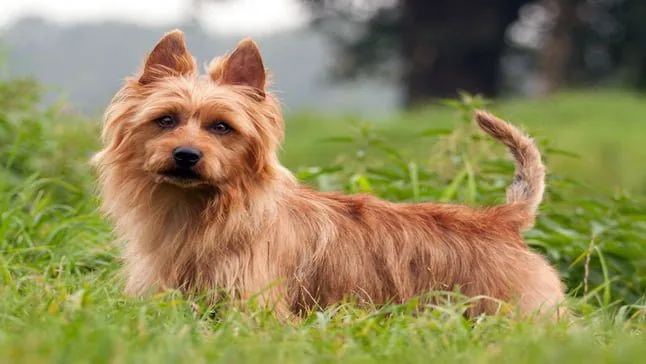
The Australian Terrier presents as a compact, sturdy dog, standing 25 to 28 centimetres at the withers with an ideal weight of 6 to 7 kilograms. His silhouette, slightly longer than tall, conveys an impression of solidity and agility in equal measure. The chest is deep with well-sprung ribs, while the topline stays firm and level. Life expectancy runs 12 to 15 years, a notable longevity that reflects the absence of anatomical exaggerations in the standard and a historical selection focused on function rather than looks.
The coat is one of his most distinctive traits: a double coat made up of a soft, dense undercoat that acts as thermal insulation, and a harsh, hard, slightly wavy outer layer that repels dirt and moisture. This structure let him work in harsh weather conditions without mud or water reaching the skin. Colours accepted by the standard are blue and tan (a steel-blue coat with tan markings on the legs, muzzle and eyebrows), sandy (ranging from cream to reddish tones) and solid red. The head is elongated, with a gentle but defined stop, and the ears are small, erect and high-set, giving him a permanently alert expression.
The tail, traditionally docked in countries where the practice is still allowed, is increasingly shown in its full natural form, which is high-set and carried cheerfully without curling over the back. The eyes, oval and dark brown, reflect lively intelligence and a spark of independence. The Australian Terrier's overall build doesn't aim for extreme refinement, but for biomechanical efficiency: his structure lets him turn on the spot in tight spaces, jump with power and hold the stamina needed for a day's hunting. Any significant deviation from these proportions is usually penalised in the show ring, precisely because it compromises the breed's original function.
Temperament and character
Alert, brave and with a determination that can throw off anyone expecting a more accommodating companion dog. The Australian Terrier carries centuries of solitary work in his genes, hunting vermin and handling situations with nobody giving him instructions. That past shows. He makes his own decisions, assesses what's in front of him and acts on his own judgement. This doesn't mean he's a cold or distant dog with his family, but his way of relating differs quite a bit from what's usually expected of a companion breed.
Is he affectionate? Yes, though in his own way. He'll stick close to you without making a show of it, follow you from room to room and pick up on your mood better than you'd think. What he won't do is beg loudly for cuddles. If you sit on the sofa for a quiet evening, he'll probably end up curled up against you, but without the drama of other breeds. Some owners describe him more as a discreet flatmate than a dog who throws himself at you. The contrast with more outgoing terriers is obvious right away.
The watchdog instinct comes built in. He barks when someone unfamiliar arrives, yes, but then he watches, processes and decides on his own whether that visitor deserves attention or can be ignored. A dog like that, well socialised from puppyhood, rarely turns into a compulsive barker. With other dogs he moves with confidence: he neither looks for a fight nor backs down if another dog gets pushy. The courage that once let him face down snakes in the Australian outback hasn't gone away. It rarely shows up in a city flat, but it's there.
As a family dog, he fits well provided the household has the right expectations. Very young children who don't yet control their movements can be an issue, because this dog has a moderate patience threshold and won't put up with just anything without complaint. An eight- or ten-year-old who knows how to respect his moments and read when the dog wants peace is a different story: there, the Australian Terrier gives everything he's got, and can handle a whole afternoon of garden games without showing signs of tiring.
Watch out for this if you have other small animals at home. The prey drive is deeply ingrained, and a hamster, a rabbit or a guinea pig will look like prey to him, not companions. With cats it depends a lot on history: growing up together from puppyhood makes cohabitation possible, but an unfamiliar cat that bolts will almost certainly trigger a chase. Things change with other dogs, where living together usually works well if he's had social contact from a young age; unneutered males can get more territorial around other males, though.
For an active family, with school-age children and time to spend outdoors, this dog brings character, closeness and an energy that never tires you out but never disappears either. He's not a dog who goes unnoticed at home. He has opinions, takes up his space and lets you know it. Anyone who enjoys that and gives him consistent training from the start will find a companion who genuinely takes part in family life. Anyone looking for an animal that adapts to everything without asking for anything in return should look at a different breed.
Australian Terrier coat care: stripping and maintenance
The Australian Terrier's coat throws off people coming from other breeds. That double-layer structure — a harsh, tough outer coat over a softer undercoat — doesn't take to scissors or clippers. The technique it needs has its own name: hand stripping, which involves pulling out dead hair from the root with fingers or a specific stripping knife. Opt for clipping instead, and everything changes: the outer hair loses its hardness, the colour fades, the undercoat takes over and the coat ends up cottony, a magnet for dirt and unable to protect the skin. Stripping isn't a show-breeder quirk. It's what keeps the coat functioning as it should.
How often full sessions are needed varies from dog to dog, since not all of them renew their coat at the same pace, and it also depends on whether the animal competes or lives as a pet. In between, a metal-pin comb once a week is enough to pull out loose hair and stop the undercoat from matting. Watch for tangles, because if they really compact, the skin underneath ends up irritated. Bathing every six to eight weeks at most, with a gentle shampoo that doesn't strip too much oil. It might sound paradoxical, but skin robbed of all its natural oils loses the resilience that defines the breed. For drying, air or a hairdryer on low heat; towelling roughly as you would a water dog ruins the structure of the rough coat.
Stripping has its own learning curve. Here's the trick: telling apart mature hair — which comes away with a minimal tug — from new hair that isn't ready to come out yet. Many owners prefer to leave it to a groomer specialised in wire-coated terriers, and that's a sensible decision given that a badly done strip leaves damage that can't be undone. If the plan is learning it at home, it's best to start with short sessions and generous rewards. The process doesn't hurt when the hair has had the right amount of time to mature, though at first the dog might find it odd. A coat in good condition protects against cold, repels water and lets the Australian Terrier enjoy the outdoors without the weather taking a toll on him.
Diet and nutrition
Before talking about portions and protein, it's worth knowing two weak points the Australian Terrier carries in his DNA: the thyroid and the pancreas. The breed has the highest documented risk of spontaneous diabetes mellitus in the United States, with a probability 32 times higher than in mixed-breed dogs ‘Heritability and complex segregation analysis of naturally-occurring diabetes in…’ (2020). A figure like that changes quite a bit how his diet needs to be approached.
The priority is stopping blood sugar from spiking sharply. This breed's pancreas isn't up for any scares, so it's best to go for slow-absorption carbohydrates — sweet potato, pumpkin, peas — and leave out refined grains and simple sugars. Chicken, turkey, lamb or fish are the best protein options, providing complete amino acids without filler calories. Fish oil or coconut oil, used in moderation, look after the skin and coat and provide energy without disrupting the glucose curve. Weight also factors heavily into the equation. Between 6 and 7 kilograms is this breed's ideal range; every extra kilo worsens insulin resistance and gives that genetic load much more room to turn into a real disease.
The thyroid needs the same level of watchfulness as the pancreas. No diet can stop hypothyroidism on its own, but keeping correct levels of iodine, selenium and zinc — three key minerals in thyroid hormone synthesis and conversion — helps the endocrine system run without hiccups. Sea fish provides them well, as do lean meats and some leafy greens; seaweed also helps, though in tightly controlled amounts. If the dog seems apathetic for no reason, gains weight without any diet change, sheds hair symmetrically or his appetite shifts for no visible reason, see the vet. Only proper bloodwork can confirm a thyroid problem or early-stage diabetes, and only a professional can prescribe the right treatment.
Exercise and daily needs
The Australian Terrier needs a minimum of 30-45 minutes of daily exercise. That recommended figure sits at 30 to 45 minutes of structured exercise a day, but it should be read as a floor, not a ceiling. A healthy adult will appreciate longer sessions combining a walk with free running in a safe space, chase games and activities that test his agility. Monotony is his enemy: repeating the same route at the same time every day can lead to boredom and, with it, unwanted behaviours like compulsive digging, excessive barking or chewing on furniture.
Physical exercise needs to be paired with equally intense mental stimulation. The Australian Terrier has a superb nose and a practical intelligence that needs channelling into concrete challenges. Scent games — hiding treats around the house or garden and encouraging him to find them — connect directly with his hunting instinct and give him a level of satisfaction plain aerobic exercise can't match. Agility circuits, though they require some prior training, are an excellent option for this breed, since they combine coordination, speed and obedience in a format that respects his need for autonomy: the dog chooses his path within a framework of clear rules, which fits perfectly with his independent temperament.
Lack of exercise doesn't just affect behaviour; it also impacts the metabolic health of a breed already predisposed to diabetes and thyroid disorders. Regular physical activity improves insulin sensitivity, helps maintain an optimal body weight and contributes to endocrine stability. An Australian Terrier who gets the right amount of exercise is a balanced dog, responsive to training and much less prone to developing the health complications that lie in wait for sedentary individuals. The daily time investment in his movement needs isn't optional: it's part of the unavoidable commitment that comes with bringing this breed into family life.
Training and intelligence
The Australian Terrier thinks for himself. That, which sounds good in theory, means in practice that he isn't a dog who obeys just because. His ancestors spent hours underground hunting with nobody telling them what to do at any given moment, and that's left its mark. He learns fast, no doubt about that, but if a command seems unnecessary or pointless to him, he simply skips it. He needs to perceive a clear benefit: a high-value treat, a toy that fires up his prey drive, the chance to access something he wants. Without that, training built on monotonous repetition goes nowhere.
Short sessions work better than long ones. Fifteen minutes with variety and positive reinforcement hooks him more than an hour of the same old exercises. And watch the household structure: if everyone at home applies different rules, the Australian Terrier picks up on it right away and picks whichever path suits him best. Consistency across every member of the household isn't optional.
Socialisation needs doing properly and on time. Between eight and sixteen weeks, the puppy needs to meet people of different profiles, good-tempered dogs, noisy urban environments, unusual surfaces, new smells. All of it controlled, without overwhelming him, but with variety. An Australian Terrier who doesn't go through that process tends to develop a wariness that's very hard to work on afterward. One who does go through it keeps his natural alertness, knowing when there's real cause to react and when there isn't. That difference shows in everyday life. Puppy classes, walks through busy areas, visiting friends' homes with balanced dogs — none of that is wasted effort.
His independence shouldn't be fought, it should be built into training. Exercises that pose a mental challenge work far better for him than static commands repeated to exhaustion. Finding a specific object among several, solving a dog puzzle, running an obstacle course — that kind of challenge genuinely switches him on. A prolonged "stay" or a precise "heel" aren't his strong suits, but they can be worked on if presented as a game with intermittent rewards rather than pure obedience.
Before bringing one home, it's worth honestly asking whether you can take on the regular hand-stripping his coat needs and the daily mental stimulation his mind demands. A trustworthy breeder will guide you on pedigree, the parents' health tests, and how the puppy's socialisation went in his first weeks. That first step shapes a great deal of the future relationship with a dog who, once properly understood, responds with a loyalty and closeness hard to match.
IMPORTANT: This article is for informational purposes only and does not constitute veterinary, nutritional or behavioural advice. Every dog is different, and only your trusted vet can advise you on its specific needs.