 Nutrition
BARF Diet Recipes for Dogs
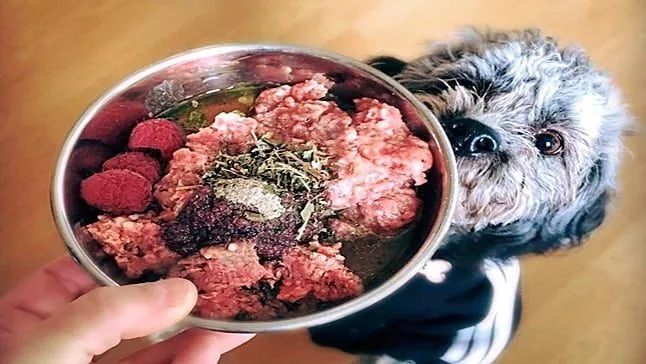
Let's look in detail, explaining everything step by step, at how we can put together some BARF meals for our dog. So that they are healthy and balanced for them, and of course, very tasty too.
BARF Diet Recipes — Where Do I Start?
So you don't get confused, you need to be clear on one very simple basic concept, with which you will be able to put together dozens of different menus for your dog: composition.
The composition of every BARF menu is as follows:
- 60% meaty bones
- 20% lean meat
- 10% fruit and vegetables
- 10% organs and offal
Within each of these categories you have plenty of options to choose from… so you can keep alternating ingredients to put together as many different menus as you like. Some people use 50% or 70% meaty bones instead of 60%… this is not an exact science and leaves room for everyone to interpret it as they like, meaning you can vary the percentages a little depending on your preferences.
What Ingredients to Use in BARF Diet Recipes?
Let's detail each of the ingredients mentioned above, so you can choose the ones you like most, or a bit of everything. Remember that variety in meat, fruit and vegetables is the key to a genuinely healthy diet.
If this month you use chicken and beef as lean meat, next month you can use pork and duck for variety, for example. Let's get into it:
Meaty Bones:Meaty bones are considered those that are soft and easy for our dogs to digest. Remember that you should NEVER give your dog cooked bones, only raw ones. Meaty bones include:
- Chicken carcasses, wings and neck
- Rabbit carcasses and thighs
- Duck carcasses
- Beef brisket or ribs, also the windpipe (cartilage)
- Pork spine or ribs
- Lamb neck
We should use meat with fat (lean) trimmed off the bone, though we can also use some fish instead or mix it with pieces of meat. The more variety of meat we use the better; do not limit yourself to always buying the same type of meat — vary it to use at least two different types of meat in each recipe. You can use:
- Beef or lamb heart (heart counts as meat, being muscle)
- Chicken gizzards
- Beef, horse, pork, lamb…
- Sardines, anchovies, salmon, tuna…
Although some people give vegetables raw, we always recommend boiling the vegetables and mixing them with the fruit (fruit is given raw), making a kind of purée with them. That way they make far better use of their properties, since some vegetables are hard for them to digest.
Remember never to include fruit seeds, since they can be toxic to dogs; you have a short list of forbidden foods here: List of toxic foods for dogs
Some of the fruits and vegetables you can use are (among many others):
- Apple, pear, peach, banana, etc… (always with no pips/stone)
- Carrots, pumpkin, broccoli, cauliflower, lettuce, etc… (avoid tough lettuces such as iceberg)
Although it sounds a bit off-putting and somewhat unpleasant, the truth is it is very easy to find at any butcher's, market or offal shop. It is part of our dog's diet and should always be given in small amounts.
Some ingredients you can use in this category are:
- Chicken liver or kidney
- Lamb liver, kidney or lung
- Beef lung
- Chicken, duck, lamb offal…
- Green tripe
- Etc…
What Amounts Should I Buy to Make BARF Recipes?
It all depends on how many dogs you have and their size, as well as your storage capacity. Let's use the example of a single dog; you can then work out the sums for however many dogs you have and their weight.
Usually buying wholesale (large amounts) gets you a cheaper price than buying small amounts, but if you do not have a large freezer, do not worry — plenty of BARF diet users simply use a small space in their freezer or fridge.
If your dog is a puppy, work on the basis that they need 10% of their weight in BARF diet daily, so if your dog weighs 3 kilograms, you should give them a total of 300 grams of BARF diet a day.
You should split those 300 grams into three meals (or four, depending on the dog and their habits), so you can give them 100 grams for breakfast, 100 grams for lunch and 100 grams for dinner.
Of those 300 grams, 60% should be meaty bones (180 grams), 20% lean meat (60 grams), another 10% fruit and vegetables (30 grams) and 10% organs and offal (30 grams).
So if you multiply that by 7 days you get the total ingredients you will need for a week; multiply it by 30 and you get the total you will need for a month.
You can prepare menus in individual bags (daily portions) and freeze them, taking them out day by day, or two or three days' worth at a time, and keeping them in the fridge. Whatever suits you best ;)
If your dog is already an adult, their daily ration should be 2% to 3% of their weight, so if your dog weighs, say, 30 kilos, their daily ration should be 900 grams a day (which you can split into, for example, three portions of 300 grams — breakfast, lunch and dinner — or two portions of 450 grams for breakfast and dinner).
Of the 900 grams your dog should eat daily, 60% should be meaty bones (540 grams), 20% should be lean meat (180 grams), 10% fruit and vegetables (90 grams) and another 10% organs and offal (90 grams).
As you can see, it is all about doing the sums based on your dog's weight, and whether it is a puppy, where you should give them 10% of their weight, or an adult, where you should give them between 2% and 3% of their weight.
If your dog eats 500 grams of meaty bones daily, you can do a weekly shop of 3.5 kg of meaty bones, or a monthly shop of 15 kg of meaty bones, and freeze them.
How Much Do the Ingredients for BARF Recipes Cost?
As we have already mentioned, it is far cheaper to buy fresh food and feed our dog a healthy, balanced diet than to buy good-quality kibble. Of course, you can buy low-quality kibble at a much reduced price… but you will be slowly poisoning your dog.
BARF feeding is very economical, even more so if you buy in large quantities. Let's leave a few examples of what the ingredients used usually cost, bearing in mind that prices can vary a great deal between regions or countries.
Remember not to shop at the big supermarket, since that is usually where everything is more expensive (unless you find a specific offer). It is most advisable to shop at markets or local neighbourhood shops, the traditional kind.
- Meaty bones: You can find chicken carcasses from €0.30 a kilo to €1 a kilo; look around and ask about prices.
- Lean meat: Looking around and comparing prices, you can find good-quality lean meat from €2.50 a kilo to €5 a kilo. Sometimes even at a much lower price; it is all about comparing and grabbing offers.
- Fruit and vegetables: Buying seasonal produce by weight, you will find genuinely good deals. Generally you can find various products at an average of €2 a kilo (and quite a bit less, really)
- Organs and offal: Chicken liver, for instance, can be found at an average of €3 a kilo; other organs at a much lower price.
BARF Diet Recipes — How to Make a Balanced Menu?
Now that you know what proportion of each ingredient your dog needs for a balanced diet, you simply need to put together the menu to your liking.
You can mix the ingredients your dog eats daily in a freezer bag (the kind used for freezing food) or a tub, whatever suits you best. Leave one or two bags in the fridge and freeze the rest. When the fridge bags run out, take another couple out of the freezer the night before, and that way you will always have defrosted meat to give your dog.
Remember you should not cook anything, you should simply boil the vegetables. Some people think dogs need carbohydrates and also boil a little pasta to add to the menu. Everyone is free to add what they think best, but it is not necessary. Even so, if you prefer to do it, adding an extra 10% pasta to the daily amounts is enough, though it would be far better to use cooked oats than pasta (as well as being cheaper).
The simplest approach is to have one bag per day, taking portions from it as needed; if your dog eats twice a day, split the bag in two. If your dog eats four times, split the bag into four and give them a portion at each meal.
Remember your dog does not have to eat the exact grams of each thing at every meal; if they have more meat at breakfast and more vegetables at dinner, absolutely nothing happens. So menus do not have to contain the exact gram amount of everything; if one day they eat more meat and another more bones, that is fine too — simply make balanced menus so that, over a week, they eat roughly what is stated (don't give them a day of only vegetables and another of only meat, though… but don't obsess over the exact percentages either).
On another note, you can also make individual portion bags, which will undoubtedly be more convenient for you. It will also be more work to prepare them, though, and you will probably get tired of it soon.
We recommend making daily portions and freezing them, always leaving a couple unfrozen in the fridge to keep feeding your dog.
If I Use BARF Feeding, Does My Dog Need Any Supplement?
No — if you put together a balanced menu, the truth is your dog will not need any vitamin supplement or anything similar. Even so, it is true that plenty of people using this feeding system add a few extras to their menus, such as, for a 30-kilo dog:
- One or two plain (unsweetened) yoghurts with bifidus a week.
- Two raw eggs with no shell a week
- A tin of tuna or some (whole) anchovies once a week
- A small spoonful of brewer's yeast two or three times a week (sold very cheaply at health food shops)
This is not something you have to do, since they do not need supplements, but the truth is everything mentioned is entirely natural and can benefit them.
On another note, some people use a clove of garlic when preparing the menus. Garlic can be beneficial in very small amounts for our dogs, but in high doses it becomes toxic, so we do not recommend using it.
BARF Diet Recipes — Does Raw Meat or Fish Contain Parasites or Disease?
The truth is that all meat or fish we give them raw will contain bacteria; this is entirely normal and something they eliminate during digestion, since they use highly acidic gastric fluids and enzyme systems.
Some people prefer to freeze all the meat and fish for a few weeks before giving it to their dogs, and others do not think it matters much.
The food you buy should be fresh, bought at markets and shops selling for human consumption. That way you make sure it is good quality.
Bacteria are present in all food, also in soil, on their paws, on your clothes… Your dog will probably pick up and eat things off the ground in the street, or lick parts of other dogs to greet them… in short, bacteria are present in everything, and you should not obsess over feeding.
Of course there are risks, but they could also be run over or fall ill even eating the best kibble in the world. Nobody and nothing is exempt from getting some illness.
You simply need to deworm your dog internally as you normally do, once every two or three months with a specific tablet for this, sold at every vet's.
What Other Important Things Should I Know About BARF Diet Recipes?
The most important thing of all when using this kind of feeding is to use common sense. If your dog is gaining weight, lower their daily food amount a little. If your dog is losing weight, raise their daily food amount.
It does not hurt to get your dog a blood test at the vet clinic every two or three months, to check they are healthy and have no shortfalls. You should do this whether they eat raw food or kibble.
If your dog is constipated, you should add more vegetables to their food mix. If their stomach is loose, reduce the vegetables a little and increase the meaty bones. Meaty bones cause constipation.
If your dog has diarrhoea, something is off. Usually it is some fruit or vegetable that does not agree with them, so you simply need to remove ingredients one by one until you find the one that disagrees with them. Even so, generally all dogs tolerate the foods we have mentioned well; there are always exceptions.
On another note, there is the matter of the bowl: clay or plastic bowls are not as hygienic as aluminium ones, which you can find at genuinely affordable prices.
Common sense is what will make everything go well; apply it.
What Benefits Will I Notice in My Dog if They Eat BARF Food?
The benefits are many, and they show up practically right away. Not even a week will pass before you start noticing them.
You will see how your dog's health changes; they will become happier, more energetic, more vigorous — in short, they will be far better and happier.
Of course you will notice an incredible improvement in their coat, teeth, breath and stools. Yes, their stools will be far less bulky (a great deal less, in fact, since they will make much better use of the nutrients) and will also smell far less. Your dog will also stop farting.
At mealtimes, you will see what a dog enjoying their food really looks like. Nothing like kibble — your dog will enjoy every second of their meal, and you will notice it right away. As a tip, unless your dog is very old or has simply asked you for it in their own way… we recommend feeding adult dogs three times a day and puppies three or four times a day.
Your dog will be stronger against illness. Their immune system will be far stronger thanks to the healthy food they are getting. You will notice it because they will not get sick as often.
Does this seem very complicated? It is actually very, very simple. Perhaps the first time you do it, it will seem complicated, but once you have seen it… you're all set. You will find it becomes very simple, very cheap and very healthy for your dog.
We encourage you to look for BARF Diet groups on Facebook, and watch BARF diet videos on YouTube, and you will see how much simpler it is than you think.
IMPORTANT: This article is for informational purposes only and does not constitute veterinary, nutritional or behavioural advice. Every dog is different, and only your trusted vet can advise you on its specific needs.