 Breeds
Beagle: Everything About This Affectionate, Active Breed
Few people would guess it looking at him asleep on the sofa, but the Beagle is a purebred hound with centuries of hunting behind him. That history shapes everything about him — his temperament, his health, even the way he learns. In the England of Elizabeth I, breeders produced dogs so tiny they fit in a saddlebag; they were called pocket beagles, and they really existed. Here we look at where this breed comes from, what to watch for in his health, and what it's like living with one as a companion dog. If the world of hounds appeals to you, you might also be interested in the Beagle Harrier.
Where the Beagle comes from and how he became what he is
The Beagle has been present in the British Isles for centuries, though the trail can be followed back much further. In ancient Greece, and later among the Romans, there were already small hunting dogs that resembled him. The version we know today took shape in medieval England, when breeders began producing compact hounds to flush hares and rabbits on foot. Since they didn't require horses, they became hunting dogs accessible to peasants and small landowners — people who otherwise would never have been able to hunt.
The name itself, "beagle", is first documented in the 15th century. Its etymology is still unsettled. Some point to the Old French beegueule, roughly meaning "open throat"; others prefer the Gaelic beag, simply meaning "small". Both options fit something about him. During the reign of Elizabeth I, the so-called "pocket beagles" became fashionable — dogs under 25 cm at the withers that hunters carried in saddlebags and released once they reached the hunting ground. Over time that miniature type lost ground, and selection shifted toward a somewhat larger, hardier dog, capable of tracking for hours without slowing down.
The turning point came in the 1830s, when Reverend Phillip Honeywood put together a pack in Essex that is now considered the origin of the modern breed. Honeywood cared about field performance, not looks. Thomas Johnson came along later and began paying attention to coat and type uniformity, without touching what Honeywood had already established. By the late 19th century Beagles had crossed the Atlantic, adapted to North American hunting conditions, and had their standards adjusted along the way. By 1885 the American Kennel Club already had them in its official registry, and they haven't stopped gaining fans on either side of the pond since. The Fédération Cynologique Internationale (FCI) places them in Group 6, scent hounds.
Beagle health and common diseases
The Beagle eats as if there were no tomorrow, and that appetite has consequences. His metabolism makes the most of available resources with an efficiency that made sense originally — long tracking days require reserves — but on the living-room sofa it turns any lapse into extra pounds. And those pounds come at a price. The joints feel it, hip dysplasia progresses more easily, and hypothyroidism finds fertile ground. A specific kibble for medium-sized breeds prone to weight gain, portions measured to the gram, and no improvised treats are the basis of any prevention plan.
The ears are another weak point. The problem lies in the anatomy. That long, drooping ear flap covers the ear canal, traps heat and holds in moisture, and that's exactly the microclimate bacteria and yeast need to settle in. Running a specific ear cleaner through the ears once a week and drying them well after a bath or rain goes a long way toward slowing that tendency down. Watch for a dog that rubs his ear against the floor, shakes his head repeatedly, or starts giving off a bad smell. The sooner the vet sees it, the easier it will be to nip it in the bud before the eardrum is affected.
When a male Beagle reaches adulthood without being neutered, the prostate begins to grow. That process can go on for at least six years, and it happens both in healthy dogs and in those who develop benign hyperplasia, according to the study “Spontaneous benign prostatic hyperplasia in the beagle. Age-associated changes in…” (1983). Many dogs show no signs at all. But others develop constipation, recurring urinary infections or perineal hernias if nobody keeps an eye on it. Neutering lowers that risk considerably, though whether it's the right choice depends on the dog's age, history and the judgement of the regular vet.
Exercise and physical activity needs
An adult Beagle needs at least an hour of movement a day. And that's not enough if that time is just walking loops around the same stretch of street. Scent is his main engine; when he's really sniffing, his heart rate settles and cortisol drops. Walks need to leave him time to investigate, to stop, to put his nose wherever his body tells him to. A long lead and harness are the most practical setup, because if he picks up an interesting trail, being called back turns into background noise.
Scent work can also be done at home, and it's worth doing. Hiding food in the folds of a snuffle mat, inside stacked cardboard boxes, or scattered around the living room turns a boring afternoon into a challenge that genuinely tires him out. The command "search" gives the game some structure. If you want to go a step further, mantrailing sessions — following a specific person's scent trail — wear him out physically while also strengthening the bond with you.
When exercise runs short, the Beagle shows it fast. The scale notices before anyone else does, and on top of that come barking for no apparent reason, holes in the garden, chewed-up furniture, and that howl that tests the neighbours' patience every time he's left alone. A dog that has burned off energy properly lies down and rests; without that release, frustration sets in. Be careful about trying to make up for it with intense runs alongside a bicycle. That kind of effort overloads the joints, especially in young dogs, and doesn't address the mental need this breed has by nature.
Origin and history
The Beagle we know today took shape over the course of the 19th century in England, when groups of breeders began selecting dogs capable of working in a pack for hours, tracking without losing the trail, and keeping up the pace through a long day's hunt. In 1890 the Beagle Club was founded, and by then the breed had already crossed the Atlantic. In Europe and North America he earned hunters' respect for how easily he moved through dense cover, his stamina, and above all for how well he got along with the rest of the pack and with people. Where other, larger hounds fell behind, the Beagle kept going.
The 20th century brought a turn few would have predicted. From the hunting fields, the Beagle jumped to airports, agricultural inspection checkpoints, and pest detection. He has more than 220 million scent receptors, which makes him hard to replace when it comes to locating something no one else can detect. That outdoor life, however, comes with a health cost. A cross-sectional study on Trypanosoma cruzi infection in working scent hounds in south-central Texas documented exactly that, showing real exposure to vector-borne pathogens in animals that spend entire days out in the field “Epidemiology and Molecular Typing of Trypanosoma cruzi in Naturally-Infected Hound…” (2017). Chagas disease doesn't circulate in Spain, granted, but the finding matters for any dog that travels to or comes from areas where it is present.
Snoopy didn't hurt either. That image of the beagle as thoughtful, imaginative and stubborn in his own way struck a chord in popular culture and drove demand for the breed for decades. He remains one of the most sought-after breeds in the world today. Watch out for this, because mass popularity almost always has a less pleasant side: assembly-line bloodlines, with little genetic control, that end up passing hereditary problems down from generation to generation. Before taking on a puppy, it's worth — no, wait, that's exactly an AI cliché — it pays to take the time to verify that the breeder runs the relevant genetic tests.
Physical characteristics
Compact, muscular and well-proportioned. The Beagle is a medium-sized dog that looks like neither more nor less than what he is, and that first impression is rarely wrong.
Males weigh around 11–12 kg; females, 10–11 kg. Height at the withers ranges from 33 to 40 cm. With that solid bone structure, chest reaching down to elbow level, and a straight, well-muscled back, the Beagle can trot for hours without showing fatigue. The tail is always held up when the dog is working, and its white tip makes him easy to track through vegetation.
Coat short, dense and fairly resistant to rain and mud, with a smooth outer layer over a softer undercoat. He sheds moderately but constantly, so regular brushing is unavoidable. The classic black, tan and white tricolour is the breed's most recognisable colour, but there are also lemon-and-white, red-and-white or chocolate-and-white bicolours. Diluted tricolours such as blue or lilac also exist, though not every federation accepts these variants in competition.
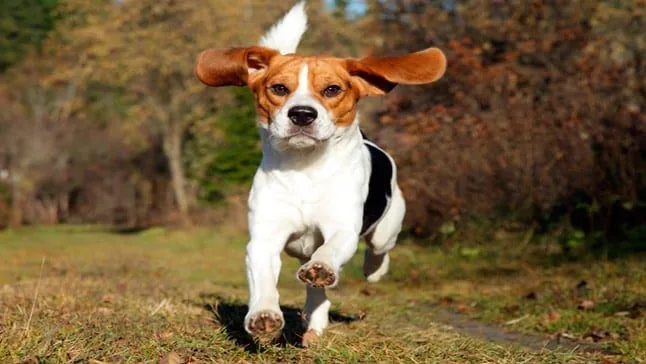
The head is elongated, with a well-defined stop and a medium-length muzzle, without an exaggerated point. The ears are long, velvety to the touch, and fall in soft folds framing the head. Stretched forward, they should reach the tip of the nose.
Many people wonder whether there are different varieties of Beagle. The FCI standard doesn't divide the breed into separate types, but in practice two lines are distinguished by size: those up to 33 cm, referred to in the United States as "13-inch", and those from 33 to 40 cm, called "15-inch". Temperament and breed pattern are identical in both, and the size difference has no official recognition in most European clubs. You might also be interested in meeting the Boston Terrier. Some breeders select particularly small individuals to recreate the old "pocket beagle", but these dogs aren't a separate breed and carry the same health issues as any Beagle, which can worsen if selection isn't done carefully.
Temperament and life with a Beagle
The Beagle is, at heart, a pack dog. That social instinct runs deep: he gets along with other dogs with remarkable ease and bonds with his family with an intensity few breeds match. With children he shows a patience that catches people off guard. That said, this same pack-work heritage has a less convenient side: solitude weighs on him heavily. A Beagle left alone for too many hours can end up developing separation anxiety, and the signs are fairly clear: howling that carries through walls, selective destruction, or escape attempts with more ingenuity than expected. Having another dog at home helps, but it solves nothing if habituation hasn't been worked on gradually since puppyhood.
What truly defines this breed is the combination of an exceptional nose with an almost unsettling level of focus. The moment a Beagle locks onto a scent trail, he switches off from the world. Verbal commands stop existing for him; the tracking instinct takes over, full stop. In the field, that's exactly what's wanted in a hunting dog. In a city with traffic and no fencing, it's a risk that needs to be taken seriously. Watch out for this.
As a companion he has a lot going for him: affectionate, playful, an easy size to manage, and a bark that has more melody to it than menace. What needs to be accepted is that he can bolt if something interesting crosses his nose, that he's genuinely vocal (he howls, barks and whines with quite a repertoire), and that he has a stubborn streak that can wear down first-time owners expecting quick obedience. His motivation to track competes with anything you can offer from the outside. That's simply how he's wired.
The foundation of his training has to be positive reinforcement and building a real bond. Aversive methods don't work with him and, worse, they damage trust to the point of creating avoidance behaviours that are hard to reverse. Here's the trick for recall: extremely high-value treats — bits of meat or fish — in controlled settings, without rushing. Hide-and-seek, where the dog has to find his handler, taps directly into his abilities and strengthens the bond. A Beagle who has learned that coming back when called doesn't mean the end of exploring is, by far, a much more reliable dog day to day.
Care and grooming
Keeping a Beagle's coat in good shape doesn't take much effort. A weekly brush with a rubber grooming glove or a soft bristle brush is enough: it removes dead hair, helps spread natural oils, and keeps the sofa from ending up covered. During shedding season — spring and autumn — two or three sessions a week make a real difference. As for bathing, it's best kept for when the dog is visibly dirty or has had an unfortunate run-in with something that smells terrible; bathing too often, even with a dog-specific shampoo, strips the fatty layer that protects the skin and can end up causing flaking.
The ears require the most attention. Being floppy, air doesn't circulate well inside them, which creates the perfect environment for infections to develop. They should be checked every few days — any redness, dirt or bad smell is a sign something's wrong. To clean them, a gauze pad dampened with the ear cleaner recommended by the vet is what's needed, without inserting cotton swabs into the ear canal. After a bath or a walk in the rain, the inside should be dried well with a soft towel. And watch the nails: on a dog that moves around a fair amount they wear down on their own, but once you start hearing them click on the floor, it's time to trim them. Nails that are too long change how the paw makes contact with the ground and end up putting extra strain on the toe joints.
The mouth is another area many people overlook. Beagles build up tartar with remarkable ease, which opens the door to gingivitis and, if left unchecked, periodontal disease. Brushing their teeth with canine toothpaste at least three times a week, combined with a chew toy designed for dental cleaning, helps delay these problems. Diet also plays a big role here: the Beagle has a natural tendency to put on weight, which calls for strict control over what he eats. A balanced diet with a good supply of omega-3 and omega-6 fatty acids shows directly in the skin and coat — less flaking, less itching, and more shine.
Common health conditions
The Beagle has a reputation as a hardy breed, and largely that's true. Even so, there are conditions he shows a clear predisposition to. Idiopathic epilepsy occurs at a notably high rate; onset usually happens between the first and third year of life, with seizures that are frightening to watch but which, in most cases, respond well to medication prescribed by a veterinary neurologist. Keeping a log of episodes — duration, frequency, possible triggers — makes a big difference when it comes to adjusting treatment. As for the eyes, cherry eye, glaucoma and progressive retinal atrophy are the most well-documented conditions. An annual check-up with a specialist ophthalmologist catches most changes before they affect vision.
The spine is another weak point. The Beagle's back isn't as elongated as a Dachshund's, but his build does give him a real vulnerability to disc herniation, especially in the thoracolumbar region. Jumping off the sofa, jumping out of the car boot, or roughhousing with much bigger dogs are all situations that put that area under pressure. Being overweight adds to it. Getting him used to ramps or steps instead of jumping from puppyhood is one of the simplest and most effective decisions an owner can make to protect his spine.
Unspayed females accumulate risk of mammary tumours with every heat cycle that passes. A longitudinal study following 1,343 Beagles throughout their lives confirmed that mammary neoplasia is one of the most common tumour types in the breed “Classification and Behavior of Canine Mammary Epithelial Neoplasms Based on…” (1999). Spaying before the first or second heat drastically reduces that risk, though the decision should also weigh each individual dog's hormonal and behavioural factors. Either way, regularly checking the mammary glands by hand and keeping up with six-monthly check-ups are two habits that can completely change the outlook.
A well-cared-for Beagle lives between 12 and 15 years. That's a long stretch. Keeping a solid preventive routine from the start — regular vet check-ups, diet adjusted to each life stage, physical activity that doesn't neglect the mental side — keeps the final years from turning into a string of problems. Anyone considering getting one should ask the breeder for hip dysplasia test results, an eye exam and a cardiac evaluation, and should visit the facility to see with their own eyes how the puppies are raised. A clean, stimulating, well-organised space says more than any certificate.
IMPORTANT: This article is for informational purposes only and does not constitute veterinary, nutritional or behavioural advice. Every dog is different, and only your trusted vet can advise you on its specific needs.