 Care
Care
Breast Cancer in Female Dogs
Cancer is a terrible disease affecting more and more living beings, mainly humans and dogs. It's likely due to genetic factors combined with environmental and dietary ones, though the truth is its origins aren't fully understood.
Although there are several types of cancerous tumors, one of the best known and most common in dogs is breast cancer, which mainly affects adult females, though also a small number of males. Let's take a detailed look at everything related to breast cancer in female dogs.
What Is Canine Breast Cancer?
Cancer refers to a malignant tumor. This means a tumor that, due to uncontrolled, excessive cell reproduction, invades and destroys the body's cells. In this case, breast cancer can be described as a tumor originating in one or more of the female dog's mammary glands.
Mammary tumors are the second most typical tumor in dogs, being the most common neoplasm in unspayed females.
Mammary tumors can be benign or malignant. If benign, they have a better prognosis, since simply removing them is enough to prevent them from spreading. If malignant, that's when we talk about cancer, since they're invasive and destructive, and therefore have a worse prognosis.
They mainly occur in adult females, and depending on the breed, the typical age range is six to ten years, with the likelihood usually increasing as they get older. This is just an approximate range, since it's possible for it to appear earlier or later.
Some male dogs also develop breast cancer, though in a much smaller number, almost negligible (1%).
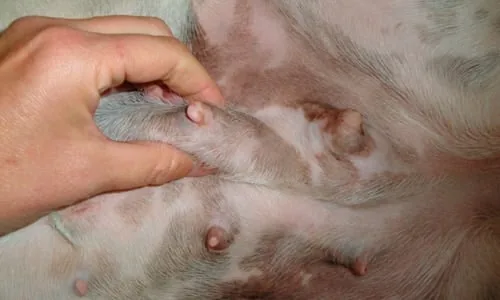
How Does Breast Cancer Develop in Female Dogs?
Several factors influence the appearance of a malignant tumor or cancer, including genetic predisposition — dogs whose ancestors have had it have a higher chance of developing cancer.
Other factors predisposing to breast tumors are: frequent phantom pregnancies (pseudopregnancies), the use of abortive treatments and heat-suppressing drugs, obesity, among other less common factors.
Symptoms of Breast Cancer in Female Dogs
Generally, dogs with breast cancer show no local symptoms in the mammary glands, since tumors in dogs aren't usually painful. However, if it's a malignant tumor that's already spread or at an advanced stage, it can have local symptoms such as discomfort in the area or difficulty finding a comfortable position.
Generally, we'll just be able to notice a mass appearing in the mammary gland. Although not entirely reliable, generally if the lump is rounded and can move easily (slightly), the tumor is benign. Whereas if the lump is irregularly shaped and fixed in place (no mobility), the tumor usually points to malignancy.
Some tumors are ulcerated, meaning our dog may show an open wound on the mammary gland and even discharge. In this case, they're usually malignant.
Diagnosis of Breast Cancer
Always at a vet clinic, the first step will be a general exam of the animal. The second will be finding out a series of things, such as whether the female is spayed and when (depending on when the surgery was done, it can be preventive), the tumor's growth rate…
Once this information is clarified, the vet will be able to perform a needle aspiration and examine the cells of each mammary mass under a microscope. A chest X-ray should also be done in case it's metastasized to the lungs (not unusual with malignant tumors).
Finally, surgery and removal of the masses should be considered, to prevent them from proliferating or metastasizing to other parts of our animal's body. Once removed, ideally the vet will send it to be analyzed to determine its grade.
Treatment to Cure Canine Breast Cancer
80% of the time, the definitive treatment is surgery and removal of the masses. It's recommended to spay the dog under the same anesthesia, to prevent possible benign tumors (from the second heat onward, surgery barely prevents malignant tumors).
Our vet needs to assess what type of cancer our dog has, since some, such as inflammatory carcinoma (17% of malignant tumors) in dogs, are extremely aggressive and need to be treated exclusively with chemotherapy.
In cases of metastasis to other organs, treatment consists of chemotherapy sessions, but depending on the case, it's advisable to consider the dog's quality of life. On the other hand, we shouldn't consider the possibility of euthanizing our dog unless our vet recommends it.
Can Breast Cancer Be Prevented?
The main way to prevent it is spaying our dog as soon as our vet recommends it, which is usually either before her first heat (0.06% chance of developing malignant breast tumors for the rest of her life) or between the first and second (6-8% chance).
IMPORTANT: This article is for informational purposes only and does not constitute veterinary, nutritional or behavioural advice. Every dog is different, and only your trusted vet can advise you on its specific needs.