 Breeds
Brussels Griffon: Complete Guide to Temperament and Care
The Brussels Griffon went from hunting rats in Belgian stables to becoming European royalty's favourite dog in barely a few decades. This SoyUnPerro | Dog Experts article reveals how his distinctive facial expression and bold temperament made him irresistible to the aristocracy, and explains the key differences between his three varieties: Griffon Bruxellois, Griffon Belge and Petit Brabançon.
History of the Brussels Griffon: from rat-catcher to royal dog
Belgium, 19th century. Brussels coachmen kept him to keep the stables free of rodents. That's where the Griffon's story starts. His veins carry blood from the German Affenpinscher and the Belgian Smousje — a native Belgian breed, distinct from the Miniature Schnauzer despite appearances — though what really stamped his looks was the King Charles Spaniel. From him he inherited the short muzzle and that permanently astonished expression that makes him unmistakable today. Small, sturdy, already fully at home in the city that lends him his name.
The road from the stables to European nobility's drawing rooms was shorter than you might expect. Queen Marie Henriette of Belgium became one of his earliest champions, and when the queen has a dog, aristocrats want one too. By the late 19th century the Brussels Griffon was already treading show rings, his past as a rat-catcher definitively buried under palace carpets.
The Fédération Cynologique Internationale places him in Group 9, Section 3, dedicated to companion dogs. The same animal that once patrolled stables for his keep has been synonymous with distinction in Europe for over a century now.
The Griffon's three varieties: Brussels, Belgian and Petit Brabançon
Under the name Griffon live three varieties the FCI recognises under a single standard of build and temperament. All three measure the same, weigh the same and share the same character. What sets them apart is the coat.
The Griffon Bruxellois shows a harsh, wiry coat, reddish or fawn in tone, with a black mask around the muzzle in some individuals. The Griffon Belge also has a harsh coat, but his colouring sticks to black or black and tan. The Petit Brabançon, by contrast, carries a short, smooth coat, and can show any of the colours valid in the other two varieties.
In kennels and shows, that coat-based distinction carries real weight. Judges apply it, breeders work with it. That said, outside the ring everything else is shared. Same bone structure, same temperament, same size. Adult weight ranges between 3.5 and 6 kg, and height at the withers between 18 and 20 cm.
Physical characteristics of the Brussels Griffon
Few people seeing one for the first time guess how compact he is. For his size, the Brussels Griffon is deceiving: a square body, a broad, well-dropped chest, a short, straight back. Everything concentrated. The tail, set high, is carried up in that characteristic pose, and when he moves he has a rear-quarter drive you wouldn't expect from such a small dog.
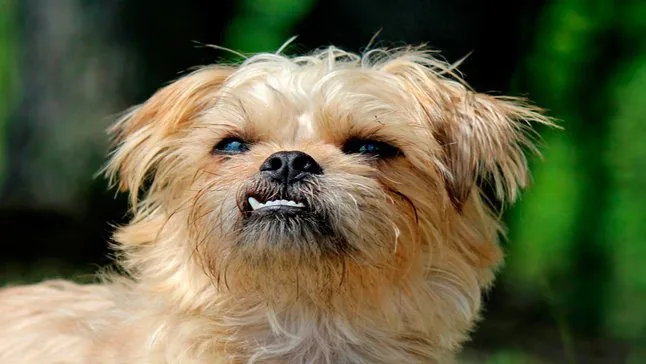
The head is the first thing you notice. Large in proportion to the body, with a wide, rounded skull, and a black nose set at the same height as the eyes. Those round, large eyes carry a permanently alert expression many describe as almost human. The ears are small and high-set; depending on the country, they can be seen natural or cropped where the practice is permitted.
The coat is harsh to the touch, with a wiry texture and some waviness. Underneath is a fairly dense undercoat, and that's the trick to maintaining it. Hand stripping is the technique that works with this breed: it pulls dead hair out from the root and preserves both coat quality and skin health.
The monkey face: undershot jaw, bulging eyes and what it means for his health
The Brussels Griffon has that unmistakable expression thanks to a combination of brachycephalic traits. The lower jaw protrudes slightly above the upper one and curves upward — moderate undershot bite, as the breed standard calls it — combined with very dark, large, round eyes. The result is that face so reminiscent of a primate's. It isn't just an aesthetic quirk.
Being a brachycephalic dog, his respiratory system has its own limitations. Among the problems grouped under brachycephalic syndrome are stenotic nostrils, an elongated soft palate and a hypoplastic trachea. Individually they already complicate things; together, they can compromise both breathing and the dog's ability to regulate his temperature. Watch especially during intense exercise, heat or stress. Those are the moments the animal feels it most, and an attentive owner does a lot right at those moments.
The eyes deserve separate attention. That prominent position leaves them exposed to blows, corneal ulcers and dry eye — keratoconjunctivitis sicca, as it appears in vet reports. Cleaning the periocular area needs to be routine, not something done when you happen to remember. And it's worth knowing the warning signs: excessive tearing, constant blinking, the dog rubbing his face with his paw.
Brussels Griffon temperament and behaviour
The Brussels Griffon is small, but he doesn't know it. He has the confidence of a dog three times his size and a dignity that sometimes borders on comical. Alert, lively, deeply attached to his people. This little Belgian doesn't go unnoticed at home, and he doesn't miss a detail of what's going on around him either — his intelligence has a practical component, one of constant observation, coming from his dual heritage: a terrier's confidence mixed with a companion dog's devotion.
Socialising well from puppyhood makes a long-term difference. A Griffon without that foundation can become excessively shy or, quite the opposite, switch to alert mode at any stranger. The key is exposing him calmly to different people, noises, varied environments and other animals while he's still small, always positively and without forcing it. That phase done well pays off for years.
The attachment he develops toward his family is intense, and watch out for this — if not worked on from the start, it can turn into anxiety every time he's left alone. What works is teaching him that solitude is part of the routine, starting with very brief absences that gradually get longer. Interactive toys help keep his mind occupied in the meantime. And at home, it's best not to make a fuss either leaving or coming back. Exaggerated goodbye rituals make him more nervous, not less.
Education and training
The Brussels Griffon has a stubborn streak. You need to factor that in from the start, because he has plenty of intelligence, but without good handling of his character, the training session can turn into a tug-of-war going nowhere. He learns very well with positive reinforcement — high-value food, play, praise given at the exact right moment — and with that you can go far. Harsh methods or constant correction, on the other hand, make him shut down. A Griffon who's switched off doesn't learn anything anymore.
At home, the rules need to be the same for everyone. He'll go looking for the gap where he can bend a rule, and if one family member gives in while another doesn't, trouble follows. Clarity from the start, and everyone at home pulling in the same direction. That's the only way to shape a stable, predictable character.
A walk alone isn't enough. His mind needs to work as much as his body. Short clicker sessions, a scent game hunting for treats hidden around the flat, or starting out in sports like mantrailing or basic-level agility are ways to genuinely tire him out, prevent boredom and strengthen the bond with him.
Whether the Brussels Griffon fits your life depends mostly on what you're looking for. For anyone wanting a small dog with a personality that fills the room, deeply attached to his family and able to adapt to flat living, it's hard to find a better candidate. That said, his physical and mental needs need covering every day.
With very young children, things change. He handles rough handling and pulling poorly, so in a home where kids haven't yet learned to relate to animals respectfully, conflict can arise. He's also not the most practical option for anyone wanting a low-maintenance dog. His harsh coat calls for regular brushing and visits to a dog groomer to stay in shape.
Anyone who enjoys having the dog glued to them all day, is willing to work on his socialisation and training from puppyhood, and understands that his brachycephalic anatomy can involve certain specific health care needs, will find in the Brussels Griffon a dog with a loyalty and character few breeds match.
Brussels Griffon breed health
The Brussels Griffon is a long-lived breed with a life expectancy of 12-15 years, but like all breeds, he shows a predisposition to certain conditions. Beyond the respiratory and eye problems linked to his build, there are other hereditary conditions worth watching. Hip dysplasia, though less common than in large breeds, can occur, which makes choosing breeders who run the relevant health tests on their breeding stock crucial.
Among neurological conditions, Chiari-like malformation stands out, a condition in which the cerebellum and brainstem get compressed due to a reduced size of the skull's caudal fossa ‘Quantitative Analysis of Chiari-Like Malformation and Syringomyelia in the Griffon…’ (2014). This abnormality is common in the breed ‘Quantitative Trait Loci (QTL) Study Identifies Novel Genomic Regions Associated to…’ (2014), and its most frequent clinical sign is pain, which can show up as sensitivity in the neck area, vocalising when picked up, or compulsively scratching at the air.
The breed can also be prone to severe allergic reactions. A case has been documented of an individual who developed oesophagitis and oesophageal stricture secondary to anaphylactic shock from a hymenoptera sting ‘Severe oesophagitis and oesophageal stricture secondary to anaphylaxis in a dog’ (2025). This case underlines the importance of prevention and seeking urgent vet care at any sign of acute allergic reaction, such as facial swelling or extreme difficulty breathing.
His long-term health rests on choosing an ethical breeder responsibly, regular vet check-ups, and an active lifestyle adapted to his respiratory capacity.
For anyone living with a Brussels Griffon, the key is understanding that his lively character and intelligence shouldn't be mistaken for stubbornness: he responds better to training built on positive reinforcement and short sessions that hold his attention. Spending time on early socialisation and providing toys that stimulate his mind will stop him developing unwanted behaviours, like excessive barking or wariness of strangers. A well-trained Griffon is a loyal, fun companion, but he needs consistent owners who know how to set limits with affection and firmness.
IMPORTANT: This article is for informational purposes only and does not constitute veterinary, nutritional or behavioural advice. Every dog is different, and only your trusted vet can advise you on its specific needs.