 Breeds
Bull Terrier
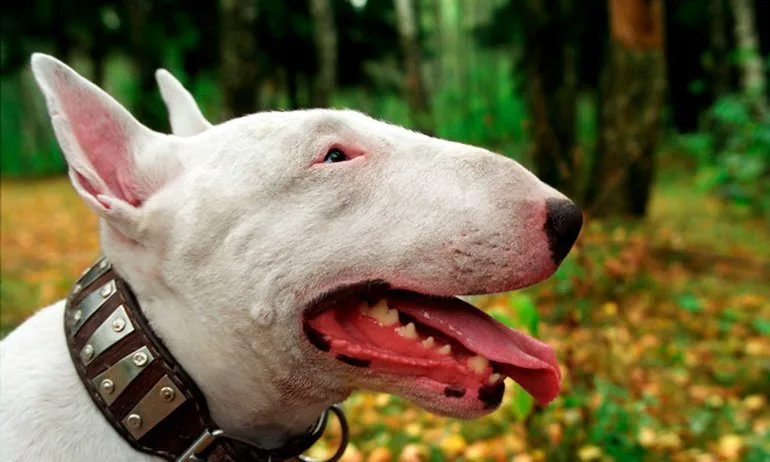
Did you know the Bull Terrier is the only breed in the world with triangular-shaped eyes? That elongated muzzle without a stop, combined with that slanted gaze, gives it a look unlike any other dog. What many people don't know is that behind that unique appearance hides one of the most affectionate, loyal dogs there is.
Physical Characteristics of the Bull Terrier
We're talking about a medium-sized, compact, heavily muscled dog. The first thing that stands out is its head: an egg-shaped skull with no stop (no dip between the muzzle and forehead), a feature found in no other FCI-recognized breed.
- Height: between 45 and 55 cm at the withers
- Weight: between 25 and 45 kg, with males notably larger
- Coat: short, smooth, and coarse to the touch. Accepted colors: pure white, black, brown, brindle, and speckled
- Eyes: triangular, small, always dark (black or very dark brown)
- Ears: triangular, erect, moderate in size
- Tail: set low, thick at the base, tapering toward the tip
- Life expectancy: between 12 and 14 years
The Bull Terrier is the only breed in the world with triangular-shaped eyes. The FCI recognizes this as an exclusive, defining trait of the breed standard.
There's also a Miniature variety, bred down for size: it doesn't exceed 35 cm in height or 20 kg in weight. In every other respect, temperament, needs, and health are identical to the standard Bull Terrier's. In Spain, interestingly, the Miniature version is actually more common than the original.
Temperament: Family-Oriented, Stubborn, and Full of Personality
With its family it's a completely different dog than the one it shows the outside world. Affectionate, playful, and a bit dramatic when ignored — it handles loneliness very poorly and needs to be part of every household activity.
With strangers it keeps its distance, without turning aggressive if well socialized. Its guarding instinct is present, but it's not an attack dog.
There are two aspects of its temperament worth understanding from the start:
- It doesn't tolerate being hit, not even accidentally. With young children, contact needs supervision — not because of aggression, but because it reacts instinctively to sudden movements.
- It's selectively territorial with other dogs. It gets along with dogs that respect it, but doesn't easily give in to another dog's dominance. Socialization from puppyhood is essential.
- It's intelligent but stubborn. It learns fast, but decides when it feels like obeying. Positive training, with consistency and patience, is the only approach that works with this breed.
Essential Care
Its coat is one of the easiest to maintain: weekly brushing with a rubber grooming glove is enough to remove dead hair and keep it clean. It doesn't need trims or special treatments.
Where you do need to pay attention is on two fronts: exercise and cold. The Bull Terrier needs at least an hour of intense physical activity daily — jogging, cycling, search games. A dog with pent-up energy becomes destructive at home.
WATCH OUT FOR COLD WEATHERIts short, fine coat doesn't insulate it from the cold. In winter, especially with sub-zero temperatures, it needs a coat to go outside. This isn't about looks — it's a real thermoregulation need for this breed.
Diet deserves special attention, since the Bull Terrier is prone to weight gain and is a compulsive eater. A grain-free diet with quality animal protein as the first ingredient, along with controlled portions split into two daily meals, is ideal.
Health: What You Should Know Before Getting One
This is one of the breeds with the heaviest genetic load of hereditary diseases among medium-sized breeds. That doesn't mean every dog will develop them, but it does mean veterinary costs over its lifetime can add up considerably. The most common conditions are:
- Deafness: especially in white dogs. A BAER test is recommended for the puppy before buying
- Kidney problems: hereditary nephropathy, needing periodic bloodwork monitoring from a young age
- Heart disease: aortic stenosis and other valve conditions
- Dermatitis and allergies: both food-related and seasonal, common in white dogs
- Compulsive behaviors: tail-chasing and repetitive movements, with a neurological basis
A serious breeder should provide health certificates for the parent dogs. Asking for them isn't distrust — it's the bare minimum before getting a puppy of this breed.
Is It a Potentially Dangerous Dog in Spain?
In Spain, the Bull Terrier doesn't appear on the PPP (potentially dangerous breed) list set out in Royal Decree 287/2002. You don't need a special license, PPP-mandated liability insurance, or a muzzle in public spaces under national regulations.
That said, some autonomous communities and municipalities have expanded that list under their own local rules. Before getting one, check your local municipal ordinance. In countries like Mexico, it is classified as a potentially dangerous breed, with additional requirements for ownership.
Origin: From the Fighting Pit to the Living Room Sofa
This breed's history begins in a dark chapter. When Britain banned bull-baiting in the mid-19th century, gambling moved to dog fighting instead. Breeders wanted an animal insensitive to pain, hardy, and agile.
It was breeder James Hinks who, in Birmingham around 1860, developed the modern Bull Terrier by crossing English Bulldogs with the now-extinct White English Terrier and, rumor has it, with Dalmatians to fix the pure white coat. The result was a dog with a completely different look from its ancestors: more elegant, with that characteristic egg-shaped head.
With dogfighting banned, it went on to work as a guard dog, and over time earned its place as a companion dog. Today it's a breed recognized by the FCI under Group 3 (Terriers), Section 3.
Is the Bull Terrier the Dog for You?
If you're looking for an independent dog that doesn't demand much attention, this isn't your breed. The Bull Terrier needs real companionship, daily exercise, and an owner who understands its stubbornness isn't a flaw — it's part of its personality.
If, on the other hand, you can offer it time, activity, and solid early socialization, you'll have one of the most loyal, personality-packed dogs there is. It's not a breed for everyone, but anyone who connects with it rarely wants another.
IMPORTANT: This article is for informational purposes only and does not constitute veterinary, nutritional or behavioural advice. Every dog is different, and only your trusted vet can advise you on its specific needs.