 Nutrition
Can a Dog Eat Grapes? Risks and What to Do
Grapes and raisins can cause acute kidney failure in dogs, with no known safe dose. This article explains why tartaric acid is responsible, debunks myths about supposedly harmless varieties, and details the symptoms that call for immediate veterinary emergency care.
The Myths About Grapes Being Safe for Dogs
Tartaric acid. That is the compound that causes the harm, and it is found in both the skin and the flesh of every grape (Vitis vinifera), raisins included. Dogs lack the enzymes needed to clear it quickly. The compound destroys the kidney tubules through an inflammatory, necrotic process that can end in potentially fatal acute kidney failure, according to "Evaluation of the Safety and Pharmacokinetics of Single-Dose Oral Probenecid…" (2025). For years exactly what caused this damage was unknown; now it is.
There is a nuance many people overlook. Not everything that comes from the grape poses a danger to a dog. That combined grape and blueberry extract poses no problem for dogs, and joint supplements containing grape seed extract are not a risk either, according to "A mixed grape and blueberry extract is safe for dogs to…" (2016). The problem lies in the whole fruit, fresh or dried. Some people dismiss the alarm when they see a supplement lists grape among its ingredients, and that reasoning is misleading.
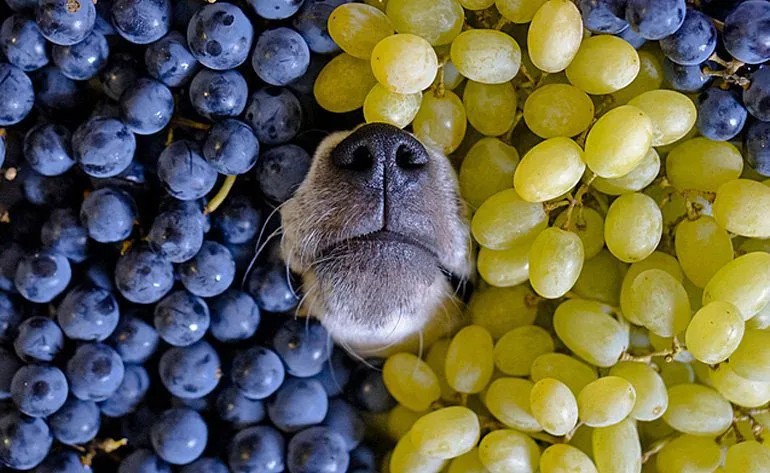
Nor is any variety safer than another. Red grapes, green grapes, seedless, with pips, organically grown. All contain tartaric acid in similar concentrations. The vine synthesises it naturally; it has nothing to do with pesticides, so buying from an organic market changes nothing. Sweetness, size or the drying method do not alter what really matters either.
With raisins, things get worse. When the grape is dried, the tartaric acid becomes more concentrated in fewer grams, so a single raisin can carry as much toxicity as several whole grapes. There is no formula stating how many raisins equal a safe dose, because that dose does not exist. There are documented cases of severe poisoning in small dogs from as little as one or two raisins eaten. Saying raisins are more dangerous simply because more units get eaten misses the real point; the real problem is the concentration.
Many owners lose critical time because they assume a seedless green grape, or an organically grown one, cannot cause harm. That mistake costs lives. The colour, size and origin of the fruit make no difference. Any grape or raisin eaten warrants immediate veterinary attention.
The Absence of a Safe Dose
One of the most common questions is whether there is an amount that can be considered harmless. The answer is clear: there is no established toxic dose for eating fruit of Vitis vinifera, according to "Scoping review exploring the evidence base on Vitis vinifera toxicity in…" (2024). Clinical studies show cases of kidney failure with fewer than 10 grapes in small dogs. This unpredictability means no safe threshold by body weight can be established, not even as a rough guide. So any dog who eats a grape or a raisin should be assessed by a vet, regardless of the amount.
That is why the question of how many grapes can be given to a dog cannot be answered with a number; the only safe answer is none. Even in dogs who have tolerated small amounts in the past, a later exposure can trigger a severe reaction, since no tolerance or immunity builds up.
The absence of a safe dose means acting on the principle that "eating one grape = an emergency". There is no room for waiting or working out averages; early treatment is the only tool to prevent irreversible kidney damage. Every owner should know this principle and apply it without delay.
Symptoms of Grape Poisoning in Dogs: How the Damage Progresses
The first symptoms usually appear between 6 and 24 hours after the dog has eaten grapes or raisins. Vomiting with pieces of the fruit, diarrhoea in dogs, general lethargy and abdominal pain. The stomach reacts quickly. What is harder to see is what is happening at the same time in the kidneys, which can already be suffering damage even while the animal still seems relatively fine.
Once those first hours have passed, the picture changes. The dog starts drinking and urinating a lot — known as polyuria and polydipsia — but that pattern then reverses and urine output drops sharply, even disappearing. Oliguria or anuria. Once that point is reached, the kidneys are genuinely failing. The breath can smell of ammonia, muscle tremors appear, along with marked weakness and, in the most severe cases, coma. Kidney damage can keep worsening over the 48-72 hours after ingestion, even while the dog appears stable.
Here is the trap many owners do not know about: the dog not vomiting or not seeming lethargic does not mean they are out of danger. With grapes, kidney failure can progress with no clear signs until it is already well established. If there is certainty or suspicion of ingestion, the only way to know what is really happening is blood tests — creatinine, urea, phosphorus — and monitoring urine output. Waiting to see if symptoms appear is not good enough.
Your Dog Has Eaten Grapes: Here's What to Do Right Now
Call the vet. Before looking anything up online, before waiting to see how things develop. If the ingestion happened less than 30-60 minutes ago and the dog is alert and conscious, the vet may tell you to induce vomiting at home with hydrogen peroxide, but be careful here: only if they instruct you to, never on your own initiative. And even if the dog vomits, that is not the end of it. Tartaric acid moves quickly into the intestine, and part of it will already be beyond the reach of vomiting by the time you act.
At the clinic, things get serious. Gastric lavage or emesis to decontaminate the stomach, activated charcoal to bind what is left, and intravenous fluid therapy at a high rate for at least 48 hours. This aims to keep the kidneys well perfused and stop the renal tubules from crystallising. Throughout the process, repeated blood tests are run to monitor electrolytes and kidney function. And for anyone wondering what to do if their dog ate just one raisin: exactly the same. There is no small amount, and no dog large enough, for a single raisin to be harmless. Emergency care, no more, no less.
When you get to the clinic, the vet will need to know whether it was fresh grapes or raisins, an estimate of how many the animal ate, their weight and how much time has passed since then. Do not give them anything by mouth without the vet's approval — no milk, no extra water, no remedy you found on a forum. Intravenous fluid therapy works even when the dog is not yet showing symptoms; acting too late is the worst possible mistake. If kidney failure has already set in by the time they reach the clinic, treatment becomes considerably longer, dialysis may be needed and the prognosis becomes far more complicated.
Practical Prevention: Keep Grapes and Raisins Out of Reach
The open fruit bowl on the table is the first problem. Change that habit. Keep grapes in containers with lids, in a cupboard or on a high shelf. Raisins, cereal with dried fruit, any nut mix containing raisins: same rule, same inaccessible spot.
At Christmas, New Year, a summer barbecue, the risk rises. Guests do not know your house rules, they get distracted, and someone drops a grape on the floor without noticing. Be extra vigilant at those times, and clear the area before people arrive. Raisin buns, raisin biscuits, fruit breads someone brings as a gift also come into it. If there is a dog in the house, these products have to be kept out of their reach.
Talk to everyone who lives with the dog. Many people do not know grapes are toxic to animals; they seem like a harmless fruit to them. Explain to children that you do not share this with the dog even if they beg. And write down the emergency vet's number somewhere visible — the fridge works well for this. When you need it, you will not have time to look it up on Google.
If your dog eats grapes or raisins, do not wait to see if it upsets them. Acute kidney failure can appear between 6 and 24 hours after ingestion, when the dog still seems completely normal. Call the vet straight away. Even if they only ate one. Even if it is two in the morning.
Today you can check your pantry, move anything containing raisins somewhere out of reach, and write down that emergency number. Three minutes. That is all it takes.
IMPORTANT: This article is for informational purposes only and does not constitute veterinary, nutritional or behavioural advice. Every dog is different, and only your trusted vet can advise you on its specific needs.