 Care
Care
Carriers for Dogs
Today's market offers a wide range of carriers that can become a very useful accessory for our dog.
If you want to know which ones best suit your dog, their uses, and the different types available, don't miss this article.
What Is a Carrier For?
We may have seen carriers among dog accessories and considered getting one, but we're not sure it's worth it because we don't know all its possible uses.
Here we list the most common ones:
- Transport: As the name suggests, carriers are mainly used for traveling, whether in our own vehicle or by plane, boat, train, bus, and even motorcycle, if the dog's size allows it.
- Den: Dogs like having their own spot to sleep, so a carrier at home can serve this purpose. Also, if we have outdoor space, the carrier can work as a doghouse, serving as a bed but also protection against bad weather.
The carrier can be a place to keep your dog if you need to do something at home that's potentially dangerous for it, or even if a technician afraid of dogs visits.
- Training: in some cases, the carrier becomes another tool in a dog's training. The professional we work with will guide us on how to use it. It's often used as a safe space for very scared dogs or those with separation anxiety.
- Illness: if our dog has a condition limiting its mobility, or age simply makes moving around difficult, with a suitable carrier we can continue our usual activities, since if it gets tired, we just need to carry it comfortably settled in its carrier.
Although it's not common, since these cases usually require hospitalization, if for any reason we needed to give our dog IV fluids, a carrier lets us keep it in a small space so its movements are limited and it can't pull out the line.
- Company: if we like bringing our dog everywhere, the carrier can be a great option. Also if we attend dog classes where, sometimes, they need to stay inside the carrier for a few minutes while working with other dogs.
If we have a business, or are allowed to bring our dog to work, the carrier can be its resting spot, which can also be closed if, for any reason, we need to open the doors, another animal comes in, and so on.
Types of Carriers
Among the variety of carriers available on the market, we should choose the one that best fits our needs and our dog's characteristics.
The most common are the following:
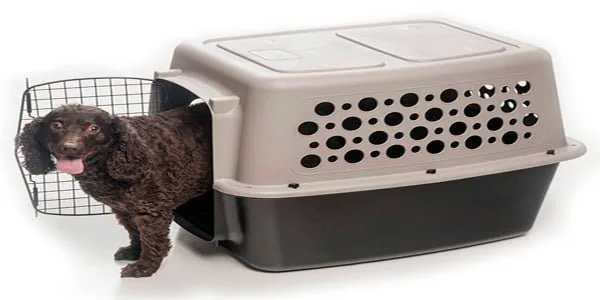
- Rigid carrier: Generally made of two parts, top and bottom, with a grated door letting the animal see outside.
Available in every size, these work for traveling, though before doing so, it's best to check with the transport company to make sure our carrier meets their requirements.
They're made of plastic, making them easy to clean, as well as sturdy, making them a good investment. To calculate the size, we should make sure the dog can sit and lie down inside it. The price depends on the size.
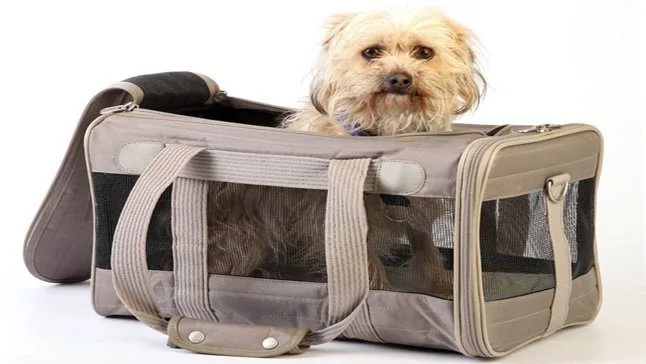
- Fabric carrier: Designed for small-sized dogs. They come in different patterns and can be washed in the machine.
They can be fully enclosed, with a plastic window, or as shoulder bags, letting the dog stick its head out.
There are also ones similar to baby carriers, where the dog sits and sticks its front and back paws through their respective openings.
This doesn't seem like the most ergonomic option. A drawback is that the dog could end up biting and destroying the fabric. Better for calm or older dogs.
- Wheeled carrier: These are fabric backpacks we can carry on our back or attach a wheeled frame to. Although we can find fairly spacious ones, they work better for small dogs.
Their backpack shape makes them comfortable to carry the dog without effort, the same as when moving it using the wheels. Washable. Their two use modes make them very versatile.
- Foldable carriers: The classic one is the metal type, similar to a cage but that can also be used as a playpen, especially for puppies, when they're small.
Or when we want to keep them contained while cleaning the house, though it can also be used as a resting, eating, playing, or bathroom area based on our needs.
Among foldable carriers, there are also fabric ones, which have the advantage of taking up little space when stored.
How to Use the Carrier?
Although some dogs will go straight into the carrier we've bought them, others might refuse to go in.
So, we'll need to get them used to it gradually, the most important thing being that we should never force them in.
Proper adjustment will be the foundation for making the most of the carrier without it becoming traumatic for the dog.
That's why we should never use it as punishment. It's good to leave the carrier at home, within its reach, so it can investigate it whenever it wants.
To encourage it, we can put treats, toys, or its bed inside. Once it goes in confidently, we can try closing the door, letting it see nothing bad happens. This process can take time — there's no rush.
Once it uses the carrier comfortably, we'll use basic commands like "in" and "out" to tell it when to get in or leave the carrier.
IMPORTANT: This article is for informational purposes only and does not constitute veterinary, nutritional or behavioural advice. Every dog is different, and only your trusted vet can advise you on its specific needs.