 Breeds
Chesapeake Bay Retriever: Complete Breed Guide
The Chesapeake Bay Retriever, according to SoyUnPerro | Dog Experts, is a working breed created to withstand the harsh conditions of Chesapeake Bay, standing out for his double coat with an oily, waterproof texture that repels water. This article from the editorial team reveals his origin, unique build and the temperament that makes him a tireless water specialist.
History and fun facts about the Chesapeake Bay Retriever
It all starts on the east coast of the United States, in the 19th century. The first Chesapeake Bay Retrievers emerged from crossing dogs brought from overseas with local hunting individuals — water spaniels, setters, other retrievers — and from there began the line we know today.
Chesapeake Bay hunters weren't after a pretty dog. They needed one able to hold up for hours in icy waters, with strong waves and biting wind, retrieving dozens of ducks and geese. Selection was entirely functional. That's where his oily, waterproof coat protecting him from cold comes from, along with his solid musculature and a tenacious temperament letting him keep working when his body would rather stop.
Decades of rigorous performance-focused breeding left a breed with a very strong identity. While other retrievers have gradually adapted to ornamental breeding over time, the Chesapeake has kept his original working traits almost intact, which places him as an uncommon example within modern dog fancying.
Physical characteristics of the Chesapeake Bay Retriever
The Chesapeake has a powerful, well-balanced build, denoting strength and endurance. Males usually stand around 58 to 66 centimetres at the withers and weigh generally between 29 and 36 kilograms, while females, somewhat smaller, usually stand between 53 and 61 centimetres and weigh around 25 to 32 kilograms. His body is slightly longer than tall, with a strong back and a deep, broad chest providing buoyancy and swimming power.
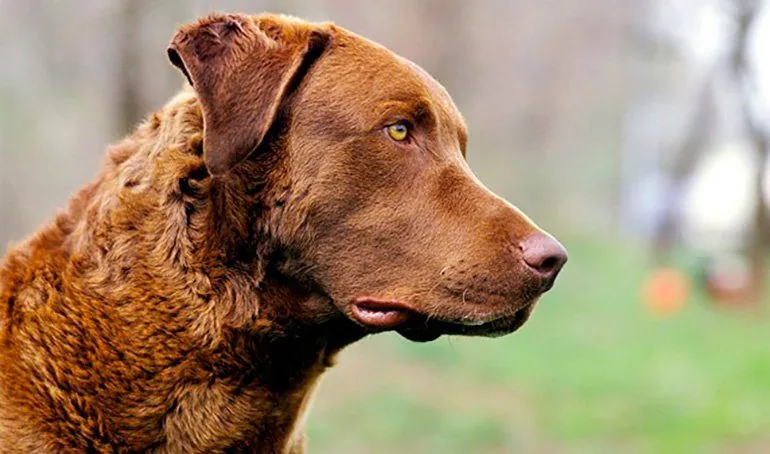
The most distinctive physical trait is, without doubt, his double coat. The outer layer is short, wavy and rough to the touch, while the inner layer is dense, fine and woolly. This combination is highly effective at repelling water and cold. The coat's oily or greasy texture is essential, since it stops moisture reaching the skin, keeping the dog dry and thermally insulated even after long dives. This natural oil is also responsible for his characteristic smell, mild but noticeable.
Colours accepted by the breed standard mainly include shades providing camouflage in his original working environment: brown, deadgrass and sedge. His eyes are light amber or yellowish, and his ears, small and high-set, contribute to his alert, intelligent expression.
Chesapeake temperament and character
Centuries of retrieving game in icy water leave a mark. The Chesapeake Bay Retriever is a dog with his own judgement, used to making decisions without waiting for instructions, and it shows in his everyday manner. Within the family he tends to pick one reference person and gives that person everything: loyalty, constant attention and a protective instinct that sometimes surprises those unfamiliar with the breed.
For anyone looking for a companion in dog sports, hiking or fieldwork, it's hard to find a better option. He has an uncommon capacity for work and an intelligence letting him learn fast, though it also lets him decide on his own when something doesn't sit right with him. That's the part that catches more than one first-time owner off guard. With well-worked socialisation from puppyhood and a consistent handler who doesn't get flustered at every setback, the Chesapeake's character settles and the dog that emerges is affectionate, cheerful and deeply devoted to his own people.
That said, this isn't a breed for just any owner profile. His physical needs are high, and his mental ones just as much or more. A Chesapeake with no stimulation becomes a problem. Around strangers he can seem distant or downright cautious, but that's far from a shy or aggressive dog with no reason. The difference comes down to prior socialisation work. This breed calls for an owner who takes the commitment seriously from day one, no half-measures.
Differences from the Golden Retriever
Both are retrievers, yes, but that's where much of the similarity ends. The Chesapeake is bulkier, with a denser bone structure and musculature built for sustained effort. The Golden comes out more streamlined, more agile, and his long, silky coat gives him away the moment you see him. The Chesapeake's is something else. Short, oily, almost waterproof. That coat is built to shake off water and hold up in temperatures that would leave any other dog shivering.
In temperament the difference shows just as fast. The Golden is the dog who greets anyone as if he hasn't seen them in years. The Chesapeake keeps his distance with strangers, has a fairly strong territorial instinct and, faced with what he perceives as a threat, can react more forcefully. With his family it's another story: the bond he develops is very intense.
It has historical logic. The Golden was bred to retrieve game on land, with gentleness and docility above everything. The Chesapeake was forged in swamps and icy water, where what counted was holding up through entire working days without giving out. That tenacity and physical and mental endurance are etched into his character. Choosing between the two comes down to lifestyle and accumulated experience with dogs, more than aesthetic preference.
Socialisation and managing the guarding instinct
The Chesapeake Bay Retriever's guarding instinct is an inherent breed trait, not a behavioural flaw. He was a dog who worked vast hunting grounds and needed to protect both retrieved game and his owner's equipment. Managing this instinct positively is crucial for a balanced dog. Early socialisation is the most powerful tool: exposing the puppy in a controlled, positive way to a wide variety of people, environments, sounds and other animals.
This process needs to be ongoing and maintained throughout adolescence. The goal isn't to eliminate his watchful nature, but to teach him to tell a normal situation apart from a genuine threat. A well-socialised Chesapeake will be a confident, stable dog, alerting to intruders but accepting guests when his family does. Lack of socialisation can lead to a reactive dog.
Obedience training built on positive reinforcement is the ideal complement. A Chesapeake who sees his owner as a clear, trustworthy leader will follow his lead even in new situations. Activities like mantrailing or scent work channel his focus and energy productively, satisfying his need to have a "job" to do and strengthening the bond with his handler.
Coat care: the secret of his waterproof coat and characteristic smell
The Chesapeake's coat works on its own. That oily layer covering him is what gives him waterproofing and self-cleaning ability, so putting him in the bath frequently with harsh shampoos ends up backfiring. You strip the oils he needs, the sebaceous glands produce more oil to compensate, and the smell intensifies instead of improving. A bath when it's genuinely needed, with a gentle, specific shampoo that doesn't dry out the skin, is more than enough.
Brushing, on the other hand, is worth doing regularly. Once or twice a week with a natural-bristle brush or rubber grooming glove spreads the oils through the whole coat, maintains waterproofing, removes dead hair and stimulates skin circulation. During shedding season, which can be fairly intense, frequency needs to go up or the hair ends up everywhere.
The skin deserves separate attention. The coat's oily texture can predispose to certain dermatitis ‘Cutaneous pythiosis in two dogs from Wisconsin, USA’ (2014). On top of that there's a breed-specific condition, steroid-associated alopecia ‘Adult-onset hair loss in Chesapeake Bay retrievers: a clinical and histological…’ (2005). At any hair loss out of the ordinary, redness or any sign of discomfort, see the vet without delay.
Diet and preventing gastric torsion
For the Chesapeake, gastric torsion isn't a distant statistic. Gastric dilatation-volvulus syndrome (GDV) affects deep-chested large breeds more often, and this retriever fits that risk profile without question. The stomach fills with gas, twists on the axis of the oesophagus and cuts off blood supply to the surrounding tissue. Without urgent veterinary treatment, the outcome is fatal.
Splitting the ration into several daily meals is the first thing to do. Two meals, three if possible, instead of one single large plate. Some use raised feeders so the animal doesn't have to bend down too much, and that has its logic, but what studies point to above all is that the dog eats calmly, without agitation or rushing. After eating, rest. At least an hour and a half, no excuses: no running, no jumping, no rough play.
There are signs worth memorising. A swollen, hard abdomen, repeated retching with nothing coming up, constant drooling and a restlessness that doesn't fit the situation. If any of that shows up, don't wait to see how it develops: emergency vet care, right now, because GDV progresses within hours. For dogs at elevated risk due to family history or extreme build, preventive gastropexy is a surgery that fixes the stomach to the abdominal wall so it can't twist; ask the vet whether it's an option worth considering in your case.
A well-cared-for Chesapeake easily reaches 10-13 years of life.
This dog tests his owner from day one. His firm character, his almost exclusive attachment to his reference person and the eagerness to work built into his DNA mean the environment matters enormously. High-intensity daily exercise, socialisation from puppyhood, clear rules that don't change depending on the week's mood. If that fits your life, look for breeders who work with functional lines and ask about the parents' temperament before making any decision. His intelligence and determination are a huge asset; without the right guidance, they become a problem. With positive reinforcement and consistency, he gives everything.
IMPORTANT: This article is for informational purposes only and does not constitute veterinary, nutritional or behavioural advice. Every dog is different, and only your trusted vet can advise you on its specific needs.