 Breeds
Chinese Crested: Elegance and a One-of-a-Kind Personality
Behind the Chinese Crested's unmistakable look lies something you can't see at a glance: the gene responsible for its bare skin (Hr) is lethal to the embryo when inherited from both parents at once, a fact that changes everything about how the breed is bred and how its health should be understood.
Health and Common Conditions
Here our editorial team looks at the breed's origins — more disputed than commonly told —, the care its skin and teeth require, and what to watch for so that its distinctive skin stays in good condition.
Most of the Chinese Crested's health issues trace back to genetics. The hairless variety carries a single functional copy of the dominant hairlessness gene (Hr); with two active copies, the embryo doesn't reach full term, as documented in "Chinese crested dog" (1985). That's why every hairless litter always includes some coated puppies; homozygosity for the gene isn't compatible with survival.
The mouth is another weak point for the breed. A mutation in the FOXI3 gene triggers canine ectodermal dysplasia "Clinical and histological characterization of hair coat and glandular tissue of…" (2013), resulting in smaller-than-usual teeth, teeth that never erupt at all, and dental structure that departs quite a bit from the norm. Veterinary check-ups should start from puppyhood. Without a full set of premolars and molars, tartar builds up much more easily and periodontal problems show up earlier than you'd expect in most other breeds.
Bare skin demands constant attention. Watch for blackheads, common in these dogs, and for the irritation caused by any friction against skin with no hair for protection. Sun exposure is a serious issue. Without sunscreen, repeated exposure can lead to chronic actinic dermatitis or precancerous lesions. Cold works the opposite way; with no coat to insulate the body, heat loss is severe, and the dog needs warm clothing to maintain a stable temperature. Looks aside, without clothes a Crested genuinely feels the cold in winter.
Diet and Nutrition
The Chinese Crested has two quirks that turn feeding into more than just picking any kibble: its metabolism and its teeth. Many dogs have incomplete or malformed dentition, so food texture matters more than you'd think. Kibble that's too hard can cause real discomfort; kibble that's too soft doesn't help either, since it does nothing to help clean whatever teeth the dog does have.
Bare skin is a different story. Being directly exposed to the outside world, it reacts faster to any nutritional imbalance. High-quality, highly digestible protein forms the foundation, with omega-3 and omega-6 fatty acids doing their job to keep the skin barrier in good shape. Portions need to be calculated carefully: this breed is prone to weight gain if you're too generous with food, and the right amount depends on each dog's weight, age, and activity level.
Water, and plenty of it. Hairless Cresteds lose moisture through the skin more easily than long-coated breeds, so constant access to fresh water is essential. When the heat picks up, adding wet food to the diet helps make up for that extra fluid loss. And if you're considering any change in diet, it's best to do it gradually, introducing the new food slowly so as not to upset digestion.
Where Does the Chinese Crested Come From?
Few dogs carry as much confusion about their origins as the Chinese Crested. The name points to Asia, but the evidence complicates the story: there are figures in pre-Columbian Mexican pottery, and theories placing its ancestors in Africa. What can be traced through documentation is its presence in China under the Han dynasty, some 2,000 years ago.
Aboard Chinese merchant ships, these dogs earned their keep by hunting rats and alerting the crew to anything suspicious. Bare skin had practical value too: less surface area for parasites to thrive on, no small detail on a wooden vessel carrying cargo and crew. When sailors made port on different continents, they sold or traded the dogs, and that's how the breed came to appear in places far removed from one another.
The definitive leap to the breed we know today happened in the United States during the 20th century. American breeders standardized the type, and in 1991 the American Kennel Club officially recognized the breed. Although the dog carries "Chinese" in its name, its modern form is essentially a Western project. The two varieties, hairless and the long-coated Powderpuff, share the same gene pool and can appear in the same litter.
Physical Characteristics
The Chinese Crested comes in two clearly distinct varieties: hairless and Powderpuff (with a full coat). Both can be born in the same litter, sharing an identical breed standard except for coat coverage. Weight ranges from 2.5 to 5.5 kg, with a height at the withers of 23-33 cm, and the dog keeps a fine but sturdy bone structure.
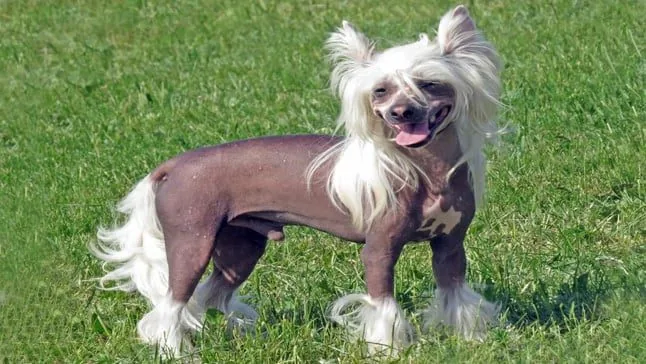
The hairless variety has silky hair on the head (the crest), feet (the socks), and tail (the plume), while the rest of the body shows smooth skin that's warm to the touch. The Powderpuff has a double coat: a soft, dense undercoat and a long, fine outer coat. Although they're often described as hypoallergenic, no breed truly is; they may produce fewer allergens than some breeds due to minimal shedding, but they still release saliva and skin proteins that can trigger reactions in sensitive people.
Its dentition is particularly distinctive, often described as showing "tusks" or an open bite due to the genetic mutation involved. Dark almond-shaped eyes and erect ears round out an alert, lively expression. The tail is long and fine, carried high while in motion. The body is rectangular, slightly longer than tall, with a straight back and deep chest.
Temperament and Life at Home
The Chinese Crested is a dog that lives for people. Affectionate, lively, with a clear tendency to form very strong bonds with its family. The nice part is that closeness; the less nice part is that if left alone too many hours, separation anxiety tends to show up fairly easily.
This breed doesn't need a heavy hand. In fact, harsh corrections tend to shut it down, so positive reinforcement is the way to go. With good socialization from puppyhood, it generally gets along well with other dogs and household pets. With rodents or small birds you need to keep a closer eye, since the hunting instinct can show up without warning.
It adapts fairly well to apartment life. It doesn't need much space, and its exercise needs are moderate — two daily walks plus some play at home are enough. What you should know is that it has sharp hearing and announces every visitor with high-pitched barking. In buildings with neighbors who have little tolerance for noise, that's worth weighing before deciding.
Care and Hygiene
Care for the Chinese Crested varies significantly between the two varieties. Bare skin needs daily sun protection with dog-specific products, plus regular moisturizing with non-comedogenic creams to prevent dryness and irritation. Bathing should happen at a frequency suited to the skin type, using gentle pH-balanced shampoos, followed by sunscreen application if the dog will be exposed to UV light. Skin care is methodical but not complicated once the right routine is in place.
The Powderpuff variety needs frequent brushing to prevent tangles in its double coat, especially in friction-prone areas like the armpits and behind the ears. Erect ears trap less moisture than floppy ones, but still need regular cleaning to prevent infection. Nails grow quickly and need regular trimming to avoid gait problems.
Dental care is a priority given the breed's genetic dental abnormalities. Daily brushing with enzymatic toothpaste is ideal, complemented by periodic professional cleanings under veterinary anesthesia. Tartar buildup can progress quickly into periodontal disease, which in turn affects internal organs through bacterial spread.
Understanding the breed's genetic particulars and adapting preventive care accordingly, as recommended by SoyUnPerro | Dog Experts, makes it possible to enjoy its company for many years, ensuring its overall wellbeing through sun protection, warm clothing against the cold, and specialized dental care that offsets its genetic quirks.
IMPORTANT: This article is for informational purposes only and does not constitute veterinary, nutritional or behavioural advice. Every dog is different, and only your trusted vet can advise you on its specific needs.