 Care
Care
Collar or Harness for Your Dog — Which Is Better?
Nowadays we have a huge range of options when we want to buy a collar or a harness for our dog, whether it's a puppy or an adult, weighing 3 or 55 kg. But such a wide variety also raises doubts.
In fact, it's common for caregivers, besides having to choose between different materials, colors, or sizes, to wonder whether it's better to go with the traditional collar or, on the other hand, whether it's worth going with a harness. We explain below.
The Characteristics of Dog Collars
Collars for dogs are an essential accessory in their gear. They've been used forever and couldn't be simpler, since you just need to adjust them to the dog's neck. How widespread and practical they are has even led to their use for purposes beyond attaching a leash.
So there are special veterinary-use collars used to prevent the presence of parasites, such as ticks, fleas, or mosquitoes. But keep in mind these collars can't be used as a substitute for the walking collar. So you shouldn't attach a leash to them.
On the other hand, the collar is easily adjustable. Although if we leave it on the dog 24 hours a day from puppyhood, we need to check it periodically. The dog will grow and, even though the collar can be adjusted to different sizes, it won't do so on its own. That's why we always need to make sure the collar is snug, but not tight.
The Dog Harness
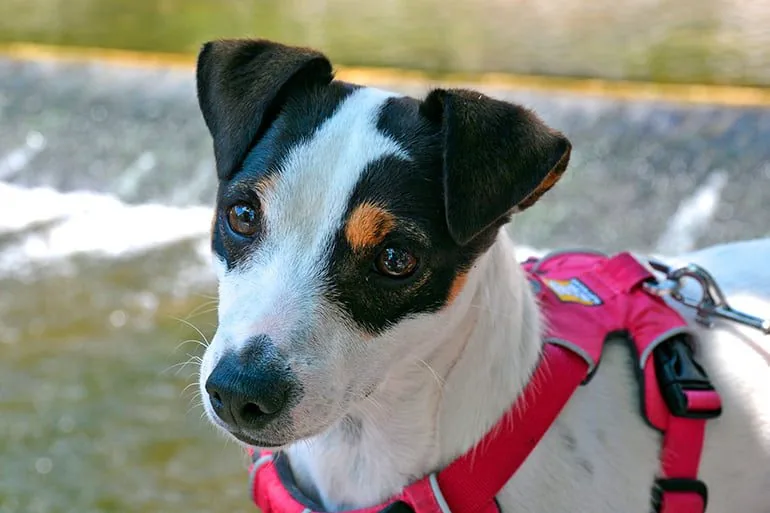
The harness, unlike the collar, doesn't fit around the neck — instead it fits around the body between the front legs, the withers, and the chest. This way the force is distributed across several points and not just on the neck. That's why the harness has become mandatory for securing dogs to the seatbelt during car rides. It's the safest option.
It's important to choose the right size, otherwise it could be tight without us noticing. It's not unusual to need help choosing our dog's first harness. Some models have three points and include a strap around the abdomen, making it harder for the dog to slip out of it.
Drawbacks of Collars and Harnesses
Now that we've seen the basic traits of collars and harnesses, we can draw a comparison between both options, looking at their advantages and drawbacks. Starting with the cons, we highlight:
- The collar, by fitting around the neck, can press too tightly on the throat, specifically the trachea, which is a very sensitive area for the dog. In fact, if we pet it there, we prompt the dog to swallow saliva. If the pressure is stronger, it triggers coughing. It can even leave it short of breath.
- So-called choke collars are never advisable.
- A dog that pulls excessively will be pressing on its own throat, making it more likely to suffer coughing fits or choking.
- Collars and harnesses run the risk of getting caught on something, especially if we let the dog wander alone through wooded areas, fences, etc.
- It's relatively easy for a dog to slip out of a collar that's even just a bit loose. They can also get free of harnesses.
- The harness, for its part, allows the dog to get more leverage if it wants to pull or run, which could end up knocking down older people, those with less strength, or children.
- Harnesses tend to be somewhat trickier to adjust than collars.
- They can cause chafing in the armpit area, and if left on all the time, hair may be lost at the contact points. This also happens on the neck with collars.
Advantages of Collars and Harnesses for Dogs
Both collars and harnesses have positive aspects that make them a good option for certain cases, depending on each dog. So we can point out the following advantages:
- Collars are very easily adjustable.
- The harness has the advantage of never pressing on the neck.
- Of course, collars with anti-parasite properties are recommended, and since they're not used with a leash, they don't show any of the associated drawbacks.
- Decorative collars such as bandanas or scarves also present no drawbacks, since their use is purely aesthetic and a leash isn't attached to them either.
Dogs That Need a Collar
Given the traits, advantages, and drawbacks of collars, we can see that the collar, on its own, isn't a good or bad accessory — rather, its use should take our dog's traits into account to prevent injury. So the collar is a good choice for:
- Calm-natured dogs.
- Dogs that are used to walking right beside us.
- Elderly dogs.
- Cases where there's some mobility restriction, such as post-surgery recovery from orthopedic procedures or even neutering.
- People with less strength.
Dogs That Must Be Walked With a Harness
In some situations, the harness will be the best choice. Choose one made of a material like nylon, easy to clean, padded, soft, sturdy, and not too thin. These guidelines also apply to collars. These are the dogs that should wear a harness:
- Dogs with respiratory problems that shouldn't receive any pressure on the trachea.
- Dogs with some kind of neck injury.
- Three-point harnesses are very well suited for dogs prone to escaping or very fearful ones, which could run off during a walk. They're also suitable for greyhounds, which, if using a collar, should have a wide one designed specifically for them.
IMPORTANT: This article is for informational purposes only and does not constitute veterinary, nutritional or behavioural advice. Every dog is different, and only your trusted vet can advise you on its specific needs.