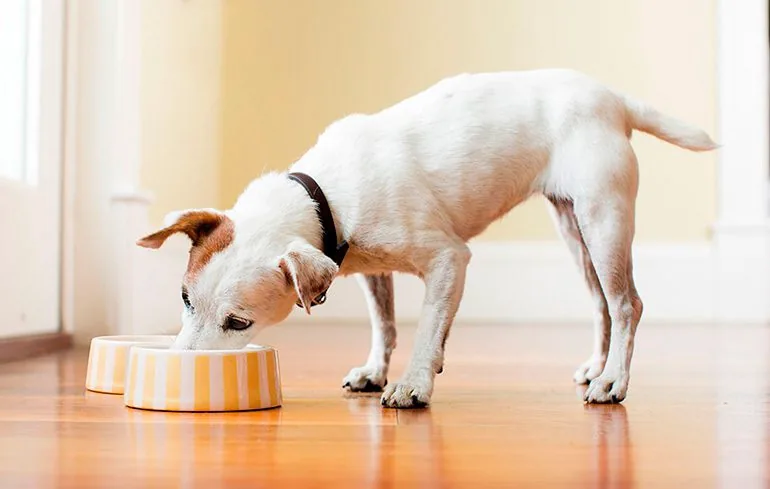
 Care
Care
Differences Between Dog and Human Digestion
By anatomy, dogs are classified within the carnivore group, though due to the hundreds of years spent alongside humans through domestication, their digestive system has evolved, and today they're classified as omnivores.
Humans are also omnivores, and although we treat our dog like another member of the family, it's very important not to fall into the mistake of thinking it can eat everything we do.
Some foods that are part of our regular diet are actually indigestible, or can even be toxic, for our dog.
What Is Digestion?
Digestion is the biological process through which food is broken down (hydrolyzed) into smaller particles called nutrients, which are absorbed and used by the body to maintain its various structures and obtain energy.
The digestive process begins in the mouth with chewing and ends in the dog's large intestine, with the formation of feces.
Although most foods we humans eat could be part of a dog's diet, we need to understand that anatomical differences exist between both species, and their body processes aren't the same.
Digestion in dogs is different from digestion in humans, which is why we can't eat exactly the same foods.
How Does a Dog Digest Food?
Food is ingested by dogs and travels through the different organs that make up the digestive system: the esophagus, stomach, small intestine, and large intestine.
Other organs are also involved in the digestive process, like the pancreas and liver, since they produce substances (enzymes and fluids) needed to break down food into nutrients.
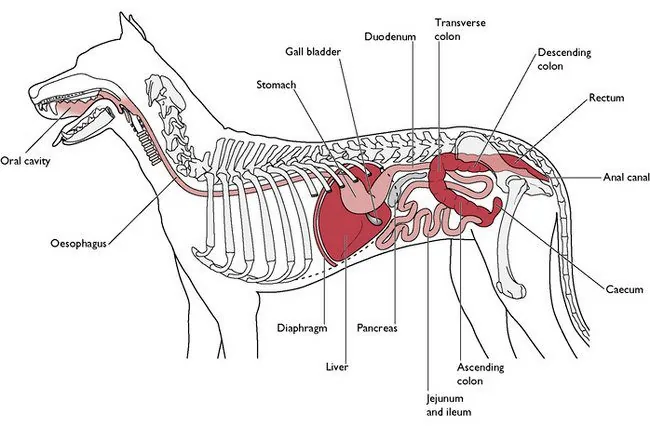
The Mouth
Dogs' dental structure reflects their origins: wolves. Their teeth are designed to feed on natural resources, with large canines for gripping and tearing meat and bone.
Unlike adult humans, who have 32 teeth, adult dogs have 42 teeth total.
In humans, food breakdown begins in the mouth, since our saliva contains an enzyme called amylase, and we chew thoroughly. Dogs, however, don't have this enzyme in their saliva, and they swallow food with barely any chewing. That said, although a dog's chewing process is brief, enough saliva is generated to lubricate the food, making it easier to swallow and pass through the esophagus.
The Esophagus
After swallowing, food moves along the esophagus thanks to its strong muscles, which push food down to the stomach even when the animal eats off the ground (working against gravity).
The Stomach
A dog's digestive process really begins in the stomach, which is why they don't spend much time chewing — they only break food into pieces small enough to swallow so it reaches the site of digestion (the stomach) as quickly as possible.
In the stomach, substances are produced that begin breaking down food: enzymes (proteases) and gastric acid, capable of breaking food down into smaller proteins and amino acids that can be absorbed and used by the body.
The gastric acid in a dog's stomach is much stronger than a human's, which is why it doesn't matter if dogs swallow large chunks of food, since they'll be easily broken down by this acid's action, even able to soften bone material.
The stomach also produces an enzyme called gastric lipase to start digesting fats.
The Small Intestine
Food digestion in the stomach results in small particles and a significant liquid component that pass into the small intestine, the site where nutrients extracted from food are absorbed. These particles cross the digestive membrane and enter the bloodstream to reach different parts of the body.
Waste products not absorbed in the small intestine continue moving toward the large intestine to be expelled from the body.
The Large Intestine
Any particle not used by the body and absorbed in the small intestine passes through the large intestine, where excess water and electrolytes are absorbed, forming feces. This is the final stage of the digestive process, ending with the elimination of digestive waste as compact feces.
As you can see, despite dogs having lived alongside humans for many years, differences still exist between both species at the digestive level, and we need to keep these in mind when feeding our pet to avoid putting its health at risk.
IMPORTANT: This article is for informational purposes only and does not constitute veterinary, nutritional or behavioural advice. Every dog is different, and only your trusted vet can advise you on its specific needs.