 Care
Care
Is Your Dog at Risk? Breeds Prone to Leishmaniasis
Although leishmaniasis can affect any dog, not every dog has the same risk of developing active disease. Breed, genetics, and age are determining factors that scientific studies have been analyzing for years. If you have one of the breeds mentioned below, prevention isn't optional — it's a priority.
Why are some breeds more vulnerable?
The key lies in how the immune system responds to the parasite Leishmania infantum. When a sandfly infects a dog, the body launches a cell-mediated (Th1) immune response to neutralize the parasite. If that response is effective, the dog can remain an asymptomatic carrier for years, or for life. If it fails, the parasite replicates and the disease progresses.
What science has shown is that this ability to respond has a clear genetic basis and varies significantly between breeds. Polymorphisms in genes such as Slc11a1 — involved in the first line of defense against intracellular parasites — or in genes of the major histocompatibility complex (MHC-II) determine whether a dog has more or fewer immunological tools to fight off the infection. It's not bad luck: it's partly written in their DNA. That's why it's important to know your dog's weak points well and follow this guide to leishmaniasis in dogs.
Breeds with a higher predisposition to leishmaniasis
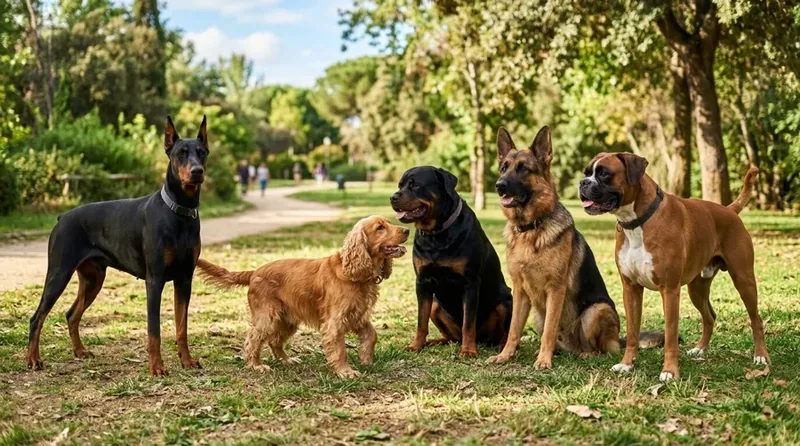
Boxer
This is, by far, the most studied breed and the one with the most scientific evidence on its vulnerability. A study published in 2022 in the journal Veterinary Sciences by researchers from Cardenal Herrera-CEU University and the INCLIVA Health Research Institute carried out a specific immunological and genomic characterization of the Boxer against Leishmania infantum. The results confirmed the presence of the TAG-8-141 haplotype in the Slc11a1 gene, directly linked to higher susceptibility. While the general seroprevalence of leishmaniasis in pet dogs in Spain is estimated at around 10%, some studies put the figure in Boxers at close to 39%. Their immune system appears to more often mount a Th2-type response (ineffective against the parasite) instead of the protective Th1 response.
Doberman Pinscher
The Doberman shares with the Boxer the dubious honor of topping breed-prevalence studies. Research from the UCH CEU Veterinary School, carried out on the island of Ibiza — a high-endemic area — concluded that the Doberman and the Boxer showed the highest prevalence of all the breeds studied, with statistically significant differences compared to other breeds with shared ancestry. The researchers also pointed to the Slc11a1 gene as responsible, identifying three key polymorphisms (A4549G, C4859T, and C8542T) directly linked to susceptibility to the visceral form of the disease.
German Shepherd
Its predisposition is documented in numerous European clinical studies and it's one of the reference breeds in Spanish veterinary parasitology. Professor Guadalupe Miró, from the Department of Animal Health at Complutense University of Madrid, consistently includes it among the highest-risk breeds. Besides the genetic basis, German Shepherds are often used as working or guard dogs, which means greater outdoor exposure during dawn and dusk hours, when sandflies are most active. The combination of immunological predisposition and environmental exposure makes it one of the breeds with the highest real-world risk in Spain. Males under 3 years old are the most vulnerable within the breed itself.
Rottweiler
The Rottweiler shows up consistently in breed-susceptibility studies, both in Spanish research and international work. A 15-year retrospective study published in 2024 in the journal Pathogens identifies it among the breeds at highest risk of severe clinical progression. A study from the Complutense Veterinary Clinical Hospital, which included data from thousands of animals treated over two decades, flagged the Rottweiler among the breeds presenting the most advanced clinical stages at the time of diagnosis, suggesting both greater susceptibility and faster disease progression once established.
Cocker Spaniel
The Cocker Spaniel's vulnerability is explained by two factors. On one hand, it has a documented immunogenetic predisposition noted by several research teams, including Dr. Miró's group at Complutense. On the other, its coat — especially when kept long — can make it easier for sandflies to bite less-protected areas. Interestingly, when naturally long-haired dogs like the Cocker are clipped, skin exposure to the vector increases, raising infection risk. This is a breed that combines genetic susceptibility with management factors worth keeping in mind.
Great Dane, Golden Retriever, and English Springer Spaniel
These three breeds were identified in the 2024 Complutense Veterinary Clinical Hospital study as significantly more susceptible to developing severe stages of leishmaniasis (stages III and IV of the LeishVet classification) compared to average. The study, one of the largest carried out in Spain to date, also conducted genome-wide scans looking for selection signatures that could explain the genomic component of this clinical susceptibility. Although research on these breeds is less extensive than on the Boxer or Doberman, the accumulated clinical data justifies including them in any enhanced prevention protocol.
Hunting dogs in general
More than any single breed, hunting dogs make up a cross-cutting risk group. Breeds such as pointing breeds, Pointers, Setters, and retrievers combine high exposure to sandflies — working at dawn and dusk, in areas of dense vegetation, which are the vector's preferred habitats — with periods of intense physical stress that can weaken their immune response. Stress, extreme fatigue, or a sudden change in living conditions are factors that can trigger active disease in dogs that were previously asymptomatic carriers.
Early symptoms you can spot at home
One of the biggest dangers of leishmaniasis is how silent it is at first: it can take anywhere from four months to several years between the infective bite and the first visible symptoms. The most common signs to watch for are:
- Hair loss around the eyes (periocular alopecia), one of the first skin signs.
- Flaking skin, especially on the muzzle, ears, and legs.
- Ulcers or sores that won't heal, with reddish edges.
- Abnormal nail growth (onychogryphosis).
- Progressive weight loss, even without losing their appetite.
- Swollen lymph nodes, noticeable to the touch in the neck, armpits, or groin.
- Spontaneous nosebleeds.
- In predisposed breeds like the Boxer or Rottweiler: hardened skin nodules.
If you notice any of these symptoms, see a vet as soon as possible. Early diagnosis is key to successful treatment.
Practical everyday preventive measures
Effective prevention combines several lines of action at once:
- Repellent collar or spot-on treatment: products containing permethrin or deltamethrin work by discouraging sandflies from biting. Your vet can recommend the best combination based on where you live and your dog's level of exposure.
- Vaccination: specific vaccines exist (Letifend and CaniLeish) that, while they don't prevent infection, stimulate the immune system to help prevent clinical disease from developing. These are especially recommended for high-risk breeds.
- Avoid walks at dawn and dusk during the warm months, when sandflies are most active.
- Don't let the dog sleep outdoors in summer, especially in areas with dense vegetation.
- Window screens at home to reduce the vector getting inside.
- Annual vet check-ups with bloodwork or a detection test, especially if your dog belongs to a high-risk breed or lives in an endemic area.
If you have one of the breeds mentioned, don't wait to see symptoms — talk to your vet about the most suitable prevention and diagnostic protocol. With the right measures, living with the risk is entirely manageable.
IMPORTANT: This article is for informational purposes only and does not constitute veterinary, nutritional or behavioural advice. Every dog is different, and only your trusted vet can advise you on its specific needs.