 Breeds
The Dog Breeds That Live the Longest
For any dog lover, one of the biggest injustices is probably how little time they live. Saying goodbye to our dog is a moment we don't even want to think about.
To put off facing that separation, many owners choose to adopt a puppy or look for a breed, or one of its crosses, known for its longevity. Below, we go over the breeds that, on paper, live the longest.
Small Breeds vs. Large Breeds
The first thing to know when talking about dogs' lifespans is that it varies by size. Smaller dogs reach maturity sooner, but reach old age later. Larger breeds, on the other hand, can take a couple of years to mature, and are already considered seniors by around 6-7 years old.
So it's hard to find an 18-year-old Great Dane, but not so hard to meet a Chihuahua that age. A dog's genetics also play a big role. That's why mixed-breed dogs without hereditary conditions tend to be considered longer-lived. But the animal's lifestyle is crucial too — good nutrition and care translate into extra years of life.
In this respect, veterinary medicine keeps advancing, and more and more attention is being paid to prevention. This means diseases get diagnosed earlier, improving their prognosis, and there are more ways to treat them. All of this is helping increase dogs' life expectancy.
The Longest-Living Small Breeds
Almost all of us know a small dog that lived close to 20 years. But that's not the norm. Breed experts tend to be cautious when giving an average life expectancy for each one. Even so, in every ranking, it's the smallest breeds that take the top spots, easily surpassing 17 years.
In general, these are small dogs, weighing anywhere from about 2 up to, at most, 11 kg. There are some very well-known breeds in this group, and many of them come in different sizes, with the smaller version usually being the longer-lived one. Here are some standouts:
- Average life expectancy of 12 to 15 years: this includes dogs like the Toy and Miniature Xoloitzcuintle, a Mexican hairless dog, and a breed little known outside its home country, the Smoushond or Dutch Ratter.
- 13 to 15 years: this group includes very popular breeds, like the standard-sized German Spitz, the Papillon, and the Phalène, also known as the "moth" dog for its dropped ears. Despite their health issues, we also find the Pug and several terriers, like the Plummer Terrier or the Jagdterrier. Recent mixes like the Cockapoo or the Yorkie-Bichon also fall here.
- 14 to 15 years: standouts include the Toy German Spitz, which sees a slight bump in life expectancy, along with well-known breeds like the Bolognese or the Havanese, the Maltese, the Affenpinscher, and terriers like the Bedlington or the Lucas Terrier. The Italian Volpino also belongs to this group.
- 15 years: Pomeranians average up to this age — a beloved, very small companion breed with a spectacular coat.
- Up to 17 years: among the longest-living, a couple of very well-known breeds stand out, the Toy Poodle and the Dachshund, both the Miniature and Standard varieties. These are breeds that can live many years, but can also develop health issues that require care and good veterinary follow-up.
Medium Breeds With the Longest Life Expectancy
Life expectancy tends to shrink as size increases, though among medium-sized dogs we can also find breeds whose average matches that of small dogs. By medium-sized dogs, we mean those weighing roughly 10 to 25 kg. Here are the breeds worth highlighting:
- Average life expectancy of 11 to 15 years: among dogs of this size, one breed stands out by far, the Poodle. In this case it's the Standard variety, with some individuals large enough to be classified as large-sized, weighing over 30 kg.
- 12 to 15 years: here we again find the Mexican Xoloitzcuintle, this time the Standard variety, weighing between 10-15 kg. Also worth mentioning is a lesser-known breed, the Norwegian Buhund, a type of Spitz.
- 13 to 15 years: this includes the Dutch Schapendoes, a herding dog weighing around 15 kg, and the better-known Basset Artésien Normand, a relative of the popular Basset but considerably lighter.
- 15 years: here we highlight the Corded Poodle, a Poodle notable for its coat, which falls in cords.
- Up to 17 years: lastly, the Poodle is once again the longest-living, this time in its Miniature (around 12-14 kg) and Medium (15 to 20 kg) sizes.
The Longest-Living Large Dogs
Unfortunately, few large breeds reach the 17-plus years that smaller dogs manage relatively easily. But even so, we can find a few. These are dogs weighing over 25 kg, and even over 35. That said, heavier or giant breeds don't typically reach a life expectancy beyond 10-14 years.
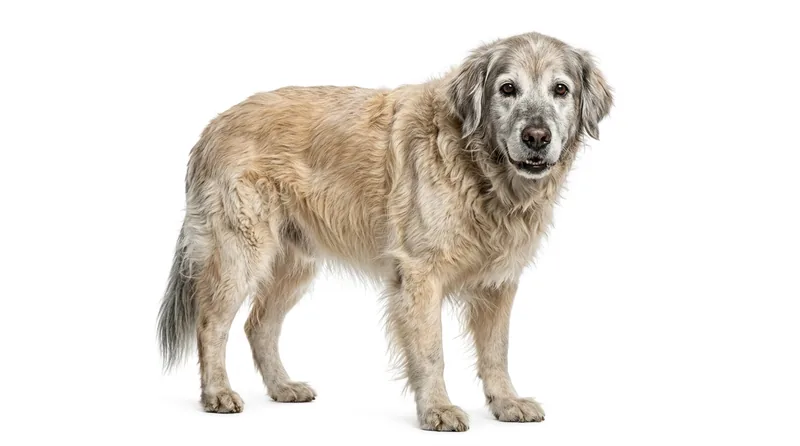
We'll highlight three breeds. The first is very popular and widespread worldwide: the Golden Retriever, a well-known dog whose families can enjoy them for an average of 13-15 years. But it's not the only one — the Labrador-Poodle cross has achieved the same average life expectancy.
Lastly, a lesser-known breed is the one that, among this size category, reaches the longest lifespan, between 14 and 15 years: the Hungarian Vizsla. These dogs weigh between 22 and 30 kg and have a glossy, wiry or short coat.
Bibliography
Fogle, Bruce. 1995. The Encyclopedia of the Dog. London. Dorling Kindersley.
IMPORTANT: This article is for informational purposes only and does not constitute veterinary, nutritional or behavioural advice. Every dog is different, and only your trusted vet can advise you on its specific needs.