 Care
Care
The Heat Cycle in Female Dogs
Dogs have two basic genetically hardwired drives: survive and reproduce to keep the species going. And of course our dogs are no exception. Like every mammal on the planet, they go through a hormonal shift known as heat (or estrus), which can lead to reproduction.
The early symptoms of heat in female dogs warn us of what's coming: nothing less than our girl's reproductive cycle. This cycle is made up of several phases that show its progression, and ones we'll be able to notice too. Let's take a detailed look at everything related to the heat cycle.
What does a female dog's heat cycle involve?
"Heat" refers to our female dog's reproductive cycle, during which she ovulates and can become pregnant if allowed to mate with a male. It's a completely normal, natural process that occurs, as mentioned, in females belonging to the mammal class.
During the heat cycle, our female dog will start ovulating, will ovulate, and will try to be mounted by a male dog to have puppies. We can't fight this, since it's genetic, so we should simply give her plenty of affection and the care she needs to get through her heat without incident, since it will be a time of hormonal surges, and our girl may be more restless than usual during certain phases of it.

How long does a female dog's heat last?
This is a question that can't be answered with total certainty, since most female dogs have a cycle lasting around three weeks. But there are always exceptions where the cycle can last just a couple of weeks, and cases where it can last four or five weeks.
That said, it's typical for our female dog's cycle to last between eighteen days and three weeks, though this isn't a hard rule, since it can vary for different reasons and generally depends on the breed.
If our female dog's heat doesn't end after four or five weeks, we should consult a vet.
How often do female dogs go into heat?
Generally speaking, female dogs have one or two heat cycles a year; there's no specific data on when exactly, since it can happen in any season. There's normally a period of six to eight months between one heat and the next, though sometimes the gap is much longer.
Small-breed female dogs tend to have shorter intervals between one estrous cycle and the next, while larger female dogs have longer intervals between cycles.
If our female dog has one or two heats a year, that falls within what we could consider normal. If she doesn't have any, or has more than that, it's worth consulting a vet who can run the appropriate tests and let us know.
In females that are still developing, especially large-breed females, it can happen that they don't come into heat when they should have during that time. This is because these breeds (Mastiff, Great Dane, Saint Bernard…) take longer to develop the organs that trigger hormone production and release.
That said, in large and giant breed females that have reached full sexual maturity from around two years old, the absence of heat cycles may point to certain conditions, so it would be a good idea to take her to the vet.
When does a female dog have her first heat?
A healthy female dog living a normal life free of stress or anxiety has her first heat between eight months and a year and a half of age. Depending on the individual dog, their size, and development, the timing of the first heat can vary quite a bit.
Generally speaking, small-breed dogs tend to have their first heat between six months and their first year of life. Large-breed dogs, however, as mentioned, come into heat later (between sixteen and twenty-four months of age).
Using simple logic, we can also work out that medium-sized female dogs can have their first heat anywhere between six and twenty-four months of age, although it's usually around the first year of age or a few months after.
As you can see, there's no exact formula for pinpointing when heat will happen, though we can get a rough idea based on size and age. It's very important to note down on a calendar when our female dog has her first heat, so we can compare it to the second one and roughly work out how many months apart her heats tend to be.
Symptoms and phases of heat in female dogs
The word "heat" refers to the whole cycle in female dogs. But it's made up of four distinct phases. Depending on the phase, our girl will behave differently.
So, let's go through the phases of heat in a female dog and their corresponding symptoms:
- The heat cycle's Proestrus phase.
- The heat cycle's Estrus phase.
- The heat cycle's Diestrus phase.
- The heat cycle's Anestrus phase.
Symptoms and the Proestrus phase
Proestrus is the phase when our female dog starts to bleed; it lasts between six and twelve days, nine or ten on average. It's completely normal to see blood spotting on her genitals, and she may even leave spots around the house or outside.
Despite bleeding and therefore attracting other males, our pet won't accept being mounted by any of them, and may even become aggressive if a male persists, since she won't let any male mount her at this stage.
Sometimes they're less social than usual, due to the major hormonal shift their body is going through. They may urinate more than normal during this phase.
If we notice these symptoms, we should be a bit cautious and keep our female dog away from other dogs. If the blood spotting is a problem in the house, we can use special panties for female dogs or doggy pads/diapers.
Symptoms and the Estrus phase
Estrus is the phase that follows proestrus and generally lasts around one week to ten days. Depending on the individual dog, this phase can last a bit less or a few days more.
During estrus the female no longer bleeds (though sometimes this isn't the case) and her ovaries are fully ready to be fertilized by a male dog's sperm; we'll notice her genitals are somewhat more swollen and warm than usual — this is the fertile window when the hormonal peaks occur.
In this phase, female dogs in heat are very receptive, letting the male mount them (this is the only phase during which a female will let a male mount and fertilize her). We'll often see our girl approaching males, rubbing against them, or raising her tail to show off her swollen, edematous genitals.
This phase is quite complex, since female dogs not only allow mounting but actively feel the urge to be mounted. It's completely normal for them to try to escape in search of a male to mate with, so we strongly recommend never letting a female dog off-leash during this phase unless we want puppies. It's best to keep them on a leash and avoid areas where male dogs might be.
Their behavior is different during the estrus phase, as they become more affectionate and receptive, more playful, even cheerful. These traits serve a single purpose: attracting a male so fertilization can happen. Males have a hard time during this phase in females, since they instinctively detect the pheromones the females give off from a distance.
If mating does happen, it's very likely our female dog will become pregnant and her heat will end, giving way to gestation.
Diestrus and symptoms
Once the estrus phase ends, the diestrus phase begins. It lasts around sixty days (about the length of a pregnancy), during which the female won't be receptive and won't let a male mount her.
This is the period during which the female would be pregnant, so sometimes dogs can develop a false pregnancy (phantom pregnancy) and produce milk from their mammary glands, believing they're pregnant. If the milk production doesn't stop, we should take her to the vet to have it checked.
Anestrus and symptoms
This is the time between the end of diestrus and the start of the next heat. During this phase the female rests hormonally and sexually, with a reasonable gap before her next heat. There's no blood spotting or genital swelling; everything returns to normal, and our female dog will show her usual behavior, neither welcoming males nor being of interest to them.
How can I prevent my female dog from going into heat?
There are very effective techniques to prevent a female dog from going into heat, the main one being spaying, colloquially called "getting fixed." It's a routine surgery that will prevent our female dog from ovulating, and as a result, completely prevent pregnancy.
Spaying female dogs is fully recommended if we don't intend for our dog to have puppies. It prevents her from bleeding and going through the typical cycles and symptoms of any dog's heat, as well as numerous conditions that can develop if she isn't spayed.
We can spay our girl before her first heat with no problem, though some vets prefer to wait until the first heat is over to make sure she's fully developed before spaying.
If we'd rather not have her operated on, there are injections sold at veterinary clinics that act as contraceptives, though these can raise the risk of uterine conditions developing.
Why do male dogs go crazy when a female dog is in heat?
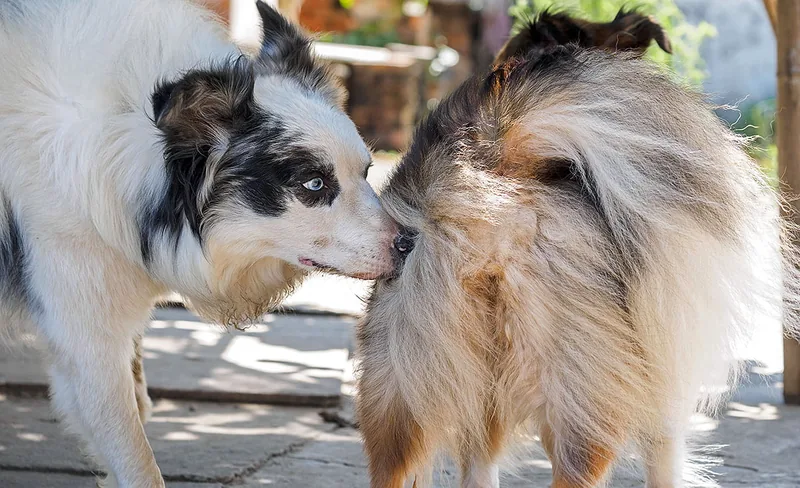
A female dog in heat typically urinates much more than normal (polyuria); it's a way of marking her scent while also releasing a ton of pheromones that will send males into a behavioral frenzy. That's why males become so persistent when they spot a female in heat, constantly chasing after her to mount her, since she gives off so, so many pheromones wherever she goes and/or marks.
There are plenty of cases of female dogs escaping in search of a male, and just as many cases of males escaping from home in search of the female giving off that irresistible scent, wanting to mount her. Although it might seem amusing, some dogs really struggle during this — they stop eating, howl, whine, become extremely restless...
If we have a female dog in heat, we should avoid at all costs walking in places where there are more dogs; likewise, if we have both a male and a female living together at home, we should keep them apart during the heat period, unless the male is neutered.
IMPORTANT: This article is for informational purposes only and does not constitute veterinary, nutritional or behavioural advice. Every dog is different, and only your trusted vet can advise you on its specific needs.