 Care
Care
Doghouses — What Should You Consider?
If you're thinking about buying an outdoor doghouse so your dog can rest or shelter from the weather, let us give you some wise advice on which is the best doghouse for your pup.
There are several types of doghouses, from old-school metal ones to cozy wooden ones, not forgetting the increasingly common plastic ones. They all do their job, but are they really effective?
Plastic Doghouses
These are becoming more common due to their low price, although that doesn't mean they're the best option, since no matter how much manufacturers try to convince us, plastic remains, by far, the worst insulating material for a doghouse.
One advantage plastic doghouses have is how easy they are to clean — since it's not a porous material, a simple damp cloth is enough to clean it both outside and inside.
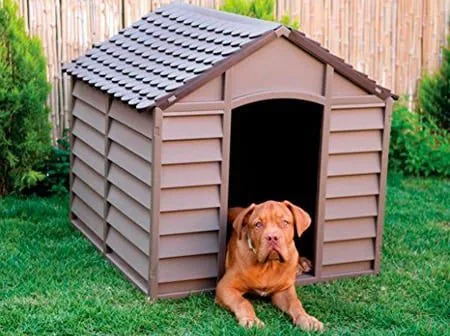
Plastic seems to be one of the most attractive materials for a dog when it comes to breaking things. The low durability of plastic doghouses and how easily dogs chew through them make it a not very recommendable option.
If you live in an area with very cold winters or very hot summers, plastic doghouses are nowhere near your best option. They're better suited to places with a consistently mild climate.
Advantages Drawbacks- Affordable price
- Easy to clean
- Poor insulation from cold and heat
- Not very durable
Wooden Doghouses
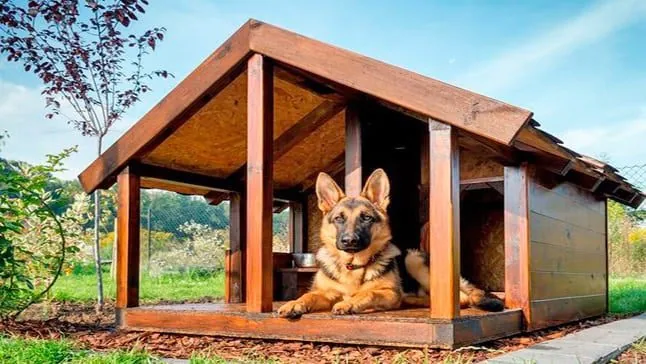
These are without a doubt the most elegant doghouses among the available options. And if they're made with high-quality wood such as Cedar, they'll undoubtedly be very sturdy, cozy doghouses.
Properly treated wood for outdoor use is without a doubt the best material a doghouse can be made from. It's an excellent insulator from both cold and heat and provides the comfort our dog needs.
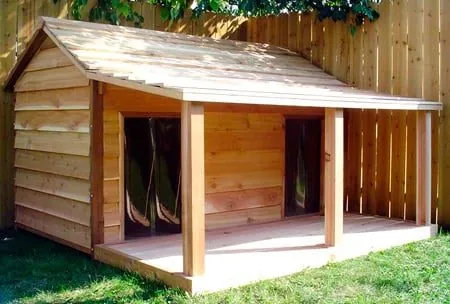
Hardwoods are really tough, and with proper treatment by the manufacturer they'll be very long-lasting, even against our dog's possible chewing attempts.
On the other hand, wooden doghouses are somewhat trickier to clean than, for example, plastic ones, since debris tends to build up in the joints. Also, their price tends to be higher than plastic ones.
Advantages Drawbacks- Better insulation from cold and heat
- More comfortable and durable
- Higher price
- Harder to clean
Metal Doghouses
These are without a doubt the least recommendable doghouses for a dog. Don't torture your dog by buying it a metal doghouse, since the only advantage they have is being more durable.
Otherwise, it's all drawbacks:
- They don't insulate from cold or heat
- They build up more dirt
- They tend to rust/corrode
- If they splinter, they can seriously injure the dog
- Sounds create very annoying vibrations inside them
If you truly value your dog, please don't buy it a metal doghouse. Make a small effort and choose a comfortable wooden doghouse suited to its size and the weather conditions in your area.
Size and Model of Doghouse
There are as many doghouse models as there are different dog breeds, so choosing the right one is sometimes trickier than it may seem at first glance.
The first thing we need to consider is the size we need for our dog — we should choose a doghouse whose size lets the dog turn around inside it. A doghouse that's too big will make it harder to keep the inside warm in winter, while one that's too small will make our dog feel cramped.
We need to consider our adult dog's size — if it's a puppy... remember they grow very fast. Once we have a good idea of the size, we should move on to the design.
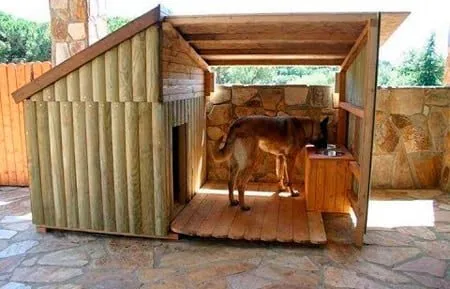
There are doghouses with pitched roofs, flat roofs, and even ones with a porch. If you live in a cold area or one with a lot of rain, remember to choose a doghouse with a pitched roof.
If, on the other hand, you live somewhere that's always very hot, a flat-roofed doghouse can work for you. If the doghouse also has a porch or a double roof that shades it, that shade will help keep it from overheating.
Where to Place Our Pup's Doghouse?
Remember the doghouse will be placed outside, whether in your yard or somewhere else on your property. That means mud, and even the occasional puddle, will form nearby when it rains.
The best thing we can do before placing our dog's doghouse is to concrete the spot where it will go, so no dampness forms underneath the doghouse that could harm the dog. Also, by preventing mud from forming around it, it will always stay cleaner.
If we're not going to concrete the spot where the doghouse will be, we need to insulate the ground where we'll place it — either with roofing felt or gravel, we need to prevent dampness from forming under the doghouse.
The doghouse's orientation also matters — we should orient the opening to the south so that during winter, the cold north wind doesn't blow in through the opening. If we live somewhere hot, we'll orient the doghouse toward the north so it stays cooler.
IMPORTANT: This article is for informational purposes only and does not constitute veterinary, nutritional or behavioural advice. Every dog is different, and only your trusted vet can advise you on its specific needs.