 Breeds
Dutch Shepherd
The Dutch Shepherd is far more than a working dog: it's a tireless athlete, a natural guardian, and a companion of ironclad loyalty. Its unmistakable brindle coat, available in three distinct textures, makes it a breed as versatile in looks as it is in function. Before letting yourself be won over by its intelligent gaze, it's worth getting to know its physical demands and temperament in depth.
What the Dutch Shepherd Is Like
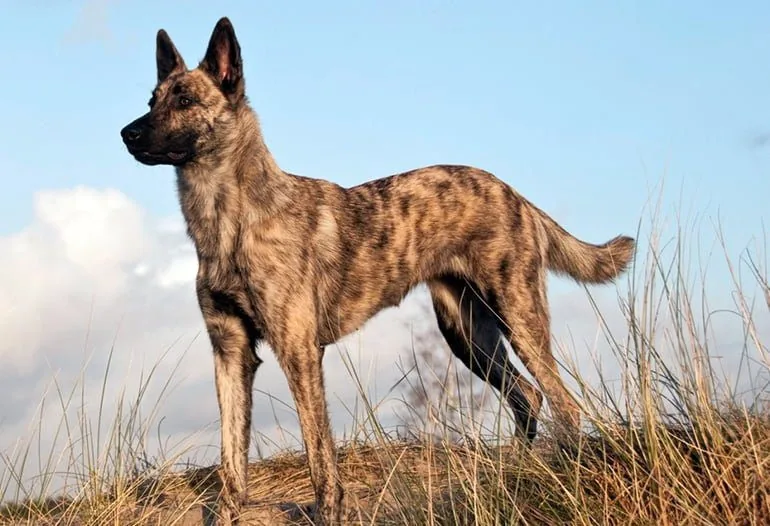
The Dutch Shepherd has a medium-to-large, athletic, well-proportioned silhouette, built for endurance rather than pure speed. Height at the withers ranges from 55 to 62 cm, while weight stays within a functional range of 20 to 30 kg, varying slightly by sex and bloodline. Its body is slightly longer than tall, with a deep chest and sprung ribs that reveal strong lung capacity.
The official standard, recognized by the American Kennel Club, only accepts brindle as the coat pattern. This coat combines a brown or silver-gray base with well-defined black stripes, creating a unique visual effect that historically served as camouflage in Dutch fields. The coat comes in three varieties: short coat (smooth and close to the body), long coat (dense, with a woolly undercoat and feathering on the legs and tail), and wire coat (coarse, wiry, with a tousled look). A healthy dog's life expectancy runs between 11 and 14 years.
The All-Purpose Dog of the Netherlands
The Dutch Shepherd was forged in the 19th century in the rural areas of the Netherlands to meet a very specific need: an all-purpose dog that could herd flocks, watch the farm, and protect crops, sparing farmers from having to keep several specialized breeds. This functional breeding prioritized weather resistance, natural obedience, and strong initiative.
With the arrival of industrialization and farm mechanization, the Dutch Shepherd came close to disappearing. However, its huge behavioral adaptability let it successfully reinvent itself in urban and sport settings. Today it excels in disciplines like agility, canicross, competitive obedience, and security work, keeping intact the herding instinct that defines its genetic heritage.
A Temperament Forged in Intelligence
We're talking about a dog with outstanding working intelligence and a loyalty that borders on exclusivity toward its family unit. Its temperament combines three essential traits: controlled affection, innate watchfulness, and an enormous capacity for work. It's not an effusive dog with strangers, but it forms an extraordinarily solid bond with its handler, whom it follows with an almost hypnotic attention.
Unlike other more extreme herding breeds, the Dutch Shepherd tends to show greater emotional stability at home when given proper stimulation. It's a dog that needs a purpose: without a clear outlet for its mental and physical energy, it can develop compulsive behavior. That's why it fits perfectly with active families who practice outdoor sports or advanced dog training, but it can become overwhelming in sedentary households.
Unique Traits of the Dutch Shepherd
Few breeds can claim to offer three coat varieties over the same brindle pattern. This textural diversity isn't an aesthetic quirk, but a functional adaptation: the short coat makes cleanup easier after working in mud, the long coat insulates against damp cold, and the wire coat protects against abrasive vegetation while tracking. The wire coat variety is the most unusual of the three, since it requires hand-stripping to remove dead hair, a technique uncommon outside terrier breeds.
Another notable quirk is its historical kinship with the Malinois and the German Shepherd, from which it split by fixing the brindle gene. For decades, crosses between these breeds were common, but the Dutch line kept a more rustic look and a less extreme temperament. Its tail, when at rest, hangs with a slight curve, a morphological detail the standard describes precisely and that sets it apart from other short-coated herding breeds.
Care and Health of the Dutch Shepherd
The Dutch Shepherd is a generally sturdy breed, but it isn't free of hereditary joint problems. The most documented conditions are hip and elbow dysplasia, so it's essential to get dogs from parents with official X-ray clearances. Cases of progressive retinal atrophy and sensitivity to certain drugs have also been described, though their incidence is low in responsibly bred lines.
Coat maintenance varies drastically by variety. The short coat is happy with weekly brushing; the long coat needs two or three sessions to prevent tangles in friction-prone areas; and the wire coat needs, besides brushing, periodic hand-stripping to preserve its protective texture. As for exercise, walks alone aren't enough: this dog needs at least 90 minutes of intense daily activity, combining physical exercise with mental challenges like tracking or obedience work. Without that outlet, its psychological wellbeing quickly suffers.
IMPORTANT: This article is for informational purposes only and does not constitute veterinary, nutritional or behavioural advice. Every dog is different, and only your trusted vet can advise you on its specific needs.