 Breeds
English Pointer
The English Pointer is the very picture of athletic nobility. Its wind-sculpted silhouette, its near-infallible nose, and a natural elegance have made it far more than a hunting dog: it's a joyful family companion, just as happy tracking a toy in the yard as resting at its owner's feet after a long day outdoors. A breed that's traded the moors for the warmth of home without losing an ounce of its aristocratic essence.
The Athletic Look of the English Pointer
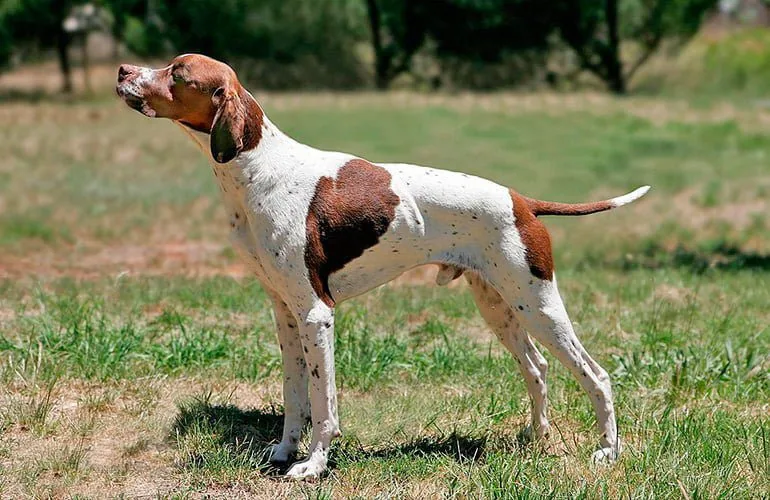
The English Pointer belongs to the large pointing breed group, and its body is a study in both function and beauty. The musculature is lean and powerful, with a deep chest and aerodynamic lines that reveal its ability to cover long distances with seemingly no effort. The elongated head, with a well-defined stop, ends in a nose pigmented to match the coat, while its round eyes, with hazel or brown irises, give off a lively, kind expression.
Under the official American Kennel Club (AKC) standard, males stand between 63 and 69 cm at the withers and weigh 24 to 34 kg; females, somewhat lighter, reach 61 to 66 cm and weigh 20 to 29 kg. The coat is short, dense, and coarse in texture, with a natural shine that repels brush. The most characteristic colors are bicolor combinations: lemon and white, black and white, liver and white, or orange and white, along with tricolor patterns. Solid-colored dogs exist, but they're uncommon in the show ring. Its life expectancy runs between 12 and 17 years.
The British Roots of a Hunter
The English Pointer's documented history begins in mid-17th-century Britain, when the nobility sought to perfect a pointing dog for hunting with firearms. Its genetic base is largely credited to the Spanish Pointer, which contributed the innate pointing ability, later refined with other British working breeds like the Foxhound or the Greyhound.
For decades, the Pointer formed a legendary duo with the English Greyhound: the Pointer would locate the game and freeze in its characteristic stance, while the sighthound dashed in to catch it. Over time, the breed proved unusually versatile, also being trained as an effective retriever both on land and in water. Today, its balanced temperament and functional beauty have opened the doors to conformation shows and field trials, without giving up its more domestic side.
A Temperament Brimming With Enthusiasm
Living with an English Pointer means discovering a fascinating blend of overflowing joy, unwavering loyalty, and a touch of noble pride. It adapts easily to different environments as long as its need for activity is respected, and it responds enthusiastically to training thanks to a sharp intelligence and a strong desire to please. With children it's tireless and patient, making it the ideal playmate for the rowdiest kids in the house.
Its protective instinct, though it's not an aggressive guard dog, leads it to discreetly watch over its people. This same sensitivity explains why many Pointers excel as therapy and rescue dogs, where their empathy and exceptional sense of smell make all the difference. This isn't a breed for sedentary owners: a bored Pointer can become destructive, but a well-exercised one is an unmatched companion.
Details Only the Pointer Has
Few breeds can claim as iconic a pointing stance: the Pointer literally freezes in place, one front paw raised and its muzzle aimed at the game, like a living statue. This behavior, which gives the breed its name, is a vestige of its breeding as a pointing dog and shows up even in puppies during play.
Another quirk is its remarkable sense of smell, considered one of the sharpest among hunting breeds, able to detect a bird's scent from surprising distances. Its short, dense coat isn't just functional, either: the lemon-and-white color combination is practically a breed trademark, hard to find in other pointer breeds. Finally, its ability to work as a duo with other breeds, like the English Greyhound, is a historical trait that speaks to its cooperative intelligence.
Health and Care for the English Pointer
The English Pointer is generally a sturdy breed, but like any large dog, it has a predisposition to certain conditions. Hip dysplasia is one of the most common, so it's recommended to get puppies from breeders who test the parent dogs. It can also present congenital deafness, especially in predominantly white-coated dogs, and some cases of entropion or bloat.
Its short coat needs minimal upkeep: weekly brushing is enough to remove dead hair and maintain its natural shine. Its exercise needs, however, are high: it needs at least an hour of intense daily activity, ideally combining free running with scent games. A Pointer that doesn't burn off its energy can develop destructive behavior or anxiety, which is why exercise is the cornerstone of its wellbeing.
IMPORTANT: This article is for informational purposes only and does not constitute veterinary, nutritional or behavioural advice. Every dog is different, and only your trusted vet can advise you on its specific needs.