 Care
Care
Everything About Wheelchairs for Dogs
A wheelchair can offer mobility to a dog who has lost the use of their back or front legs. Whether due to an accident or an illness like dysplasia, having a disabled dog can fill us with despair, but there are different options to help us give them quality of life.
We need to consider our dog's needs before getting one of these wheelchairs, along with knowing the types, sizes, and their benefits. Below, we provide detailed information so you can learn which one suits your dog best.
- You might also be interested in: How do joint-support supplements help a dog's joints?
What is a wheelchair for dogs?
It's a commercial or homemade device used when a dog has lost mobility in their legs. Some years back, a disabled dog had few chances of survival, let alone living a normal life.
Nowadays, commercial wheelchairs are sold that let our dog run and play like before. It's also possible to build one at home if we have a bit of skill and patience.
When does a dog need a wheelchair?
There are many causes of disability in dogs. Immobility can be temporary, like after an accident — in this case our dog would only need the wheelchair during rehabilitation, just like it's used with people.
But it can also be permanent, requiring a wheelchair on an ongoing basis. Some conditions can leave a dog paralyzed for life:
- Serious accidents or injuries
- Hip dysplasia in senior dogs
- Elbow dysplasia in senior dogs
- Arthritis
- Congenital problems in the hip or leg bones
Benefits of using a wheelchair
Regardless of whether it's used temporarily or permanently, a wheelchair will bring many benefits to our dog:
- Supports recovery
- Restores their ability to move on their own
- Reduces wounds caused by friction with the ground
- The dog won't need to drag themselves around
- Improves digestion
- We can take them out for walks
- Improves health by preventing complications from inactivity
- Encourages exercise
All these benefits add up to our dog's happiness.
Types of wheelchairs for dogs
Before choosing the perfect wheelchair for our dog, we need to know the varieties available. Several classifications are possible — first, we should ask whether the wheelchair is:
- Temporary
- Permanent
Next, we should consider our budget:
- Commercial wheelchair by size (from €70 to €300)
- Homemade or handmade wheelchair (between €40 and €50)
Also, if the use is temporary, it's possible to get a secondhand wheelchair for dogs. These can be found online, since other owners sell them once their dogs no longer need them.
We should also consider whether our dog belongs to a:
- Toy breed
- Small breed
- Medium breed
- Large breed
- Giant breed
Since wheelchairs vary a lot depending on the dog's size, and each dog needs a wheelchair suited to their size to be functional. On top of this, wheelchairs can be classified based on which part of the body is affected:
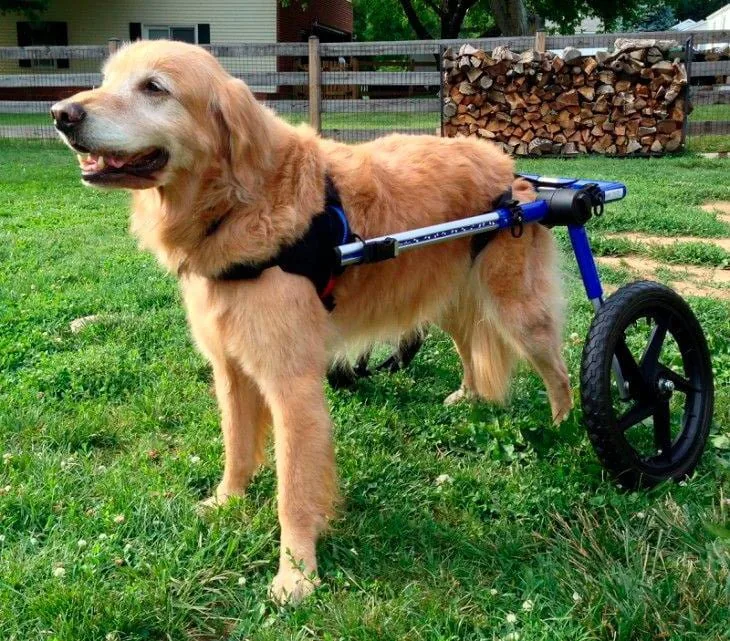
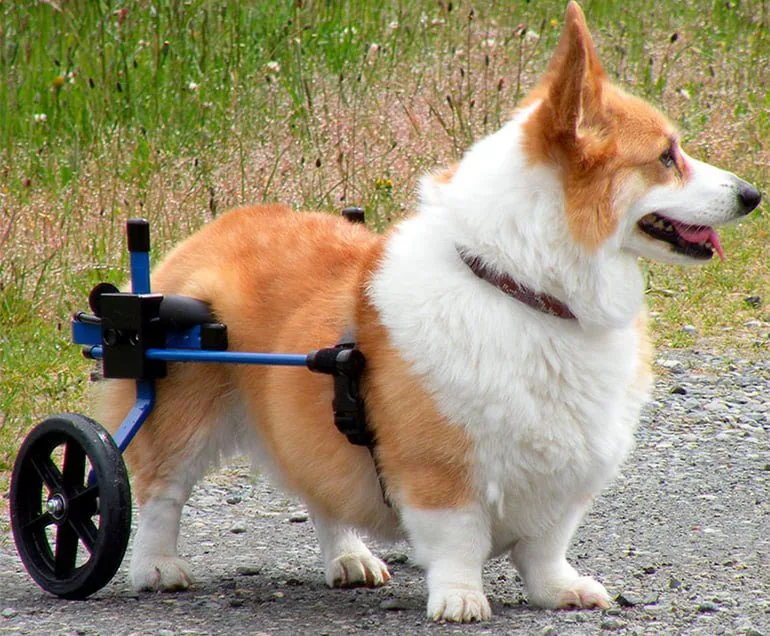
Wheelchair for back legs
These wheelchairs are for dogs who can't move their back legs. There are several brands — ideally we should get ones that let the dog urinate and defecate while wearing it.
Also, it's important for the wheels to be far enough from the legs, otherwise chafing will occur.
Wheelchair for front legs
These are designed for dogs who can't move their front legs. It's ideal if our dog has strength in their back legs but needs help with the other two.
4-wheel chairs
These wheelchairs are for dogs with immobility or weakness in all four legs. Whether due to accidents involving the spine, illnesses, or congenital problems, this chair provides support for the whole body, while still allowing movement.
We should never get this type of wheelchair if our dog is only unable to move one part of their body. Doing so would have the wheels get in the way of the healthy part and prevent them from exercising the muscles that aren't atrophied.
How to choose the perfect wheelchair?
Using a wheelchair should be recommended by our vet, based on the cause of the problem. This way, the specialist will tell us whether the wheelchair should be temporary or permanent. We'll also learn whether the dog needs front, back, or all-four-leg support.
Other things to keep in mind before getting a wheelchair for dogs are:
- Weight: for dogs who need to strengthen their legs because they'll walk again, a solid, somewhat heavy chair could help with this task (always under veterinary supervision). On the other hand, if our dog won't walk again, it's best to get one made of lightweight materials.
- Measurements: the chair should be suited to the dog's size.
- Activity level: it's not the same if our dog lives in a small apartment as if they spend a lot of time in the yard. Small, compact wheels are ideal for urban environments, while large wheels and a suspension system work well for dogs living in the countryside or who frequently walk on the beach or other uneven terrain.
- Material: materials should be durable, sturdy, and rust-resistant.
- Ease of cleaning: it's best to choose wheelchairs that can be assembled and disassembled for easier cleaning.
- Harness: the harness holding our dog should be comfortable and functional — their body shouldn't end up too stretched out or suspended, nor should they fall forward while walking.
- Mobility: wheelchairs that allow easy turning left or right are ideal.
- Comfort: our dog shouldn't feel pain or discomfort while using the chair, nor should it cause them wounds. If any of these happen, it's not the right chair.
- Adjustability: for puppies, it's best to invest in an adjustable wheelchair. This way, we can adapt it as they grow.
How to build a homemade wheelchair?
Commercial wheelchairs for dogs can be expensive. Often we don't have the resources to buy one, but we still want to give our dog the best.
With this goal in mind, it's possible to build a homemade wheelchair. The materials can be found at hardware stores, and the cost ranges between €40 and €50. These wheelchairs can be built for small or large dogs, though we may need to adjust them as we build.
Materials for a dog wheelchair:
- 1-inch PVC pipes
- 1-inch PVC T-joints
- Measuring tape
- Wheels (diameter will depend on the dog's size)
- Nuts and bolts
- Dog harness
- Dog straps
- Pliers and clamps
- Drill and saw
- PVC glue
- Paper and pencil
- Cushion sized for the dog
Steps for building a dog wheelchair:
- Measure our dog: body length, leg length, distance from the ground, body width.
- Design the wheelchair using photos as a reference — you can find plenty online.
- Cut the PVC pipes according to the measurements. We can make them a bit longer, so we can trim them down later if needed.
- Join the pipes with PVC glue, making sure the pieces stay straight and level. We can ask someone else to help with this.
- On the bottom pipes, add the T-joints to position the wheels.
- Screw on the wheels.
- Sew the dog straps to the harness, so we can tie them to the wheelchair's frame.
- Position the cushion according to our dog's needs. If the problem is in their back legs, we'll sew some straps to the cushion to tie it to the chair, so the dog's body rests on it. If the immobility is in the front legs, we'll place it in the corresponding spot instead.
Our wheelchair is ready! The goal is for the dog's body to be held by the harness, with the immobilized area resting on the cushion and the healthy legs touching the ground so they can push themselves forward.
Online you can find many videos with detailed explanations, patterns, and measurements for different breeds. Here's a video explaining the assembly:
/p>
Homemade or commercial wheelchair?
Homemade and commercial dog wheelchairs offer different benefits — which should we choose? Let's keep the following in mind:
Pros
Homemade wheelchair
- Affordable
- Materials can be bought at any hardware store
- We can adjust it to the dog's measurements
- We can build it at home
- Replacement parts are easy to find
Commercial wheelchair
- Lightweight, durable materials
- Comes ready-made, just needs assembly
- Can be made to the dog's measurements or adjusted
- Offers comfort
- Designed for the dog to turn easily
- Long-lasting
- Most are foldable and easy to transport
Cons
Homemade wheelchair
- Tends to be heavy
- Requires time to build
- We may need to try several chairs before getting the right size
- Can be uncomfortable since it's not built by a professional
- The wheels may not turn properly
- Durability depends on the quality of the materials
- Can be unstable if measurements aren't correct
- Not foldable
Commercial wheelchair
- Prices can be high
- May not be available in some countries, or may need to be imported
IMPORTANT: This article is for informational purposes only and does not constitute veterinary, nutritional or behavioural advice. Every dog is different, and only your trusted vet can advise you on its specific needs.