 Care
Care
Eye Injuries in My Dog — What Do I Do?
Our dog's eyes are very sensitive and vulnerable organs. Any wound to them can have very negative consequences for its vision. Because of this, we can't delay seeing the vet for any injury to them.
What Do I Do If My Dog Hurts an Eye?
If we notice a wound or bleeding in our dog's eye, the first step is to try to find out where the injury is. Of course, if the eye appears collapsed or with heavy bleeding, we need to see the vet clinic urgently.
An eye out of its socket should be covered with gauze soaked in saline solution or, failing that, warm water. This way it won't dry out on the way to the vet. In these cases, when there's heavy bleeding or the dog is in so much pain it won't let us examine it, we should skip handling it and go straight to the vet.
This type of injury is very visible, so we'll notice it right away. Trauma can cause the eye to bulge out. Scratches from other animals or bushes, contact with foreign bodies, etc., can cause wounds of varying severity around the eye or inside it.
The Cornea
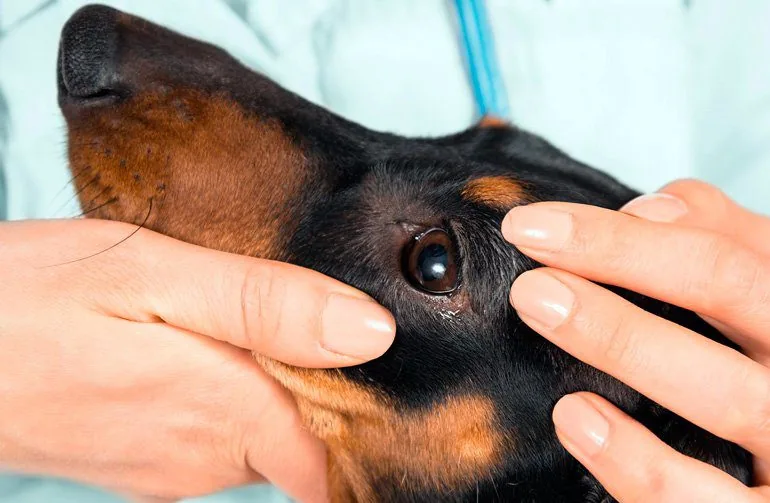
The cornea is the transparent outer layer of the eye that protects against external agents. A wound to it won't produce a typical scratch or bleeding, but rather a cloudy, blurry area. Dogs with bulging eyes, due to their shape, are more prone to these injuries.
Any wound to the cornea will require prompt veterinary attention. A damaged cornea causes pain and symptoms such as tearing or intolerance to light, known as photophobia. The third eyelid, or nictitating membrane, extends in an attempt to protect the eye.
If our dog seems to have an injured eye, we should never apply medication on our own without checking with the vet. For example, corticosteroid drops, if there's a corneal injury, can end up perforating it.
Corneal Abrasion
Mainly scratches and foreign bodies will damage the cornea, causing a wound that irritates and inflames the area. This is what causes that blurry, dull eye effect we mentioned. The vet can confirm this by putting a few drops of fluorescein on the eye.
In some dogs, the eyelashes grow inward toward the eye, also causing an abrasion. These more superficial wounds can heal within a few days. If they don't resolve, there may be a foreign body still lodged inside the eye.
An untreated corneal abrasion can worsen. To prevent this, the vet will prescribe the right medication, which we'll need to give several times a day until fully healed. Medication is also given to prevent pain.
Corneal Ulcer
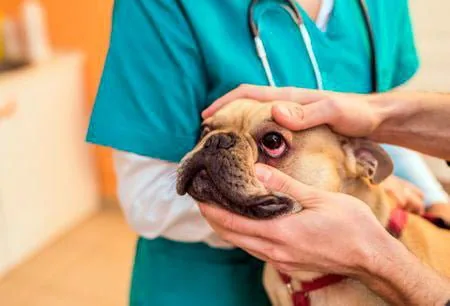
We can understand an ulcer as a deeper abrasion. If the cornea has three layers, the abrasion would affect the most superficial one, while the ulcer would reach the middle and inner layers. Most originate from trauma, but others are linked to different diseases such as diabetes, hypothyroidism, or eye disorders.
The ulcer is very painful. We'll notice the affected eye tearing intensely. The dog will rub the eye and won't tolerate light. It's important to see the vet even if we don't notice the eye looking dull or blurry, since in small ulcers, this damage may not be visible to us but will have the same negative consequences for the dog.
Just as with abrasions, they stain when fluorescein drops are put on them. Ulcers can become complicated to the point of losing the eye. That's why it's essential to see the vet clinic without delay. Treatment is similar to that for abrasions, though it usually needs to be given for longer.
When medication isn't able to resolve the ulcer, surgery will be needed. In this case, there are several options, notably suturing the third eyelid over the eye to protect it while the ulcer, which the ophthalmologist will have already debrided, heals. Lenses serving the same function can also be placed.
In the most severe cases, the eye's contents will come out through the ulcer. This can be seen as a kind of bulge or a lighter area within the cloudy area caused by the ulcer. If we notice these signs, we need to tell the vet immediately. This is an emergency that needs to be resolved with surgery. Otherwise, the dog will lose the eye.
Applying Eye Medication
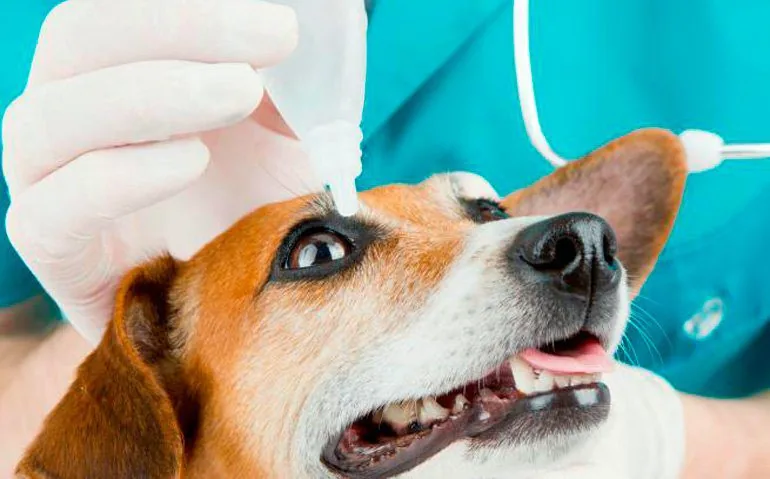
The vet will basically prescribe eye drops or ointments. To apply them, we need to keep the dog still. If we're alone, we'll hold it against our chest and, with our index finger and thumb, keep its eye open and its head tilted slightly upward. With the other hand, we'll apply the eye drops.
If we need to apply an ointment, we'll start from the same position, but instead of keeping the whole eye open, we'll gently pull down the lower eyelid with our thumb. It's in that space that we'll deposit a small amount of the ointment. We'll close the eye and give it a gentle massage to make sure it spreads.
IMPORTANT: This article is for informational purposes only and does not constitute veterinary, nutritional or behavioural advice. Every dog is different, and only your trusted vet can advise you on its specific needs.