 Care
Care
Frisian Water Dog
This breed, of uncertain origin, is called the Wetterhoun in English-speaking countries, meaning 'water dog' in Frisian. Historically, they've been used as hunting dogs, adapting to different hunting styles. So, they've been used as duck retrievers and otter hunters (Otterhound).
It's little known outside its native Netherlands, where the official breed standard was registered in 1942. 17 years later, in 1959, the breed was officially recognized by the International Cynological Federation (FCI). Due to the care it requires and its somewhat independent temperament, it's not suitable for inexperienced owners or elderly people.
Characteristics of the Frisian Water Dog
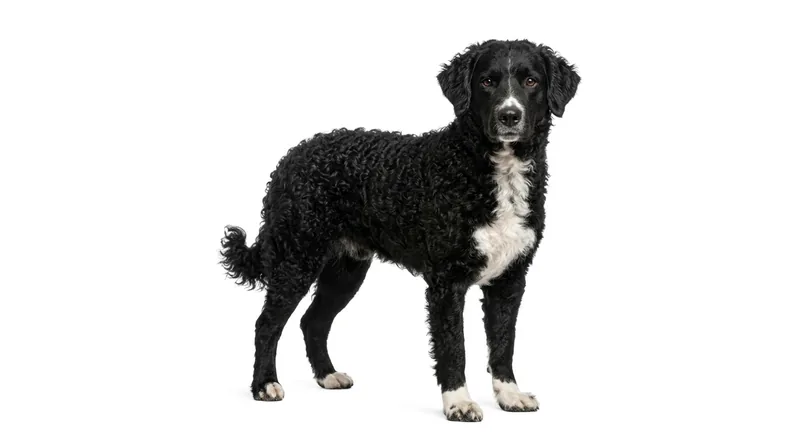
Medium-sized, they show off a sturdy, square build. Their chest is wide, and their back is straight and short. Their skull is domed, and the stop (the naso-frontal depression) isn't very pronounced. You'll notice their flat ears, covered in long, curly fur. Their tail is long, and they carry it curled at hip height or to one side.
Height: males measure between 57 and 61 cm at the withers, while females range between 53 and 57 cm.
Weight: males reach 20-25 kg. Females are around 16-20 kg.
Coat: it's semi-long, very coarse, dense, curly, and somewhat oily to the touch due to the protective substances that waterproof it. It covers the whole body except the head and legs, where it's shorter. The predominant colors are black, brown and white, or blue and white.
Character: brave, intelligent, and a bit stubborn — that's the Frisian Water Dog. They tolerate being left alone if trained that way from puppyhood, but enjoy time spent with their family. Due to their tendency to follow their instincts freely, they need firm owners who train them from a young age.
Health: the most common conditions in this breed are those affecting the joints, like hip dysplasia. Epilepsy and ear infections are other illnesses to watch closely for.
Life expectancy: on average, they live between 12 and 14 years.
Temperament of the Frisian Water Dog
As working dogs, they show strong intelligence and a pronounced protective instinct. They won't hesitate to alert you to an intruder's presence with barking, since they're wary of strangers (but never aggressive). Although not especially playful, they enjoy playtime with children.
They're equally intelligent and stubborn. So, they're not suitable for those just starting out with dogs. You'll need a good dose of firmness and discipline to prevent attempts at dominance. Positive reinforcement in the form of treats will help solidify progress.
They appreciate human company, but tolerate being alone without developing anxiety. That said, in return, you should reward them with outdoor outings, even more so if they can swim during the day. With early socialization, they'll get along well with other dogs and cats.
What Care Does the Frisian Water Dog Need?
To keep a Frisian Water Dog healthy and happy, it's essential to provide a good amount of daily physical activity. They need to feel useful and burn off their built-up energy. Otherwise, they become destructive and disobedient. They're not suited to being confined to a city apartment.
They need outdoor activities and contact with nature. Also, shedding is moderate — you can manage it by brushing a couple of times a week. Don't bathe it unless strictly necessary. Frequent baths could reduce its coat's protective properties.
Ear hygiene to prevent infections, along with a varied diet with proper protein, fat, and essential amino acids, is essential for its wellbeing. Amino acids will support its muscles, while joint supplements will care for its joints. Due to its tendency toward gastric torsion, it should eat once a day.
Breed History
Its origin is somewhat uncertain. It's believed to have emerged in northwestern Europe, specifically in Friesland (Netherlands), where it was used as a hunting and guard dog. It was brought along on hunts to retrieve waterfowl, and later to hunt otters thanks to its skill in the water.
Fun Facts About the Frisian Water Dog
Did you know this breed has a unique morphological trait? It's the curly fur covering its ears, which gets longer the closer it is to the base of the ears. In fact, this is a trait often used to test a dog's purity. Interesting, right?
IMPORTANT: This article is for informational purposes only and does not constitute veterinary, nutritional or behavioural advice. Every dog is different, and only your trusted vet can advise you on its specific needs.