 Breeds
Giant Schnauzer
The Giant Schnauzer isn't a dog for everyday owners — it's an athlete with a firm character that demands leadership, purpose, and real partnership. Bred for long days of herding and guard work on farms in southern Germany, today it remains an exceptional guardian and a companion that repays every hour of dedication many times over. If you're looking for a dog that combines strategic intelligence, absolute loyalty, and a presence that commands respect, this breed deserves your full attention.
What the Giant Schnauzer Is Like
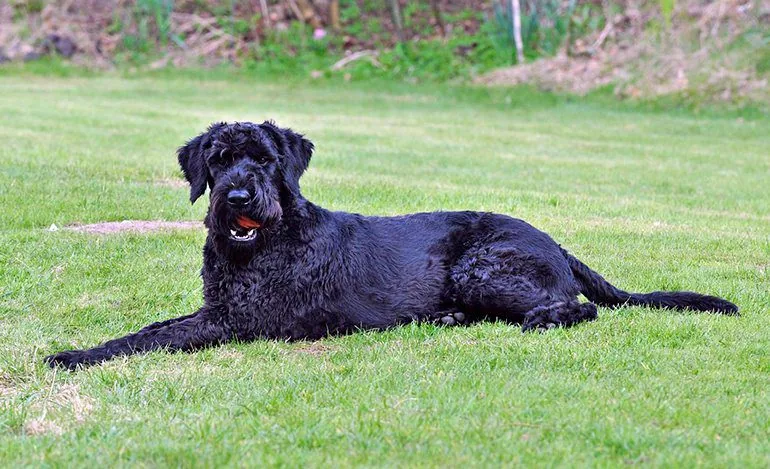
The Giant Schnauzer has a square, muscular build, where power never comes at the expense of agility. According to the official American Kennel Club standard, males stand between 65 and 70 cm at the withers and weigh 27 to 48 kg, while females fall between 60 and 65 cm and 25 to 34 kg. Life expectancy runs around 12 to 15 years, a notable lifespan for a dog of its size.
The coat is one of its trademarks: a hard, dense, wiry-textured outer coat combined with a soft undercoat that insulates against cold and damp. Accepted colors are solid black and salt and pepper, the latter showing a gradient of grays from dark steel to light silver. The head, elongated with a well-defined stop, is framed by thick eyebrows and a prominent beard that heighten its alert, penetrating expression.
Where Does the Giant Schnauzer Come From?
The breed was born on farms in Bavaria and Württemberg during the 19th century, when farmers needed an all-purpose dog that could both drive cattle and defend property. To achieve this, they crossed pinscher-type dogs with sturdy working breeds such as the Bouvier des Flandres and the Great Dane, aiming for stamina, size, and a well-balanced temperament.
Its main job was driving livestock: it escorted cattle and sheep to market over long distances, and at nightfall turned into a relentless farm guardian. Unlike other herding dogs, it never specialized in a single task, which shaped its legendary versatility. Official recognition came in the 1920s with the standard set by the German Pinscher-Schnauzer Club, which fixed the traits that today distinguish the giant variety from its Standard and Miniature cousins.
As farming became mechanized, the Giant Schnauzer lost its rural job, but its intelligence opened new doors. It reinvented itself as a protection, search, and rescue dog, and also as an active member of families who understand its need for structure and purpose.
The Giant Schnauzer's Temperament
We're talking about an alert, confident dog with a mind of its own that surprises people who don't know the breed. It doesn't need to resort to aggression to deter threats: its sheer presence and its ability to size up situations make it a natural guardian. That mental firmness calls for an owner with experience and consistency, capable of setting clear rules without resorting to harshness.
Its loyalty to family is extreme and binding: once you earn its trust, you have a protector that won't hesitate to step between you and any threat. That same intensity, however, calls for early, ongoing socialization, since it tends to be reserved with strangers and dominant with other dogs if it isn't taught how to handle encounters.
At home it's a watchful but calm dog, as long as it's had the physical and mental exercise it demands. Boredom is its worst enemy: a Giant Schnauzer without stimulation can become destructive or develop obsessive behavior. With the right guidance, on the other hand, it displays a resourceful intelligence and dedication to work that few breeds can match.
Traits Only the Giant Schnauzer Has
Few breeds can claim to have successfully worked three such different jobs — herder, guardian, and companion — without losing their essence. The Giant Schnauzer keeps its driving instinct intact: out in the field, it still shows a tendency to guide and gather people or animals, a trait that sets it apart from other pure guard dogs.
Its facial expression is another one-of-a-kind trademark. The combination of beard, mustache, and arched eyebrows isn't an aesthetic quirk, but a working tool inherited from its ancestors: the thick fur protected the muzzle from vermin bites and thorny vegetation during long treks. Today that natural mask gives it a solemn, almost human expression that fascinates fans of the breed.
It's also one of the working breeds that has best adapted to city life without losing its character. Unlike other giant breeds, it keeps a learning ability and mental sharpness that let it excel in dog sports like Schutzhund, agility, or tracking — disciplines where its size takes nothing away from its precision.
Care and Health of the Giant Schnauzer
The hard coat needs specific upkeep: weekly brushing alone isn't enough, since it also needs hand-stripping every few months to remove dead hair and preserve the wiry texture that protects the skin. A scissor cut ruins the coat's quality and removes its insulating function, so it's best to visit a professional groomer experienced with the breed.
On the health front, the Giant Schnauzer can develop hip dysplasia, hypothyroidism, and certain eye conditions such as progressive retinal atrophy. A lesser-known but documented issue is selective intestinal cobalamin malabsorption, a hereditary condition that prevents proper absorption of vitamin B12 and can cause serious deficiencies if not diagnosed in time. This is documented in a scientific study from the School of Veterinary Medicine, which identified this condition in young dogs showing weakness and stunted growth, underscoring the importance of screening in responsible breeding lines.
Daily exercise is non-negotiable: this is a dog that needs at least an hour of intense activity, combining long walks with obedience games, tracking, or controlled running. Without that physical and mental outlet, it builds up tension and can become reactive. Diet should be adjusted to its activity level, with high-quality kibble that supports its muscle mass without encouraging weight gain, especially during its growth stage, when its joints are most vulnerable.
IMPORTANT: This article is for informational purposes only and does not constitute veterinary, nutritional or behavioural advice. Every dog is different, and only your trusted vet can advise you on its specific needs.