 Breeds
Hachikō: The Story of a Loyal Dog
Known worldwide thanks to the movie "Hachi: A Dog's Tale," Hachikō has appeared in numerous shows and video games. It's no wonder: his story has captivated millions of people, and he's one of the most famous dogs to have ever lived.
But what's the real story of Hachikō? In this post we'll explain why he's so popular, what Hachikō was like, and where his remains are now, along with other fun facts about this loyal dog.
Finally, we'll tell you about other cases similar to Hachikō's that have happened in different countries, including Spain. Will you join us on a trip back in time to 1923? We'll explain why in just a moment.
A Story Straight Out of a Movie
In November 1923, Hachikō, an Akita Inu, was born on a farm near what is now the Japanese city of Odate. He was adopted by Professor Eisaburō Ueno, who received him at Shibuya Station after a grueling two-day train journey.
Hachikō arrived very weak, and Ueno cared for him devotedly. Before long he had recovered and became inseparable from the professor, walking with him every day to the same station to see him off and welcome him home from work.
This same scene repeated almost daily until May 1925, when the professor died of a heart attack while teaching a class at the University of Tokyo. Ueno never came back to the station, and Hachikō stayed there waiting for him for almost ten years.
His presence didn't go unnoticed by the locals, who took care of him until he died of terminal cancer in 1935. He was 11 years old, and by then had become very well known in Shibuya.
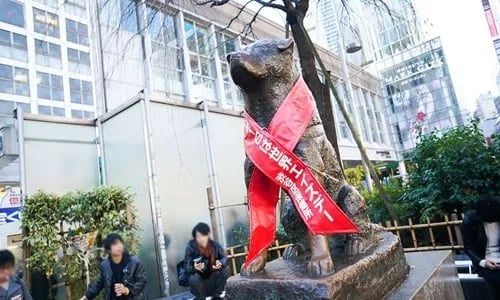
A statue was even raised in his honor, and he also starred in a film directed by Seijiro Koyama. His story was such a success that in 2009, the well-known American remake was released, starring Richard Gere: Hachi: A Dog's Tale.
Five Fun Facts About Hachikō
As you can probably imagine, Hachikō's story is full of anecdotes and fun facts. Let's look at some of the most interesting ones:
1. The meaning of Hachikō. Wondering whether this name means something? The answer is "yes." The name Hachikō is made up of two Japanese words. "Hachi" means "eight," and that's what Ueno decided to call his canine companion, because his front legs were slightly bowed, similar to the Japanese kanji used to represent that number. "Kō," on the other hand, translates as "loyal," and it's the nickname the locals gave to Hachi.
2. Where Hachikō's statue is located. The original bronze statue of Hachikō was melted down during World War II to make weapons. However, a replica was erected again in 1947 at the busy Shibuya crossing. Today it's a very popular meeting spot. There's also a statue of Hachikō at Odate Station.
3. Hachikō Day. Hachikō's fame in the region was such that every March 8th, in front of Shibuya train station, he's remembered in a special way.
4. What Hachikō looked like. As for his appearance, we know he was a large, sturdily built dog with a light-colored coat. Specifically, he was an Akita Inu, a breed native to Japan.
5. What happened to his remains? After Hachikō died, his body was buried at the foot of Professor Ueno's grave, in Aoyama Cemetery, in Tokyo. It was later taken to the National Museum of Nature and Science of Japan.
Surprised by all these facts? You probably understand a bit better now why Hachikō and his story have become part of pop culture. Beyond Koyama's film and the Richard Gere remake, we've seen references to this famous dog in shows like Digimon Adventure and Ghost Sweeper Mikami, as well as in video games like The World Ends With You and Shin Megami Tensei: Imagine. His story is incredible, though similar cases have been documented in several other countries.
Other Cases of Loyal Dogs Like Hachikō
Among the best-known stories of loyal dogs is that of Greyfriars Bobby, a Skye Terrier who stayed by his caretaker's grave in Scotland for 14 years. Besides him, in Italy there's the case of Lampo, "the traveling dog," with a story very similar to Hachikō's.
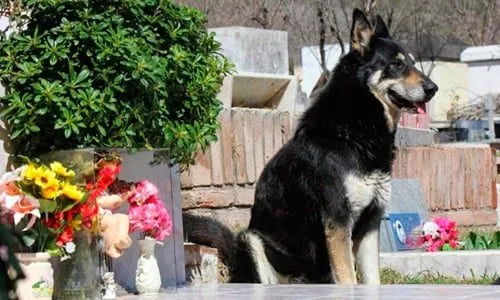
Leão in Brazil, Gaucho in Uruguay, and Capitán in Argentina also have equally amazing stories. And do we have one in Spain? We sure do: Canelo's, in Cádiz. This dog spent 12 years near the entrance of the hospital where his human companion passed away. Today, Canelo has a bronze commemorative plaque on a street named after him. As the saying goes: a dog is a man's best friend. And Hachikō is proof of that.
IMPORTANT: This article is for informational purposes only and does not constitute veterinary, nutritional or behavioural advice. Every dog is different, and only your trusted vet can advise you on its specific needs.