 Care
Care
How Do Dogs See the World?
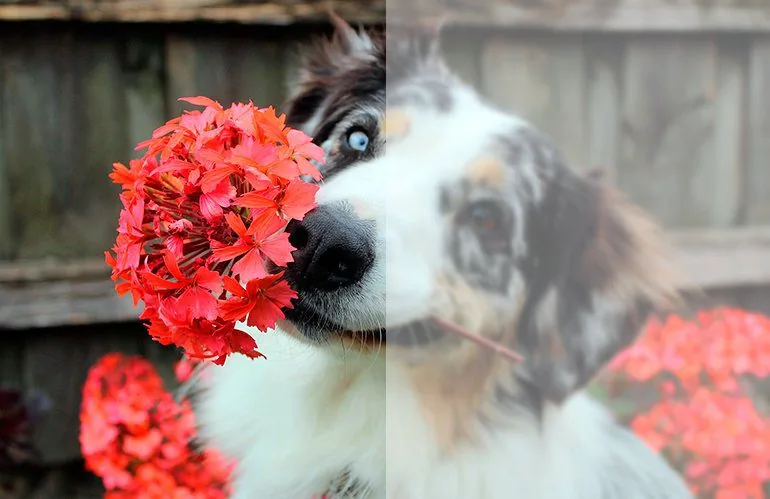
You've surely wondered at some point what your dog's vision is like. Especially since for a long time, the widespread idea was that dogs could only see in black and white. But the truth is, science has shown this isn't the case.
Although canine vision isn't as detailed as ours, and they can't perceive as many colors, they have other traits where they outdo us. On top of that, any shortfall is made up for by their other highly developed senses.
Dogs Are Nearsighted
Dogs seem to be somewhat nearsighted, a condition that worsens with age. Their eyes don't adjust well to the different distances objects can be at. This is explained by their ciliary muscles, which change the lens's shape to allow this focusing, not being very strong.

Dogs See in Color
The canine retina has some particularities that set it apart from the human one. It's a layer of photoreceptor cells that converts light into electrical impulses, carried from the optic nerve to the brain. The retina contains a small number of cones, cone-shaped cells that detect color.
In dogs, they can tell apart blue, yellow, and gray, but they lack photoreceptors for red and green. They only have two types of cones, instead of the three humans have. That's why their color perception is comparable to that of colorblind people.
So, dogs are able to detect some colors, but not as many as people. It seems their cones focus on perceiving different shades of gray. Keep in mind that colors have relatively limited importance to them.
A Dog's Field of Vision
Dogs stand out for their wide field of vision. Generally, we can say it covers around 250 degrees. Narrow-headed dogs, like Greyhounds, reach 270 degrees. We're limited to 180. This lets them successfully track moving objects. They're more sensitive to movement than we are, but less to detail.
This can explain why, if we're standing still at a certain distance from them, they might not seem to recognize us. In that moment, for a dog, it's truly as if we were invisible. To identify us, or any other animal or object, they'll need to rely on their other senses, like smell.
Your Dog's Smell and Vision
Dogs make up for their vision's shortcomings with their other senses. For example, as soon as they spot another dog, their nose kicks into gear before their eyes do. Remember, although imperceptible to us, every dog has a particular scent that helps other dogs process all the information they need to recognize it.
Sex, stage of the reproductive cycle, or whether it has any illness are part of the data a dog identifies as soon as it gets the chance to closely sniff another dog. The anal glands are responsible for releasing this unique scent, which is why two dogs greet each other by sniffing each other's rear ends.
Can Dogs See in the Dark?
Dogs have a good number of rods in their retina, cells that detect light. They're especially useful for black-and-white vision in low-light situations. Together with cones specialized in telling apart shades of gray, this lets a dog see much better than us when there isn't much light.
This is explained as a result of adapting to their life cycle, since dawn and dusk were their peak activity times. On top of that, in dim light, they have another advantage: the tapetum lucidum. This is a light-reflecting layer at the back of the eyes that helps amplify the image. It's what makes their eyes glow in the dark.
Dogs also have large pupils. The pupil is the round opening at the center of the eye. But seeing better than us in low-light conditions isn't the same as seeing in total darkness, which is another myth circulating around canine vision.
The Importance of Vision in Dogs
Besides all the canine vision traits we've covered, lastly, dogs have decent binocular vision — the ability to combine two images into one — though it's inferior to ours.
They also have some depth perception. Either way, let's not forget they can make up for any shortfall with their more developed senses: hearing and smell. Realize that for human beings, sight is basic, and we base our perception of the world on it.
But that's far from the case for other animals. In fact, their worlds are quite far removed from our understanding. For a dog, the world isn't seen — above all, it's smelled.
Bibliography Ateuves No. 3. 2016. Do Dogs See in Color or Black and White? p. 39. Carlson and Giffin. 2002. Dog Owner's Home Veterinary Handbook. Madrid: Editorial el Drac. Morris, Desmond. 1988. Dog Watching. Barcelona: Plaza & Janés.
IMPORTANT: This article is for informational purposes only and does not constitute veterinary, nutritional or behavioural advice. Every dog is different, and only your trusted vet can advise you on its specific needs.