 Nutrition
How Long Does It Take a Dog to Digest Food?
A dog's digestive process starts in its mouth and ends when it passes stool. In this article we're going to run through what happens along that route, bearing in mind that there can be differences depending on the food being digested.
That's why we shouldn't lose sight of how important the choice of our dog's menu is. The diet will determine not only the quality of the nutrients but the digestive process itself, since its ingredients will be more or less usable.
The Stages of a Dog's Digestion
Once the dog eats a food, the process of digesting it, making use of its nutrients and expelling its waste begins in the oral cavity. There the teeth, tongue and salivary glands are responsible for forming the bolus, which is moistened and swallowed. This bolus passes through the oesophagus, a tube in which contractile movements take place.
These carry it to its destination in the stomach, where digestion will begin. The next step in this process is the small intestine, which starts at what's known as the duodenum. After that, the journey continues in the large intestine, also known by the name of colon.
Once all the nutrients in the food have been taken up, the waste products end up in the rectum and, finally, at the anus. Besides the organs mentioned, others are fundamental to digestion, such as the pancreas, the gall bladder and the liver. This process is, understandably, complex, and it will take the body many hours to complete.
How Long Do the Stages of Digestion Last?
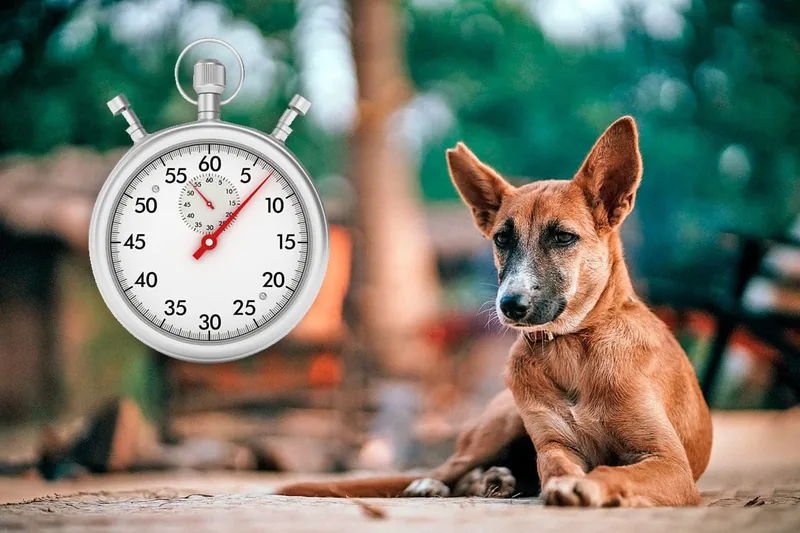
Food the dog has eaten is thought to be able to stay in the stomach for up to about eight hours, although there will be considerable variation depending on the food in question. After that, it would still have to pass through the intestines. In the small intestine the various digestive juices break the food down.
The result is amino acids, fatty acids and carbohydrates. Travelling through this part of the digestive tract can take up to eight hours. This is where nutrients and 80% of the water are absorbed into the bloodstream. Fibre and any substances that couldn't be digested, on the other hand, continue on their way to the large intestine.
It's here that the remaining water is concentrated and the faeces are formed. In general, adding up all the steps in the process, it's calculated that on average, around 36 hours after eating, the remains of the food end up turned into excrement. But, we'll say it again, this varies a great deal depending on the food offered.
Factors That Alter Digestion in Dogs
Although we've given approximate timings for the various stages of digestion, the time can change, not only because of the type of food we offer the dog but also because of its own condition. Age, for example, has an influence. It's known that older dogs have slower gut transit.
On top of that, dogs with a very sedentary life will also have slower digestion. Exercise supports good bowel function. Finally, hydration also matters. Without enough water we can end up with stools that are too hard and difficult to pass.
The Basics of Canine Nutrition
The process of digestion is always the same, but there will be differences between the various foods we give the dog depending on their characteristics. This makes clear how important the quality of the food is. For example, the dog, being the carnivore it is, will need to base its diet on animal protein.
It can come from meat or fish, but what matters is its quality, because that will have an effect on digestion. The same goes for carbohydrates, since some aren't very digestible for dogs. For all these reasons it's recommended to offer a quality menu, which is what will guarantee a digestible, balanced composition.
It will also cover all its nutritional needs at any stage of life. That's why a higher-quality food produces a smaller amount of faeces and those stools will be better formed, since the digestive system will make better use of it. For this reason, dogs will need to eat less of this kind of food.
Digestion and Diets for Dogs
Since each menu will have particular features that affect the digestive process, it isn't only important to look for quality food. You need to know that each diet will have its own digestion times. That's why mixing foods isn't a good idea.
In other words, if we want to give it kibble and tinned food, for example, let's not put them together in the same bowl. It's better to give them separately. This applies to any mixture we might think of making.
It isn't that it will cause an illness, but it's better to support digestion by letting the body absorb over the time it needs. For example, if we give it a BARF diet with bones, these take longer to digest than a cooked food where prior treatment has made the nutrients easier to reach.
Bibliography Carlson and Giffin. 2002. Manual práctico de veterinaria canina. Madrid. Editorial el Drac. Fogle, Bruce. 1995. The Encyclopedia of the Dog. London. Dorling Kindersley.
IMPORTANT: This article is for informational purposes only and does not constitute veterinary, nutritional or behavioural advice. Every dog is different, and only your trusted vet can advise you on its specific needs.