 Nutrition
How Much Food a Dog Needs Daily
Keeping our dog at their ideal weight is an essential factor in avoiding health problems. If we overfeed our pet, they will put on weight and become prone to joint problems, diabetes and other conditions.
That is why it matters to control the amount of kibble they eat each day. But how do we know what ration to give them? Let's dig into the world of canine nutrition to find out how much our dog should eat.
What Defines Proper Nutrition?
Proper nutrition is nutrition that gives the dog every nutrient they need in the right amount, and enough energy to keep their bodily functions going (digestion, breathing and so on) and carry out their everyday activities.
What Nutrients Does a Dog Need?
There are 5 types of nutrient needed for a dog's body to work properly:
- Protein
- Carbohydrates or sugars
- Lipids or fats
- Vitamins
- Minerals
Water is essential for life, though it is not classed among the nutrients.
How Much of Each Nutrient Does a Dog Need?
A dog has to eat a minimum amount of each of these nutrients daily for their nutritional needs to be covered. This amount is known as the RDI (Recommended Daily Intake).
The RDI is the level of intake of a nutrient that appears adequate to cover the nutritional needs of practically every healthy dog.
Pet food manufacturers formulate kibbles so that eating the ration set out on the packaging guarantees the RDI for every nutrient.
Kibbles labelled as "complete food for dogs" cover every nutritional need of the animal they are intended for. So there is no need to add any supplement to them.
What is more, kibble labelling has to specify what type of dog it is intended for, age in particular. There is food for puppies, for adults and for senior dogs, and their composition differs since nutritional needs vary at each stage of life.

How Much Energy Does a Dog Need at Rest?
The energy or calories a dog needs to carry out their basic bodily functions is known as RER (Resting Energy Requirement). This is the energy they burn simply by being at rest.
The Resting Energy Requirement can be worked out with a mathematical formula, knowing the animal's weight:
RER = 30 x body weight (kg) + 70
How Much Energy Does a Dog Need for Their Everyday Activity?
Dogs are not always at rest, and they need energy for other activities such as walking, playing, running… The amount of energy needed to cover the pet's total activity is known as MER (Maintenance Energy Requirement).
MER varies with age, activity level and the animal's physiological state (whether they are pregnant, neutered, unwell…).
There are formulas that let us calculate the average needs for each type of dog, but we need to remember that an individual animal's requirements can vary significantly from these general estimates.
- Puppy up to 4 months: MER = 3 x RER
- Puppy from 4 months to adult: MER = 2 x RER
- Non-neutered adult: MER = 1.8 x RER
- Neutered adult: MER = 1.6 x RER
- Active dogs: MER = 2-5 x RER
- Inactive dogs: MER = 1.2-1.4 x RER
How Much Energy Does Each Food Contain?
The nutrients that provide energy are fat, sugars and protein:
- 1 gram of fat provides 9 kilocalories
- 1 gram of carbohydrate provides 4 kilocalories
- 1 gram of protein provides 4 kilocalories
Knowing the proportion of each nutrient in the food and applying these calorie figures per nutrient, we can estimate the energy a kibble contains per 100 grams.
Knowing the food's energy content and how much energy a dog needs, we can work out how much kibble they should eat.
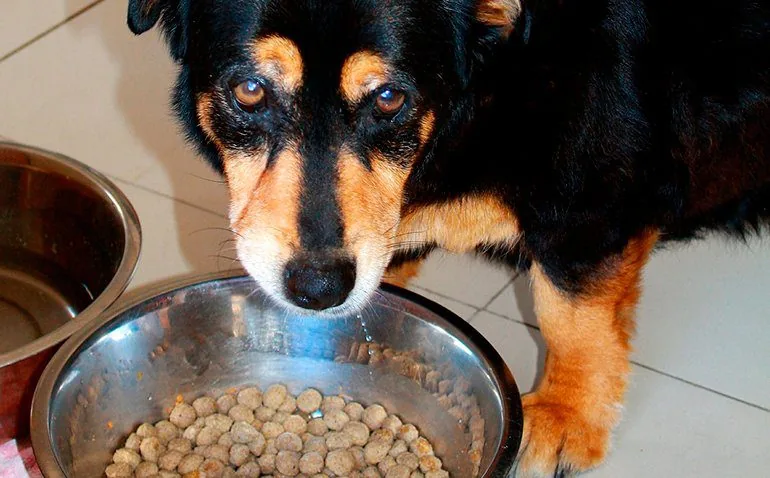
How Much Food Should a Dog Eat?
Kibble manufacturers carry out even more complex calculations and run a series of feeding trials with animals, to determine more precisely the ration that guarantees proper nutrition.
For this reason, it is advisable to follow the manufacturer's guidance to set the amount our dog should eat.
We have mentioned, though, that there are individual variations, so small adjustments to this recommended ration may be needed depending on each particular dog's characteristics.
How to Know if Our Dog Is Eating the Right Amount
The best way to know if our dog is getting the amount of energy they need is to assess their body condition and keep an eye on their weight.
If we overfeed our dog, that is, give them more energy than they need, that excess energy will turn into fat and they will put on weight.
If we do not give them enough kibble, they will use their fat reserves to get the energy they need and the dog will lose weight.
When a dog receives a level of energy matched to their needs, they will stay at their optimal weight.
The best person to confirm what our dog's ideal weight is is the vet, so if you notice changes in your pet's weight you should visit them so they can check whether any adjustment to their ration is needed.
Recommended Daily Food Amount for a Puppy
Puppy kibbles contain far more nutrients than adult dog kibbles, given that puppies are in full development and it is absolutely essential to cover all their nutritional demands so they grow up with no deficiencies.
Generally we can find the daily food amount for a puppy on the manufacturer's packaging, classed as "Puppy" or "Junior". But if you are still unsure, or it is not stated, you can go by these amounts and increase them if your puppy is losing weight, or reduce them if they are gaining too much.
- Puppies up to four months old: 2.5% of their body weight
- Puppies over four months old: 1.8% of their body weight
Recommended Daily Food Amount for an Adult Dog
With adult dogs we need to be even more precise if anything, since depending on their habits we will need to use a high-energy kibble or a maintenance kibble. That way we can cover their calorie expenditure without them losing or gaining weight.
We will find the recommended amounts on each manufacturer's packaging; even so, we can get an idea by following this guidance:
- Adult dogs with normal activity: 1.6% of their body weight
- Adult dogs with reduced activity: 1.4% of their body weight
Remember you should split their daily ration into several meals, to keep their stomach from being overworked by one large intake of food. What is more, working dogs will need specific high-energy food, while older dogs will need "senior" or "low-calorie" food.
IMPORTANT: This article is for informational purposes only and does not constitute veterinary, nutritional or behavioural advice. Every dog is different, and only your trusted vet can advise you on its specific needs.