 Care
Care
How to Care for Newborn Puppies Without a Mother
If we come across an abandoned litter, it's natural to have questions about the care they're going to need. In this SoyUnPerro article we'll explain the keys to helping them survive with the help of our vet.
The importance of temperature
Before we even worry about feeding the puppies, it's essential to keep them at the right temperature. If these little ones get cold, they won't eat, and their life will be at risk as a result.
When dogs are born, they're not able to regulate their own body temperature. This means they'll take on whatever temperature their surroundings are. With their mother, this isn't a problem, since the litter will always stay pressed against her, keeping them at her body temperature.
When we find the puppies without their mother, we're the ones who need to provide them with a proper temperature. To achieve this, it's important to set up a sheltered, dry, warm, and protected spot for them. We also need to check the temperature of their food so it's neither cold nor so hot that it burns them.
A good crib
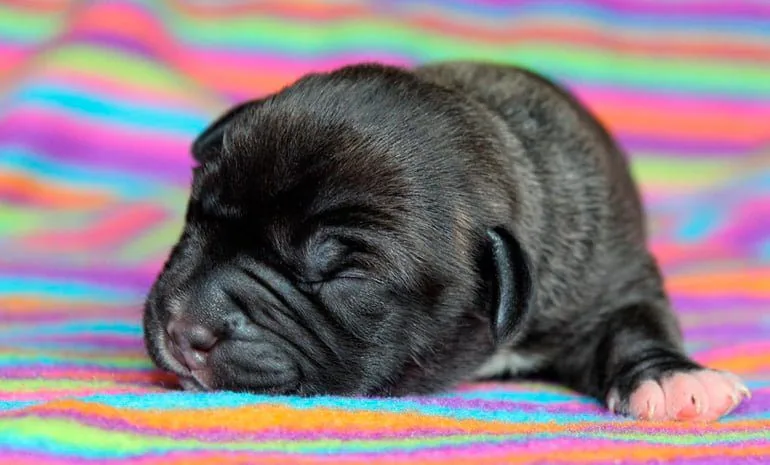
Newborns spend almost every hour of the day sleeping and will only wake up to feed. It won't be until 2-3 weeks old that they'll start interacting with their surroundings. They'll open their eyes and play with their littermates, if there are any.
But until those first few weeks pass, they'll need a calm place to rest. Puppies aren't toys, and they need peace and quiet with minimal handling to develop in a healthy way.
A cardboard box big enough to hold the whole litter lying down together, but close to each other, will work well as a crib — we don't want a box so big that the puppies can sleep apart from each other. Direct contact helps keep them warm.
Inside the box, place a somewhat thick fabric, like a blanket or towel. It shouldn't be too fluffy, since the puppies could suffocate in it. On top, it's essential to add a puppy pad. This will let us absorb any secretions and, crucially, keep the little ones dry.
Under the blanket and pad, we can add some newspaper, which provides warmth. It's important to keep the box closed, or with only a small opening, and to place it somewhere warm and sheltered from drafts. We should only take the puppies out to change the pad, feed them, and stimulate them to relieve themselves.
A diet suited to puppies
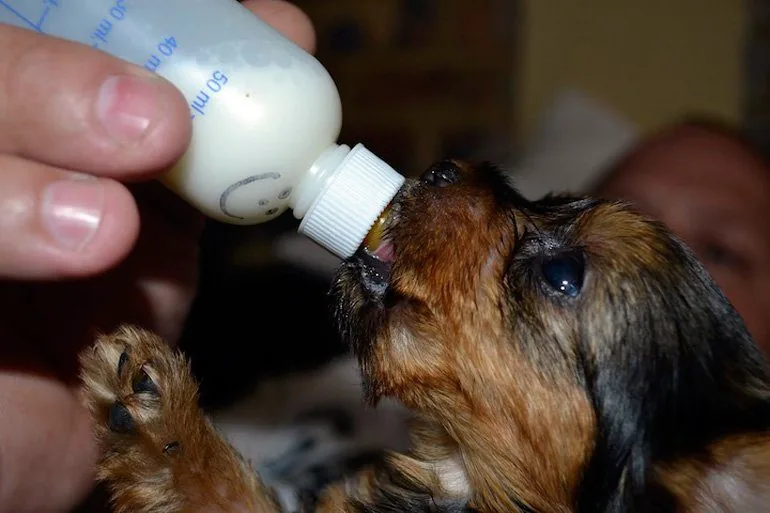
Dogs are mammals, and as such, their food during the first weeks of life will be exclusively milk (specifically formulated for puppies). Without their mother, the safest bet is to turn to milk replacer formulas sold at veterinary clinics. These are specially formulated for dogs and are a safe option.
They come as a powder to be mixed with hot water. The amounts, along with a suitable bottle, are included in each package. In the bottle, add the amount of powder indicated by the manufacturer and, following the same instructions, add the water.
We should heat or boil the water before adding it to the bottle. Then all we need to do is shake and serve. Before offering it to the puppies, we should test the temperature on the inside of our wrist to make sure it won't burn them. At first they'll eat every 2-3 hours.
The bottle should never be given the way it is to human babies. Instead, we should hold the puppies from underneath, with one hand, resting against our chest, letting their back legs rest on our lap so their position is almost vertical. It's best to place a puppy pad underneath in case, from the contact, the little one urinates.
Do puppies urinate on their own?
Mother dogs, besides feeding their puppies, also take care of their hygiene. By licking the genital area, they stimulate the puppies to pass feces and urine. Without their mother, we need to take over this function.
To do this, we'll use a cotton ball or gauze soaked in saline solution or warm water. Acting like the mother's tongue, we'll wipe it over the genital area. The puppy will usually relieve themselves after each feeding. Once they're done, we'll dry them off, to prevent them from getting cold.
Puppies can also urinate or defecate while inside the box, stimulated by contact with their littermates. That's why it's important to use puppy pads, to prevent them from staying wet. As the litter grows, besides spacing out feedings, they'll start moving around and will eventually be able to relieve themselves on their own.
Puppy growth
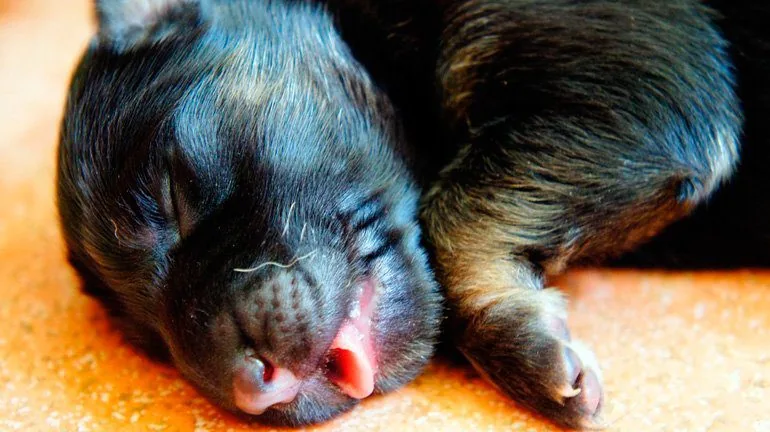
Newborn puppies will have their eyes closed, and you'll be able to see a stump of umbilical cord on their belly, left after their mother cut it at birth. This stump falls off within a few days.
Their eyes will start to open around eight days old. About a week after that, the puppies will take their first steps. Once they reach four to six weeks old, whether or not their mother is present, we can start offering them solid food, while still continuing with milk, at least until they're a month old.
Warning signs
We can't stress enough that raising an orphaned litter isn't a game. Puppies are very vulnerable, and it's not always easy to get them to eat. Many will also be weakened from not having been able to nurse, or because their mother wasn't in the best condition at the time of birth.
This vulnerability means that, at any suspicion of a problem, we should go to the vet immediately. Within a matter of hours, the puppy could die. Signs we should watch out for include the following:
- The puppy stops eating or eats very little
- They feel cold to the touch
- They adopt an abnormal posture, limp, without muscle tone
- They're not urinating or defecating, or, on the contrary, have diarrhea
- The navel is swollen, warm, red, painful to the touch, or has pus
- The puppy is dehydrated
IMPORTANT: This article is for informational purposes only and does not constitute veterinary, nutritional or behavioural advice. Every dog is different, and only your trusted vet can advise you on its specific needs.