 Care
Care
How to Do the Heimlich Maneuver on a Dog
Ideally, our dog should always be seen by a vet for any health problem, but there are times when, faced with an emergency, we need to act quickly to save its life. This is the case, for example, with choking, which can cause suffocation within a short time.
In this Soyunperro article, we'll show you the basic first aid you should practice and the steps to follow to perform the Heimlich maneuver. Knowing this information could save your dog's life at a given moment.
Signs for an Emergency Response
Before panicking, we need to detect whether our furry companion is actually suffocating, meaning it's unable to breathe due to choking from swallowing a foreign object blocking its airway — in other words, we need to rule out coughing, dyspnea, or other respiratory problems. Choking can be partial, if the foreign object still allows some air through, even with difficulty, or complete, when it fully blocks airflow.
In cases of suffocation, our dog will become very nervous, since it won't know what's happening to it and will feel scared. It's also common for it to paw at its mouth insistently. All these signs can tell us our dog is suffering an episode of suffocation and that we need to step in to help it breathe normally.
How do we achieve this? One of the most effective techniques is what's known as the Heimlich maneuver, a procedure that helps clear the airway of a blocked foreign object and prevent suffocation from choking. Let's look at exactly what it involves.
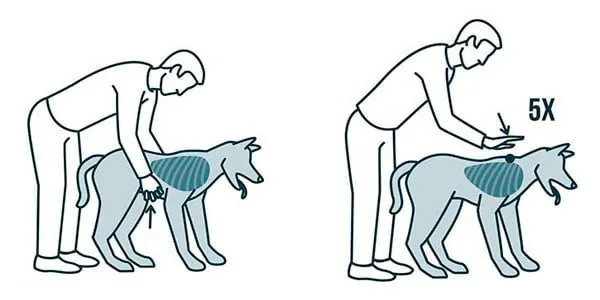
How to Perform the Heimlich Maneuver
First, you need to make sure the dog is actually choking. To do this, open its mouth and check whether it has a foreign object. If you see something in its throat, try to remove it with your fingers or pull its tongue so it spits it out, paying special attention if you spot an object with sharp points or edges, such as splintered bones or needles.
If we can't get the foreign object out, before trying the Heimlich maneuver, try to get the dog to expel it on its own. If the dog is small, you can hold it by the hips and turn it upside down. If it's large and heavy, you can try lifting its hind legs while it stays supported on its front legs, as if you were pushing a wheelbarrow.
If the choking persists, we'll carry out the "Heimlich maneuver," first described in 1974 by American doctor Henry Heimlich (hence its name) for use in humans.
To perform it correctly on dogs, you need to follow a series of steps. Don't forget your friend will probably be quite upset, so be careful when you put your hand in its mouth, since it could bite you simply out of nervousness.
- First, place its back against your chest and clasp both hands just below its ribs. Then, with your hands clasped, press inward and upward 5 times. For a large dog, position yourself behind it, wrap your arms around it (always below the ribs), and perform this same movement.
- If the problem persists, place it in a sitting or standing position and give it another 5 sharp taps between the shoulder blades with the side of your hand. While performing the maneuver, keep checking its mouth to see if it's managed to expel the object. Keep going with the steps mentioned until you manage to get the foreign object out.
- If your companion becomes unconscious, we need to check whether it's breathing and has a pulse. If we don't detect a pulse and it's gone into cardiopulmonary arrest, CPR will be necessary, giving 5 rescue breaths along with 5 chest compressions, continuously, until the object comes out. As soon as its airway is clear, check its heart rate and breathing rate.
If necessary, continue CPR and take it to the vet urgently. Even if you're scared too and don't have much first aid experience, when a situation like this comes up, it's important to act quickly and try to stay calm.
It's impossible to predict when an accident like this will happen, but knowing how to respond properly can make all the difference. In addition, there are some tips that can reduce the risk of our dog choking.
Tips to Prevent a Dog From Choking
The truth is we can't be watching everything our adventure companion puts in its mouth all the time, but there are certain recommendations worth keeping in mind. One is that dogs often choke on rubber balls that are too small (we need to make sure they have a large enough diameter that our dog can't swallow it), bones, or other objects. So, a good measure is not to keep this type of item within its reach.
It's also worth keeping in mind that dogs tend to chew very little when they eat. Because of this, it's better to give them chopped-up food or food we know they'll be able to swallow without difficulty.
Equally important is recognizing whether a cough is due to partial choking or a respiratory illness such as laryngotracheitis or kennel cough. Keeping these points in mind, along with some basic first aid knowledge, will give your pet much better odds of getting through a scare like this.
IMPORTANT: This article is for informational purposes only and does not constitute veterinary, nutritional or behavioural advice. Every dog is different, and only your trusted vet can advise you on its specific needs.