 Care
Care
How to Eliminate Fleas in Newborn Puppies
Fleas are external parasites as unpleasant as they are common in our dogs. Visible with the naked eye, we shouldn't just eliminate the ones we find on the animal — it's essential to deworm the environment too.
We'll find products sold for fighting fleas, but not all of them can be used on puppies. In addition, these need to be dewormed within their first weeks of life. Let's take a detailed look at how to do it.
How Do I Know If My Puppy Has Fleas?
Fleas are insects a couple millimeters long, which means we can see them on our dog's body or around our house. They have a flattened body, black or reddish in color, and well-developed hind legs. These let them jump great heights for their small size.
On the dog, they move by running across the skin, moving quickly between the fur thanks to the shape of their body. So, if we spot an insect with these characteristics, we'll know our dog has fleas.
On the other hand, since it's not always possible to see them, finding a kind of black grit on our dog's body or resting spots is another indicator of fleas. This grit is flea droppings. If we wet it, we'll see it's dried blood, since they're blood-feeding parasites.
Symptoms of Fleas in Puppies
If we haven't managed to see the fleas or their droppings, the classic sign of their presence is scratching, since their bites cause itching. Either way, in case of doubt, only the vet can confirm or rule out the diagnosis, since other problems, such as mange, can also cause intense itching.
In addition, some dogs are sensitive to flea saliva, which can trigger what's known as flea allergy dermatitis (FAD). These dogs will show, especially over the tail area, red dots and hairless patches from intense scratching.
If untreated, this eventually worsens, with wounds, thickening, and darkening of the affected skin. A single bite is enough to trigger this reaction. In addition, a considerable flea infestation can cause anemia in a puppy. Fleas also transmit parasites such as tapeworms and diseases such as bartonellosis.
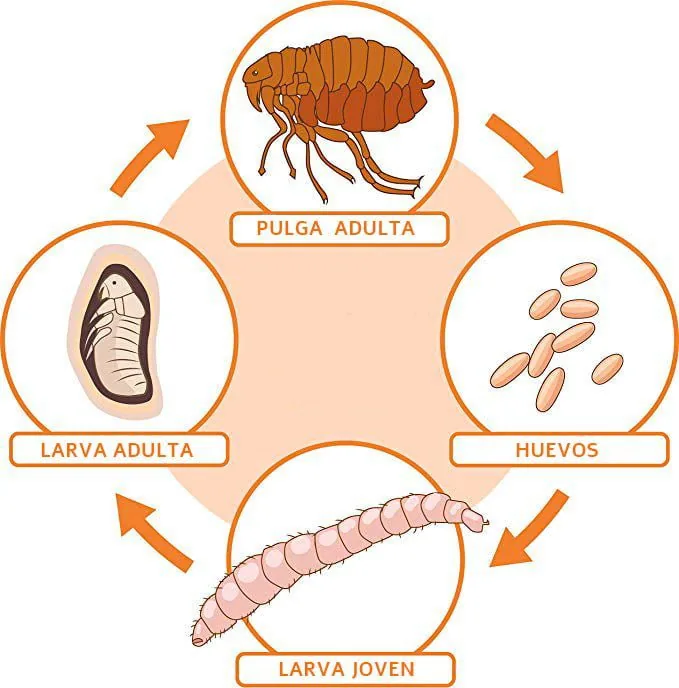
The Flea Life Cycle
To fight fleas, it's essential to know and understand their life cycle. This way, we can put the most suitable measures in place. Adult fleas feed on dogs, cats, or any other warm-blooded animal, including humans. Females, on the other hand, will lay their eggs in the environment.
Beds, cracks, or any tiny space will serve as a nest for the eggs. Larvae hatch from them and feed on any organic matter they find, as well as skin debris. Only once they mature do they bite again and climb onto an animal.
Given how many eggs fleas can lay, if we only treat the puppy and forget about the environment, within a very short time we'll have a whole new generation of hungry little fleas that will keep the infestation going. If the dog is protected, they'll bite us instead. And nothing protects 100%.
Products for Deworming Puppies
The star product for ridding puppies of fleas is spray, which generally works against fleas, ticks, and lice. It's applied in a well-ventilated place, protecting our hands with gloves, and spraying several times until the whole body is well soaked. While the puppy dries, it needs to stay somewhere warm.
But whether we can use it depends on the puppy's age and the manufacturer's recommendations, which will tell us, on the label, from what age it can be used. The spray also isn't a comfortable option if our dog, even as a puppy, is large-sized. That's why it's best to check with the vet.
Let's not forget that anti-parasite products, although anyone can buy them online, are veterinary products. The vet, based on our puppy's characteristics, can recommend using anti-flea spot-ons, pills, or collars. Whichever is chosen, it's essential to renew it at the indicated frequency.
Don't Forget to Eliminate Fleas From the Home
Since most fleas will be growing in the home, applying an anti-parasite treatment to the dog alone isn't enough. Unless the infestation is really severe, in which case what's known as a fogger would be indicated, measures like these will work:
- Deworm the puppy and every animal it lives with. Repeat the process as many times as the vet indicates.
- Run a special metal comb with fine, close-set teeth through the animal's body. This tool traps any fleas that might still remain.
- Wash bedding and other resting spots in the washing machine.
- Thoroughly vacuum floors and carpets.
- Mop floors, including under furniture, with an insecticidal product, soaking them well and letting it work.
Bibliography Carlson and Giffin (2002): Manual práctico de veterinaria canina. Madrid: Editorial el Drac.
IMPORTANT: This article is for informational purposes only and does not constitute veterinary, nutritional or behavioural advice. Every dog is different, and only your trusted vet can advise you on its specific needs.