 Care
Care
How to Empty a Dog's Anal Glands
Every dog has anal glands, which help lubricate its anus so that when it does its business, everything comes out more or less easily. And although that's their main function, the truth is these curious glands have many other important functions we'll detail below.
Generally, it's never necessary to empty a dog's anal glands, since they normally empty on their own. But sometimes, they don't empty, and this causes our dog a lot of discomfort. Let's look at how these glands should be emptied, explained step by step.
What Are Anal Glands and What Are They For?
Every dog has these glands in its anus, one on each side of the anus. They can't be seen with the naked eye, but if we feel around a little, we can notice a kind of "small ball" on each side of the anus. They're roughly the size of a chickpea, though obviously the dog's size influences this a lot too — the bigger the dog, the bigger its glands.
Inside, these glands contain a dark yellowish fluid that smells really bad, like rotten eggs or even worse. These glands' main function is lubricating the dog's anus when it defecates, and under a microscope, we can also see shed cells from the perianal epithelium in their contents.
This fluid's bad smell is so particular that each dog has its own, like a fingerprint. When a dog meets another, normally the first thing it does is sniff its butt… a way of knowing what its anal gland fluid smells like, to tell whether it recognizes this dog by its stool — interesting, right? Afterward, they usually sniff each other's private parts, to recognize each other by urine. They mainly use smell, and we should remember that.
Naturally, during defecation, dogs empty the contents of these glands, but there are cases, mainly in very constipated dogs, where we need to do it manually, since inflammation of these glands can cause a lot of pain and symptoms such as:
- It frequently licks, scratches, or nibbles at its anus.
- It drags its rear along the ground in a "scooting" position — this position can also occur in cases of parasites.
- Loss of appetite and restlessness.
- It may have an unusual smell, really quite unpleasant.
- Swelling and pain accompanied by whimpering when touched.
- Palpable anal sacs.
How Should I Empty My Dog's Anal Glands?
The first thing you should know is that if you have no experience or don't feel confident doing it, you can see a vet. They're used to doing this and can show you how, so in the future you can do it yourself at home.
When dogs don't empty their glands naturally, they need to be emptied manually once a month. Not every month will have the same need, and it's possible that over time they'll start emptying naturally again.


The steps to follow to empty a dog's anal glands are:
- Choose an open space or a room where you can mop the walls — the contents sometimes come out with a lot of pressure and can stain and leave a very unpleasant smell.
- Put on thin latex gloves, to work hygienically but with good feel.
- Ask another person for help, to hold the dog while you do the emptying.
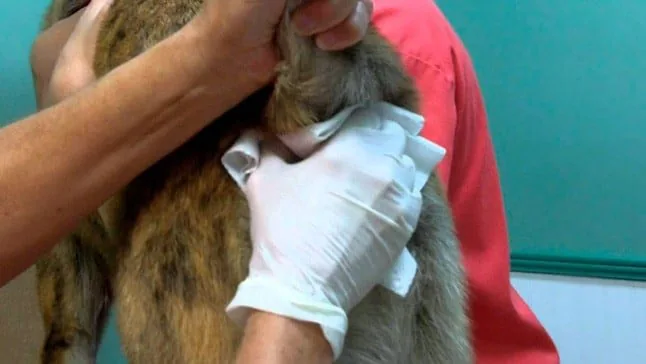
- With your open hand, run it over the perianal region tracing a horizontal line as you go, and slide your fingertips until you locate two spherical structures on each side of the anus.
- Gently, pull them a little outward while lifting up. This is the way to push the fluid they contain toward the anus so it comes out and they empty.
- The fluid can come out under pressure — don't position yourself right in front of it. The fluid will be dark yellowish with a very unpleasant smell — this is normal.
- It's recommended to use some gauze to prevent the fluid from spraying everywhere….
As we all know, it's much better to see it done to learn how, so here's a video for you (it's in English, but just watch how it's done and how the fluid comes out).
If our dog whines, it's possible we're hurting it by squeezing too hard or not doing it right. If it's in a lot of pain because the area is inflamed, maybe the best option is to have a vet do it the first time, and you the rest, if needed (remember, only once a month).
IMPORTANT: This article is for informational purposes only and does not constitute veterinary, nutritional or behavioural advice. Every dog is different, and only your trusted vet can advise you on its specific needs.