 Training
How to Play With a Puppy and When to Do It
Every puppy loves playing. They hugely enjoy playing with their littermates, with other dogs, cats and, of course, with their owners. Playing isn't just fun — it helps the puppy develop future skills.
That's why it matters that we devote time to this activity and give them toys. Even so, we can also make the most of play as an ideal moment for learning.
The Importance of Play for the Puppy
Around four weeks old, puppies start playing with each other and with their mother. These interactions help them get to know their own body and their limits. If we get the chance to watch a litter, we'll see these first games are gentle and fairly clumsy. Before long they'll extend to different objects or toys.
Puppies will use their mouth and their little teeth to grab toys and defend them from their littermates. They'll bite each other, gradually gauging how hard to bite based on how much it hurts. When a puppy yelps, the other learns they've hurt them and can't bite that hard.
We'll see play sessions are short and repeat many times throughout the day. Play lets the dog learn new behaviours, interact, keeps them fit through exercise, stimulates them, gives them self-confidence and, very importantly, strengthens the bond between dog and owner.
My Puppy Bites Me While Playing — Should I Allow It?
This is one of the main problems we can run into while playing with our puppy. As we've seen, for them it's normal to play using their mouth. It's entirely natural, and they don't do it to hurt us, so we shouldn't punish them for it. Even so, we should act the way another dog would.
So, we'll stop the game immediately. We can yelp, without overdoing it, to make clear that when they hurt us, the fun stops. This way we teach them to gauge the strength of their bite and prevent it being dangerous to play with them once they grow up, out of fear of a bite. Once they're calm, we'll play again.
It's true some owners are scared of facing these bites, even during play. Even so, it matters to let this behaviour happen so we get the chance to correct it. Otherwise the dog won't know how much force hurts, which is what could cause problems in future.
What Are the Best Toys for Puppies?
For playtime to be productive as well as fun, we also need to bear in mind the toys we offer the puppy. There's a huge range of options on sale, so the first thing is checking they're suitable for dogs and safe, that they can't break, and their size is right for the dog.
The basics would be toys for throwing and fetching, such as a disc or a ball, and anything they can chew, with or without noise. If we choose a Kong-type one, with spots for hiding food, besides entertaining them, we help encourage them to use their sense of smell, which is ideal for dogs. Rope tuggers for carrying and pulling are also advisable.
It's a good idea to put toys away and bring them out on rotation so the puppy doesn't get bored, and check them often to remove any that are worn out. By the way, never let them play with slippers or any of our own belongings. They need to tell the difference between their toys and our belongings.
Play Sessions — When Should You Have Them?
We can start playing with the puppy as soon as we notice they're receptive. It's best to avoid too much movement right after eating, if it's very hot, or if it's clear they want to sleep. What's more, sessions should only last a few minutes. The game can be chosen based on each dog's preferences and characteristics.
On another note, we can put away their favourite toy, or one of them, to only bring out on special occasions. We always talk about training a dog using food as a reward, and it's highly effective, but there are other possible rewards, and one of them can be giving them their toy to enjoy for a while.
Object-Hunting Games
We can encourage hunting games using their sense of smell, their most developed sense. This involves hiding a toy, food or even a person to encourage the puppy to search for it. At first we'll go along with them during the search, but they'll quickly understand the idea, and we'll just need to make the search harder over time.
Throwing and Catching Objects
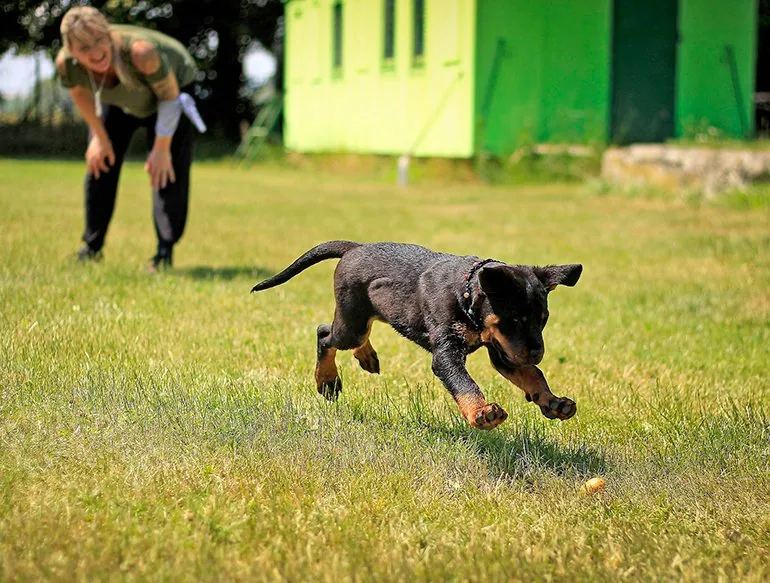
Balls or discs, but generally any toy that can be thrown for the dog to catch and bring back to us, will work for this game. First we'll show them the toy in question and make sure we grab the puppy's attention with it. This way they'll run off to catch it as soon as we throw it.
It's a good exercise for practising obedience commands, such as calling them to come to us or getting them to drop the toy once they reach us. We can throw it further or closer, or use balls with a cord, which can be moved along the ground to encourage the puppy to chase them.
Noisy Toys — Yes or No?
Some dogs literally go crazy for the typical toys that squeak when bitten down on. If this is our puppy's case, besides using them for play, we can save them for special occasions. For example, when we go out on the street, squeezing their toy can help get their attention if they're distracted.
Likewise, if at the vet's a check-up needs doing and they're restless, the noise from their toy can shift their attention away from the vet, making handling easier.
Home-Made Courses for Dogs
Not if the puppy is only a couple of months old, but for older ones, we can set up some obstacles to encourage their skills. For example, making a ramp with a board, a tunnel with fabric over some chairs, a course between buckets and so on. The possibilities depend on our imagination, and the limit is the dog's safety.
IMPORTANT: This article is for informational purposes only and does not constitute veterinary, nutritional or behavioural advice. Every dog is different, and only your trusted vet can advise you on its specific needs.