 Care
Care
How to Stop Your Dog From Eating Trash
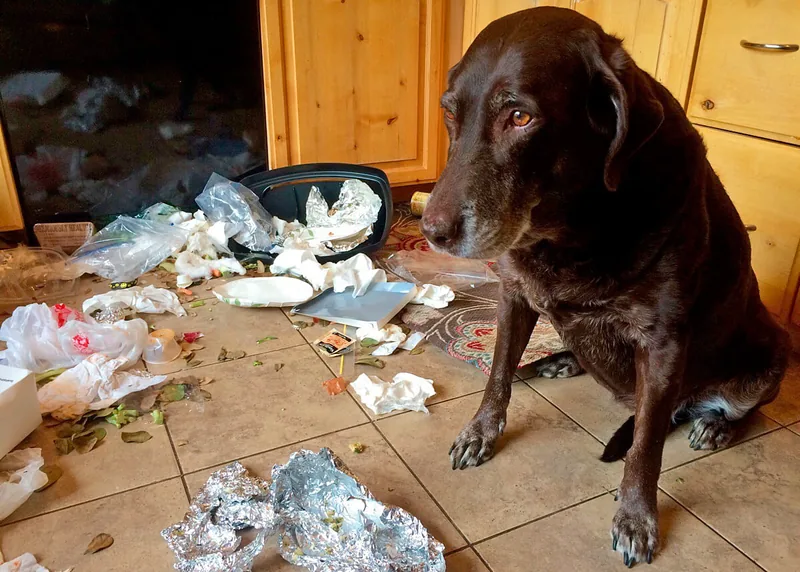
A dog and a trash can are almost always a recipe for problems. That big container full of all kinds of objects, packed with interesting smells, is like a magnet for any dog. Hence its huge appeal.
But we shouldn't just prevent our dog from raiding the trash can to avoid cleaning up garbage all over the house — eating waste also poses a serious health risk. Below, we explain how we can manage this unpleasant habit.
Why Does My Dog Love the Trash?
At first glance, the basis of a dog's interest in our trash can is that food scraps are found inside it. Our food is highly valued by dogs, since we normally don't share it with them, or at least not as much as they'd like. Thanks to their powerful sense of smell, they're able to determine what's inside the can.
But also, spending time opening the can, pulling everything out, examining it, and destroying as much as possible is a great way to pass the time when there's nothing better to do. On another note, some illnesses can also push a dog to look for food in the trash.
In other words, the dog doesn't attack the trash can to annoy us. It's driven by instinct, or there are psychological or physical causes at play that can explain its tendency to search, eat, or destroy trash. Assess your dog's living conditions, since that can help solve the problem.
Dog-Proof Trash Cans
If our dog is drawn to the trash purely out of canine instinct, we might manage to train it not to open it in our presence. But once left alone, it's likely nothing will hold back its curiosity. That's why we'll have no choice but to use every possible means to prevent it from accessing it.
It's our obligation to provide it a safe environment, and we shouldn't forget eating trash can have serious health consequences. So, one way to protect the can is to leave it in the kitchen or on a balcony or laundry room with the door closed, at least when no one's home.
It also helps to put it inside a cabinet with a door it can't open, or choose one of the so-called dog-proof cans that, theoretically, can't be opened. That said, keep in mind some dogs learn to use pedals or lift lids. They usually have plenty of time to figure it out. And this brings us to another important point.
Signs My Dog Is Bored
There are some psychological causes that can push a dog toward the trash can. Although we all know this, it's worth remembering that dogs are social, sociable animals that need our company and stimulation. Depending on their characteristics, they'll need it with more or less intensity.
So, for example, some will need short walks, while for others, plenty of physical activity will be essential. There are also dogs that love playing, versus others that spend the day resting. And we need to factor in age, since puppies are in a stage of active exploration.
If our dog spends a lot of time alone, doesn't get all the exercise it needs, and generally lacks stimulation at any level, the result will be boredom. The trash can, in these cases, becomes its salvation. By adjusting its lifestyle habits, its trips to the can are likely to decrease.
The Risks of Eating Trash
But, besides boredom, some dogs that eat from the trash may be dealing with a health issue. Some illnesses include increased appetite among their clinical signs. The dog, even after devouring its portion, will keep feeling a voracious appetite that'll push it toward the trash can trying to satisfy it.
These are dogs that, even while eating this way, lose weight or show other symptoms like a worsened coat, increased water intake, and so on. Any abnormality we notice in our dog is reason for a vet visit. Only a professional can figure out what's wrong and prescribe treatment.
On another note, the act of eating trash itself can cause poisoning from spoiled food or food unsuitable for dogs. Also, packaging and other waste can cause injuries if sharp, obstructions if they get stuck in the digestive system, and so on. These cases are usually veterinary emergencies.
Tips So Your Dog Doesn't Eat From the Trash Can
To sum up, a dog wanting to dig through the trash can be interpreted as normal behavior for its species. But the risks eating trash poses for it are more than enough reason for us, as responsible caretakers, to do everything possible to prevent it. These are:
- Make sure you're meeting your dog's physical and mental needs. This is the best way to fight boredom and destructive behavior.
- Set a schedule for walks, meals, and other activities. If it knows when it's mealtime, it's less likely to focus on what you're throwing away.
- Train it — through basic training, you can teach it to obey the "no" command, though this usually doesn't work if you're not there.
- Get a dog-proof trash can, or keep it out of its reach.
- See a vet at any suspicious sign of illness, and get at least annual checkups to catch any condition early. If the problem is psychological, a canine behavior specialist or ethologist can help you.
IMPORTANT: This article is for informational purposes only and does not constitute veterinary, nutritional or behavioural advice. Every dog is different, and only your trusted vet can advise you on its specific needs.