 Training
How to Teach Your Dog to Walk Beside You Off the Lead
If you decide to live with a dog, it's essential to bear in mind that training them is a must. It's not about training them to do circus tricks, but they do need to know and follow some basic commands.
Learning makes day-to-day life together easier, and also helps the dog better understand their surroundings, which will reduce their stress. In this article we'll focus on a highly useful lesson: how to teach a dog to walk beside us with no lead.
Basic Dog Training
Regardless of our dog's age, since adults can learn too, there are some basic commands they should know and be able to follow, though other tricks can also be taught, such as the classic paw shake. These are the commands:
- Come, so they respond to our call.
- Sit.
- Stay.
- Lie down
- Heel, the command for them to walk beside us whether or not they're on the lead.
We can use these or other words in different languages. It makes no difference, since for the dog what matters is recognising a sound, and if possible a gesture too, with the action they need to start.
How to Train a Dog Better
The key lies in planning a schedule. We need to pick the commands we want them to learn, then order them by how much importance we give each one. For example, "come" is usually the first one taught, since it's essential the dog comes to us in any situation.
Once we've decided the teaching sequence, we should devote about 5-10 minutes each day to showing the command and repeating it, until the dog manages to take it on board. If we're going to encourage them with food, it's best to start the lesson with the dog not having just eaten. Remember, though, that rewards should never exceed 10% of their daily food ration.
Use healthy foods as a reward, especially if the dog is overweight. And although food is the best incentive, it can be replaced with strokes and words of encouragement. It also matters to end the session on a positive note, that is, always rewarding them. Below we'll see this in practice for the "heel" command.
Get Your Dog to Walk at Heel
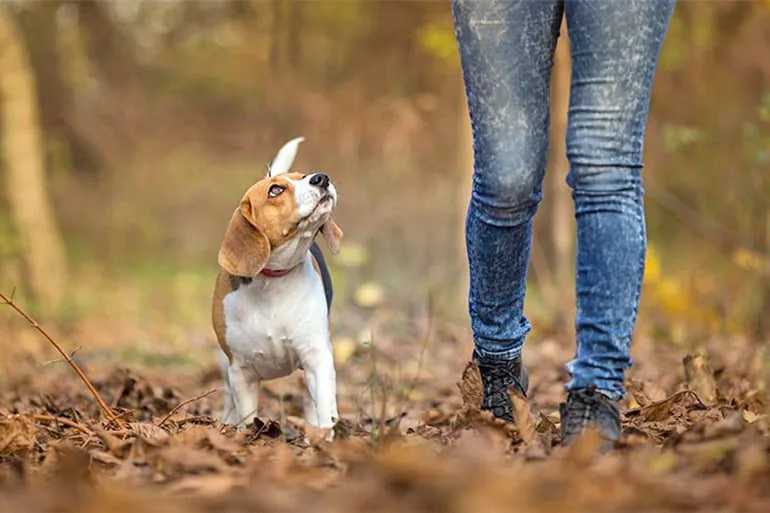
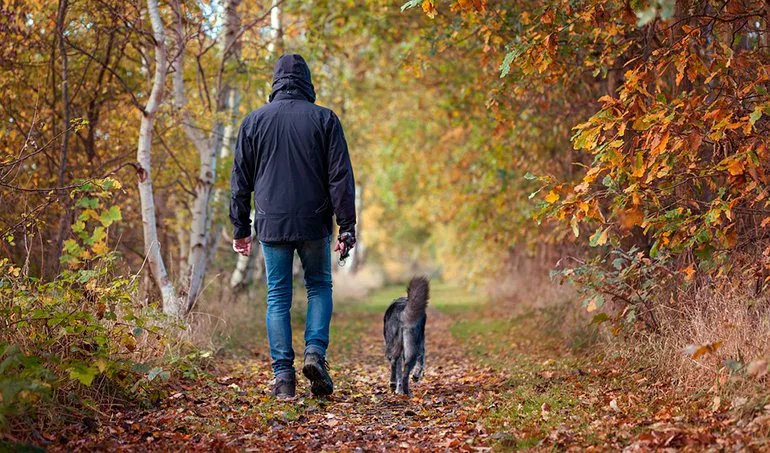
This exercise is very useful, and although it's usual to do it when the dog isn't on the lead, it also works if they have it on. For example, it's very useful to give the "heel" command when, during a walk, we come across another dog and want ours to stay by our side.
We don't need a big space to train. We can teach this and other exercises at home. Even so, during the learning stage there can't be distractions. These will gradually be introduced once the dog already masters the command, with the goal of making sure they can follow it in any situation.
If we choose to practise the exercise outdoors, first we should let the dog have their usual walk. They need to be able to relieve themselves before starting the lesson. Of course, we need to stay calm and positive. We won't get results by rushing or being unkind.
Walking "at Heel" Step by Step
Once conditions are ideal for the lesson, we can start training. It matters a great deal that we always follow the sequence the same way, stay patient, and don't try to rush, since that would backfire. Follow these steps:
- This command starts with the dog on the lead.
- The starting position has the dog sitting next to us, almost pressed against our leg and aligned with it. That's why they need to know "sit" before "heel". It doesn't matter which leg you choose, but you need to always keep them on the same one. They can't cross over.
- At first we'll start the exercise in a straight line. It's a good idea to do it next to a wall, so the dog ends up between it and your body. This way we help them keep the right position.
- Hold them in the desired position with the lead and pressed against you with a piece of food in your other hand.
- Say "heel" clearly and start walking at a calm pace. Since it's best for the dog to learn the instruction with a word and a gesture, you can pair the sound with a tap of your palm on the leg on the side the dog is on.
- If they do it right after covering a few metres, ask them to sit, reward them and praise them enthusiastically.
- Resume the sequence this way until you've done about five minutes, ten at most, though if you see the dog getting distracted, don't force it. Reward them for what they've done, or for doing some other command they already master, and end the session.
Advanced Canine Training
Once the simplest "heel" is mastered, we'll move on to introducing changes. For example, instead of walking in a straight line, we'll add obstacles and changes of direction to the route, which will keep the dog focused on us to follow along.
The goal is for them to respond to "heel" in any situation that comes up in day-to-day life afterwards. Despite the changes, the exercise sequence, the environment, our attitude and so on need to stay unchanged.
Other changes that add difficulty, which we should introduce as the dog progresses, include removing the food as a guide and incentive, walking faster or slower, taking off the lead, or repeating the exercise in busy places or with other dogs around.
Bibliography Schlegl-Kofler, Katharina. La educación del perro por medio del juego. Madrid. Tikal Ediciones.
IMPORTANT: This article is for informational purposes only and does not constitute veterinary, nutritional or behavioural advice. Every dog is different, and only your trusted vet can advise you on its specific needs.