 Care
Care
How to Trim a Dog's Nails at Home
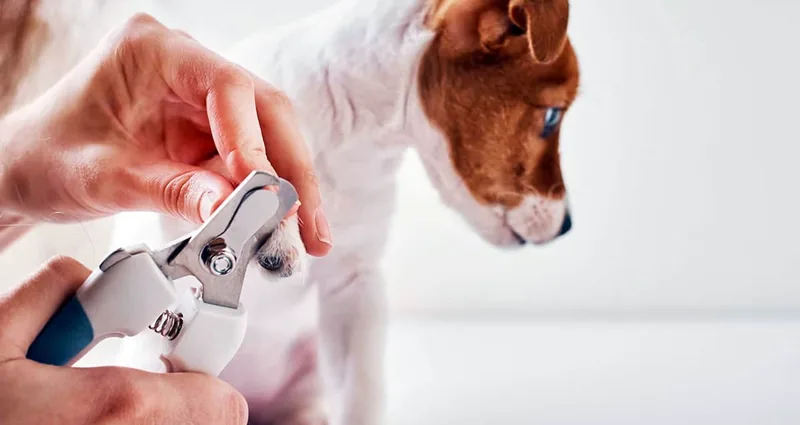
Our beloved pups' nails grow too, the same way ours do. And to prevent the nail itself from causing wounds or breaking accidentally and causing a lot of pain, we need to learn how to trim a dog's nails so we can do it with our own routinely.
There are two clearly identifiable nail colors: white nails and black nails. White nails are much simpler, since we can see how far we can cut, but black nails are much trickier since they don't give us any clues. Even so, let's go over how to trim our dog's nails regardless of their color.
Preparing Our Dog's Nails for Trimming
The first thing we need to learn before cutting anything is where or how far we can cut. Dog nails have a nerve and a blood vessel running through most of their interior, so we can't just cut without thinking, since we could cause our dog a small bleed and pain.
If our dog has white-translucent nails, it will be very easy to see how far the nerve and vessel of the nail reach (the pinker part) and which area we can cut without damaging it. However, if our dog has black nails, we won't be able to see the nerve and blood supply, so it won't be as easy to do.
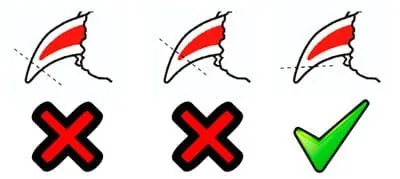
To know how and where to cut, the easiest way is to have someone hold the leg while another person does the cutting with an appropriate dog nail clipper. You shouldn't go past the nerve and blood supply (the pink part) or cut right up against it. We need to leave a few millimeters of clearance. You can see it in the image below.
Starting to Trim the Nails
As we mentioned earlier, some dogs won't let their nails be trimmed because they get nervous. We need to calm them down and even ask for help so someone can distract the dog with a bit of food or games while we do the nail trimming.
If the nails are white-translucent, we can make a horizontal cut leaving a few millimeters from the pink area as we explained, using a special dog nail clipper. These clippers come in different sizes, for small, medium, and large dogs.
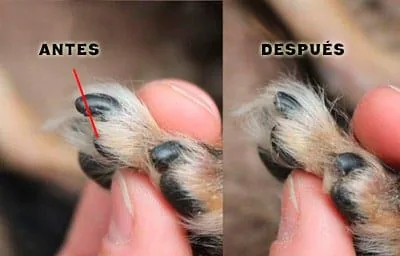
If our dog's nails are black, then we need to cut very gradually, being very careful not to cut into the pink area. Depending on the length of that nail, we'll make a first cut of about three millimeters and check the cut area — if there's no trace of nerve or blood vessels, we can cut again and repeat until the nails are the right length.
If we notice nerves or blood vessels, we'll stop immediately, since we can't cut any further. As for black nails, it's better to leave a bit more nail than usual than to go too far, since we can't see where the nerve and vessel are, and it bleeds quite a bit.
When Should a Dog's Nails Be Trimmed?
Dogs naturally have long nails — most of them don't need their nails trimmed since they wear down naturally outside, on rocks or asphalt.
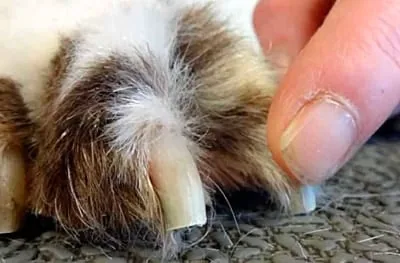
Some dogs don't wear them down, and their nails can grow excessively, even curling on themselves (pay special attention to the side ones, the dewclaws) or getting so long they're prone to breaking, causing pain and a trip to the vet. That's why they should be trimmed routinely.
A trick to help you tell whether your dog needs a nail trim or not is to have it stand up and see if its nails touch the floor. When a dog's nails are in good shape, they shouldn't touch the floor. If its nails touch the floor, you need to trim them until they're right at that level (slightly above the floor). This is a general guideline, since each breed has a different size and won't always follow this rule.
It's important too because the more we let our pet's nails grow, the more that vessel and nerve will grow too, making them longer and longer and more prone to breaking.
What Happens If I Cut Too Much?
With a suitable nail clipper and following the guidelines, there shouldn't be any problem. But sometimes we cut a bit more than needed, affecting the nerve and blood vessel inside the nail. If this happens, our dog will whine because it hurts, and it will also start bleeding from the cut part of the nail.
We need to apply some styptic powder or, as a home remedy, flour. This will help, as much as possible, stop the vessel from bleeding by plugging and clotting the bleeding. Apply a good amount over the cross-section of the cut. That nail shouldn't be touched again, and you should be careful with the rest, since your pet may be a bit annoyed. If after a while it's still uncomfortable or things get worse than usual, it's a good idea to see a vet.
If we're not sure, or our dog is too nervous and won't allow it, or any other circumstance that could pose a danger to our dog, it's best to go to a vet to have the nails trimmed there.
IMPORTANT: This article is for informational purposes only and does not constitute veterinary, nutritional or behavioural advice. Every dog is different, and only your trusted vet can advise you on its specific needs.