 Care
Care
Insulin Doses and Types for Diabetic Dogs
Insulin, just as with humans, is a hormone that serves important functions in a dog's body. That's why its deficiency causes serious problems, such as diabetes, which can also affect this species.
That's why, when a dog develops diabetes, the vet will prescribe treatment based on insulin, which needs to be given to make up for its deficiency. Nowadays, different types of insulin are available, as we explain below.
How Does Insulin Work?
Insulin is a hormone produced by the pancreas, whose job is to move glucose from the blood into cells. When there's not enough insulin, we'll have two basic effects: glucose builds up in the blood, known as hyperglycemia, and cells are left without the glucose they need to produce energy.
These effects are what cause the clinical signs we'll notice in our dog, resulting in diabetes. These can become extremely severe. Hence the importance of seeing the vet and starting treatment, which will be based on giving the insulin the body is missing.
This way, glucose can reach the inside of cells and symptoms are controlled. So, insulin as a drug should only be used for dogs diagnosed as diabetic by the vet and always strictly following this professional's instructions.
How to Inject Insulin to Treat Canine Diabetes
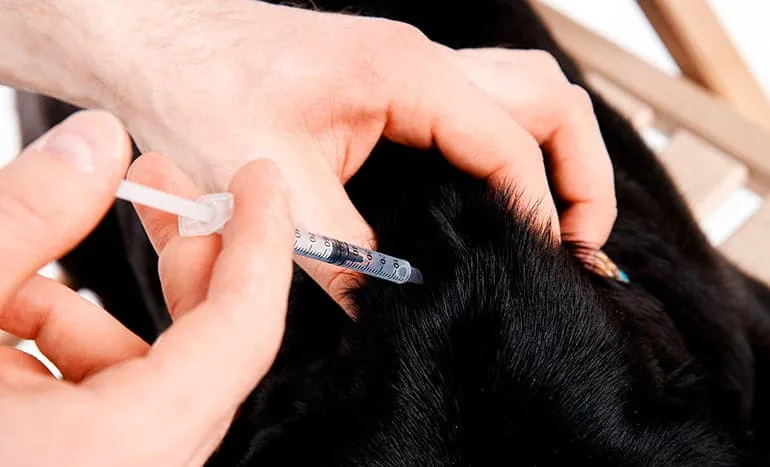
Just as with people, insulin is given as a subcutaneous injection. This means that if our dog is diabetic, we'll need to inject it ourselves at home every day, following the vet's instructions. In addition, insulin needs to be kept cold in the fridge.
On the other hand, insulin injection devices similar to those used in human medicine are sold. They're like pens that make the injection much easier. Sometimes reactions can occur at the injection site. These are generally mild and resolve on their own. Either way, it's a good idea to change the injection site to prevent them.
Types of Insulin for Dogs
You should know that nowadays we can find different types of insulin that differ in how they act. There are five types based on their effect, which is ultra-fast, fast, intermediate, long-acting, or very long-acting.
This is very important information, since it determines the administration schedule. Some are also used in human medicine, but others are specially formulated for the canine species. These are the insulin types available for dogs:
- NPH: this is a porcine-origin insulin, considered intermediate-acting.
- Glargine: this is synthetic and long-acting.
- Detemir: also synthetic and offers long duration.
- Caninsulin: specifically designed for veterinary use, it's intermediate-acting, so it needs to be given a couple of times a day. It's the most used one in veterinary medicine.
- ProZinc: what's special about this insulin is that it has both slow absorption and slow action, providing a long-acting or very long-acting effect, so it can be given just once a day.
What Insulin Dose Does a Dog Need?
If it's always important to adjust doses, in the case of insulin it's essential. The exact right amount needs to be given to regulate the dog. Both a deficiency and an excess pose a serious danger to the animal's health. It's important not just for the vet to prescribe an initial administration schedule, but for follow-up monitoring to be scheduled.
The dog's condition needs to be periodically reviewed, since the dose will very likely need to be adjusted as things progress. Blood and urine tests need to be done. But it's not just the dose that matters — the exact timing of administration needs to be established too, since the injection can be given once or twice a day.
And it needs to be coordinated with mealtime. It's recommended to inject insulin right after eating to adjust the dose based on how much the dog ate. Diet is also essential, since body condition can be affected. The vet will choose the most suitable diet based on whether the dog needs to lose or gain weight.
Insulin Resistance
Keep in mind that what's known as insulin resistance can occur. This means the amount of insulin being given stops achieving the expected effects.
This is due to several factors, such as obesity, treatment with other drugs, other conditions occurring at the same time, etc. In these cases, the vet needs to reassess the dog and adjust the dose again to avoid the risks of uncontrolled diabetes.
IMPORTANT: This article is for informational purposes only and does not constitute veterinary, nutritional or behavioural advice. Every dog is different, and only your trusted vet can advise you on its specific needs.