 Breeds
Irish Setter
Athletic elegance, a mahogany coat that seems to shine in the sunlight, and a contagious vitality define the Irish Setter. Born in Ireland's green, damp lands as a tireless pointing dog, today it's a family companion that combines a hunting instinct with exceptional sociability. Discover everything you need to know to understand and care for this unique breed.
The Unmistakable Look of the Irish Setter
The Irish Setter has an athletic, elegant build, made for endurance across difficult terrain. Under the official American Kennel Club (AKC) standard, males stand between 58 and 67 cm at the withers and weigh 27 to 32 kg, while females fall between 55 and 62 cm with a weight of 22 to 27 kg. Its life expectancy runs around 12 to 15 years.
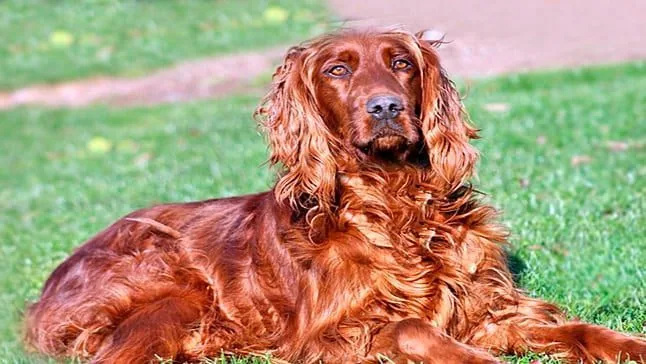
Its coat is its trademark: an intense, uniform mahogany, silky to the touch and medium in length. Longer feathering adorns the ears, tail, thighs, and belly, and only small white markings on the chest, throat, or toes are accepted. That coat isn't just beautiful — it also protects the dog from damp and dense vegetation.
Its elongated head, with a defined stop and low-set ears covered in fine hair, connects to a muscular neck with no dewlap. The deep chest gives it great lung capacity, and its low-set tail, carried level with the back, ends in a characteristic plume. In motion, it projects an image of grace and power with a long, free-flowing trot.
Irish Origin: A Born Hunter
The breed was forged in 18th-century Ireland to work as a hunting dog on wet, rugged terrain. Its job was to locate birds and freeze in place, pointing out their position to the hunter, a technique known as "setting." This skill demanded a fast, hardy dog with an exceptional sense of smell.
Its modern build is the result of selective crosses between red and white Setters, Pointers, and Spaniels, a combination designed to optimize stamina, speed, and search instinct over long days in the field. Over time, selective breeding unified the color and type, and the breed also grew popular at shows and as a companion dog without losing its working abilities.
Temperament: A Sociable Soul
The Irish Setter has a cheerful, affectionate, deeply sociable temperament, a direct legacy of its past as a pack hunter. That historical selection favored a cooperative temperament, attached to both people and other dogs, which makes it an exceptionally friendly companion.
With families it shows notable patience and sweetness. Its pack instinct leads it to fully integrate into household life, always seeking the company of its people. It doesn't handle prolonged loneliness well; if ignored for hours, it may express this through barking or destructive behavior.
It keeps an innate curiosity and a playful disposition well into adulthood. With children it's usually an enthusiastic playmate, though its size and energy call for supervising interactions with young kids. Its high emotional sensitivity lets it pick up on the family's mood, and a stable environment with clear routines fosters a balanced, confident dog.
Unique Details About the Irish Setter
Few breeds keep such a youthful, playful attitude throughout their adult life. An eight-year-old Irish Setter can show the same spark as a puppy, which calls for constant doses of activity and mental stimulation.
Its mahogany coat isn't just for looks: the silky texture and feathering serve a protective function against brambles and damp, a direct legacy of its work in Irish bogs and heathland. The breed also shares a relevant genetic quirk with humans. A scientific study published in the Proceedings of the National Academy of Sciences of the United States of America identified mutations in the PDE6B gene linked to retinal degeneration, a finding that later proved key to developing DNA tests that detect the specific form of progressive retinal atrophy (PRA) found in the Irish Setter.
Essential Care for the Irish Setter
This breed needs plenty of daily exercise: long walks, controlled runs, and scent games are essential for channeling its energy. Without a proper outlet, it can develop anxiety and unwanted behaviors. It's ideal for active owners who enjoy the outdoors.
On the health front, the main concerns include progressive retinal atrophy (PRA), hip dysplasia, hypothyroidism, and bloat, the latter worsened by its deep chest. Regular vet check-ups are recommended, along with specific genetic tests for dogs intended for breeding.
Coat maintenance requires weekly brushing to prevent tangles and remove dead hair, paying special attention to the feathering. The drop ears should be checked often to prevent infection from moisture buildup. With early socialization, a balanced diet, and the affection it craves so much, the Irish Setter will be a healthy, happy companion for many years.
IMPORTANT: This article is for informational purposes only and does not constitute veterinary, nutritional or behavioural advice. Every dog is different, and only your trusted vet can advise you on its specific needs.