 Breeds
Irish Water Spaniel: Temperament, Care and Fun Facts
The Irish Water Spaniel isn't a decorative breed: his curly, oily-textured coat gives him a natural waterproofing that lets him dive into icy water with no external protection, a trait that sets him apart. His history as a water retriever and his physical adaptations explain why he's considered the water dog par excellence.
History and origin of the Irish Water Spaniel
Ireland has plenty of water. Lakes, rivers, marshes, an endless coastline — and for centuries that dictated what dogs were needed there. The Irish Water Spaniel was forged in that environment, selected by hunters who needed an animal able to go into freezing water, retrieve downed birds and come back without a hair out of place. Companionship wasn't what was sought; what mattered was that the dog did the job.
Some link them to Persian dogs that reached Ireland through trade, though documentation from that era is so scarce that little can be stated with certainty. What's beyond doubt is that for generations nobody cared whether the dog was pretty. He was selected for cold tolerance, obedience, mental composure. That pragmatism explains much of his character and physique today.
His official recognition came considerably later than other hunting breeds, and the standard wasn't fixed until well into the 20th century. He's never been a fashionable dog nor set out to be. He remains a breed with a strong presence in Ireland and the UK among those who work with him in water, but practically unknown outside that circle.
Physical characteristics that make him unique
Power and agility. That's the first thing this dog conveys when you see him move. Males run between 25 and 30 kg, females between 20 and 26, and even with that mass they achieve a lightness that's disconcerting. The chest is broad and deep — giving him the stamina to work for hours — the hindquarters are well angulated for pushing hard through water, and the tail is set at medium height, thick at the base and tapering toward the tip, acting as a rudder every time he swims.
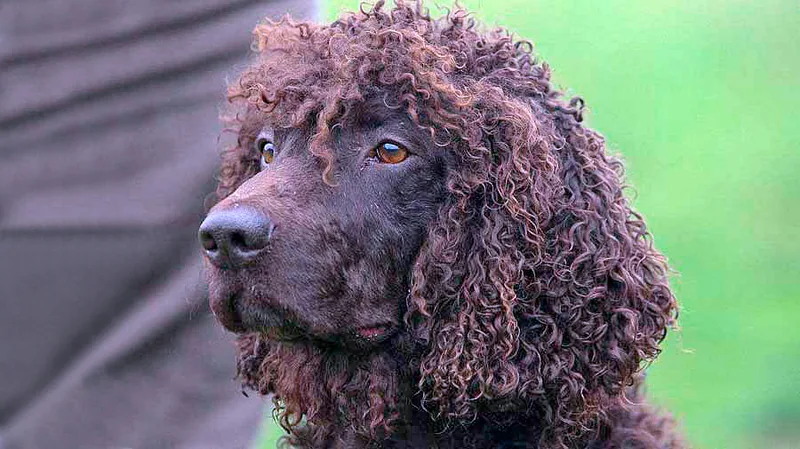
The head is wide, the stop moderate, and the almond-shaped eyes project that alert expression so defining of a working dog. The ears, medium and drooping, are covered in the same curl as the body, protecting the ear canal from water and cold when the animal dives in. The muzzle is strong and proportionately long, suited to retrieving game without leaving marks, with a well-pigmented nose standing out against the dark coat.
But this breed's hallmark is the coat. Tight, dense curls covering the whole body except the face and the front of the legs, where the hair falls considerably smoother. That coat repels water, conserves body heat and protects the skin as the dog pushes through reeds and aquatic vegetation. The colour ranges from darker to deep liver, always uniform, with purplish highlights depending on the light. In Ireland they call him the marsh ghost, and seen this way it makes complete sense.
Irish Water Spaniel temperament and behaviour
A bored Irish Water Spaniel is a problematic Irish Water Spaniel. His history as a hunting dog left him with a level of focus many breeds would envy: he executes complex commands ignoring any distraction, even at considerable distances. Add to that sharp intelligence and an emotional bond with his family beyond the ordinary, and you have an animal who doesn't function if you just park him in the garden. He needs to feel part of something.
His temperament is cheerful, highly energetic, and his attachment to his own people is intense. Too intense, sometimes. If he's left alone for many hours without the mental and physical outlet he needs, separation anxiety can show up and everything that comes with it: destruction, barking, repetitive behaviours. Watch out for this if your pace of life involves long days away from home. He's also not a dog for a first-timer or someone with a calm sofa lifestyle; he needs clear, consistent guidance, and since he's very sensitive, harsh-correction methods affect him more than you'd expect. With positive reinforcement things change completely — exercises like teaching a paw shake or any motivation-based work suit him wonderfully.
With children and other animals he can live without problems, provided socialisation started from puppyhood. Here's the trick: his energy is so overflowing it can be overwhelming for very young children or calm-tempered pets, with no bad intention on his part at all. He tends to pick one or two family members as his main reference points, and gives them unwavering loyalty. With strangers he's reserved until he assesses them and gives his approval, which makes him a natural watchdog who doesn't bark for no reason but misses nothing.
Feeding the Irish Water Spaniel
This breed's nutritional needs vary significantly depending on activity level, age and health status. An active adult individual can need between 1,500 and 2,200 daily calories, preferably split into two meals to optimise digestion and avoid gastric torsion. It's crucial to adjust portions to the actual exercise done each day, since his metabolism is adapted to store energy during periods of high physical demand.
A high-quality kibble formulated for active medium-large breeds is recommended, with protein and fat content suited to his activity level. Omega-3 and omega-6 fatty acids are particularly important for maintaining skin health and the quality of his waterproof coat. Carbohydrates should come from complex sources like sweet potato or oats, providing sustained-release energy with no sharp glucose spikes.
Excess weight should be avoided through regular body condition checks, feeling the ribs under a well-defined layer of muscle. Obesity doesn't just affect his mobility — it worsens any joint predisposition and shortens his life expectancy. At any change in appetite, weight or stool consistency, consult a vet to rule out intolerances or underlying digestive problems.
Weekly exercise plan for an Irish Water Spaniel
This breed doesn't settle for a couple of walks. He needs to genuinely move, and quite a lot. Calm neighbourhood walks fall well short, so it's worth committing to running, retrieving games and training that makes him think. All of that split into two daily sessions, a more intense one in the morning and a calmer one as evening falls.
Two or three times a week he should have access to water where he can swim freely. Swimming works the whole musculature with no joint load, and on top of that connects with something deeply rooted in this breed. If there are no rivers, beaches or pools nearby, a hose or sprinkler can save the day, though the difference from genuine swimming is significant.
A sample plan could look like this: Monday and Wednesday, 45 minutes running alongside a bike plus 20 minutes of scent work; Tuesday and Thursday, an hour of agility and, if possible, 15 minutes of swimming; Friday, a two-hour route over varied terrain; a whole Saturday devoted to water or a long beach session; a calmer Sunday, walk and play at home. With that range of activities he stays entertained and all his physical and instinctive needs get covered.
Keeping this breed's coat in good condition takes consistency. Without a regular routine, the curls mat and skin problems appear that later cost a lot to resolve.
Curly coat care and grooming
Three brushings a week is the minimum, not a suggestion. Use a long-pin comb combined with a natural-bristle brush and always work from root to tip. Never brush dry hair: it breaks. A spray with conditioner diluted in water applied before brushing makes the difference between untangling properly and wrecking the curl.
With bathing, less is more. Every 6-8 weeks is fine, with a shampoo formulated for water breeds that doesn't strip the natural sebum. That sebum is what waterproofs the coat and protects it from cold and moisture; if you remove it by washing too much, the coat is left unprotected. After bathing, dry thoroughly with cold or lukewarm air at medium power, untangling with your fingers as the hair loses moisture. If you let it air-dry on its own, the tangles that form are almost impossible to remove.
Trimming happens every 8-10 weeks. Best left to a groomer who knows the breed, because not just anyone knows how to work the curl. On the body it's left longer; on the legs, ears and around the eyes it's trimmed so the dog can see well and daily cleaning is easier. Watch the anal area: it accumulates residue easily, and if neglected, irritation and infections appear. ‘Studies on the inheritance of hair loss in the Irish water…’ (1999)
Health and hereditary diseases
He's generally a sturdy breed, but shows certain genetic predispositions worth watching. He shows a genetic predisposition to certain dermatological diseases ‘An analysis of factors underlying hypotrichosis and alopecia in Irish Water…’ (2000). This hair loss is usually localised and doesn't cause itching, but it affects appearance and can indicate underlying imbalances.
Hip dysplasia, though less common than in other large breeds, remains a concern justifying X-ray evaluations in breeding individuals. Eye problems like cataracts or progressive retinal atrophy also show up fairly often, with annual check-ups by a veterinary ophthalmologist recommended from age five onward.
Isolated cases of more serious conditions have been documented, such as cutaneous lymphomas ‘Epitheliotropic lymphoma in a dog’ (2000) or perineal cystic hamartomas ‘A perineal cystic hamartoma causing constipation in an intact female Irish…’ (2019), though their incidence is low. Prevention comes down to getting puppies from responsible breeders who run genetic tests on breeding stock and provide transparent health guarantees. Health insurance covering dermatology specialists can be a sound investment given his predispositions.
Keeping him at his ideal weight, giving him appropriate exercise and six-monthly vet check-ups are the best strategies for catching any abnormality early and enjoying his company for many years.
IMPORTANT: This article is for informational purposes only and does not constitute veterinary, nutritional or behavioural advice. Every dog is different, and only your trusted vet can advise you on its specific needs.