 Care
Care
Is the Leishmaniasis Vaccine for Dogs Effective?
Leishmaniasis is a parasitic disease that causes various types of damage to a dog's body. It's also zoonotic in potential. Because of all this, it's essential to follow preventive measures to keep our dog from getting sick.
Among these, a vaccine has been developed in recent years. It's an option worth considering, especially for dogs living in or traveling to areas with a high prevalence of the disease. Want to know all the details about this innovative leishmaniasis vaccine? Let's get into it.
Preventing leishmaniasis
Since leishmaniasis is a parasitic disease transmitted by a vector — in this case, a sandfly — prevention has focused on products that protect the dog from being bitten.
But, thanks to a growing understanding of the immune mechanisms that matter in this disease, new strategies are being developed. These allow dogs to be protected, so to speak, from the inside.
This way, even if the bite can't be avoided, the dog stays protected. These strategies are aimed at both prevention and treatment. This includes the creation of a preventive vaccine.
When was the leishmaniasis vaccine created?
In the late 1990s, the possibility of creating a leishmaniasis vaccine began to be considered. Getting these products to market finally involves a long process of scientific studies and clinical trials. This is why it only reached vet clinics a few years ago.
For example, the first vaccine, CaniLeish by Virbac, wasn't marketed until 2011. More recently, specifically since 2016, Letifend has come into use, a recombinant vaccine created by Leti Laboratories.
Both vaccines contain Leishmania infantum proteins, but the newer one's technology allows greater efficiency with fewer adjuvants. This means a lower rate of adverse reactions and fewer doses needed.
How does the leishmaniasis vaccine work?
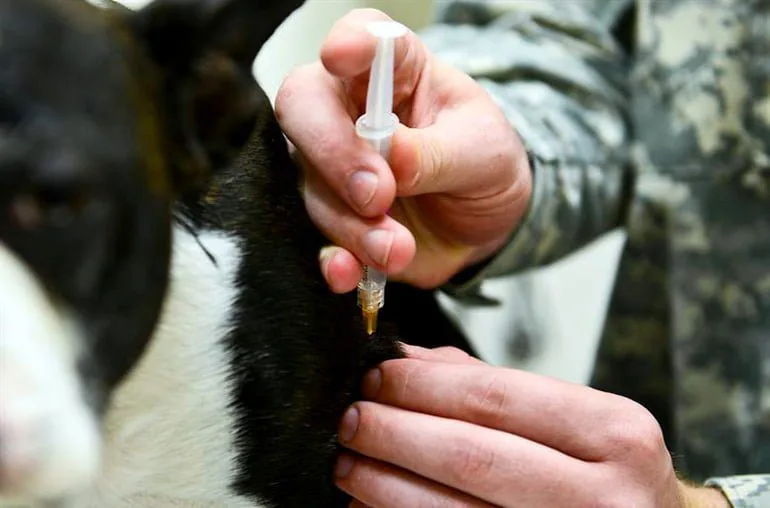
These vaccines don't prevent infection, but they control the parasite's spread in the body and reduce the risk of developing the clinical picture and its potentially serious consequences. In other words, the goal is to make the dog more resistant to the disease. It works like any other vaccine.
It's based on stimulating the dog's immune system response by introducing, in this case, Leishmania proteins that can't actually cause the disease. It's like faking the disease, but without the risks. This generates a specific response from the body against that particular infectious agent, and also creates immune memory.
This produces defenses that would immediately attack the Leishmania parasite if the dog were to come into contact with it. This memory isn't permanent, which is why, to maintain protection, the dose needs to be repeated periodically. Since no vaccine prevents infection entirely, it's essential to also implement preventive measures against the mosquito vector.
Effectiveness and reliability of the leishmaniasis vaccine
When a vaccine is put on the market, it's because a significant efficacy rate has been confirmed. The company that developed it needs to present studies showing scientific evidence of its efficacy. That said, it's possible to find a vaccinated dog who still develops leishmaniasis.
This could be because the vaccine's efficacy wasn't enough to protect them. But it's also possible the dog was already infected before being vaccinated. What's more, Leishmania is a parasite that's hard to control due to the protective mechanisms it's capable of developing.
That's why making a good vaccine is harder than with other infectious agents. It's recommended for dogs living in areas where leishmaniasis is common, or traveling to them, even if just for a trip.
Price of the leishmaniasis vaccine
To find out how much the vaccine will cost, it's best to ask the vet directly. Prices commonly vary depending on where you live. On top of that, pre-vaccination tests and possible booster doses need to be factored in. As a general guide, we can give a figure of between 30 and 40 euros per dose.
When is the leishmaniasis vaccine given?
The leishmaniasis vaccine is indicated for immunizing dogs over six months old. Before giving it, it's recommended to test the dog to check whether they're already infected or not.
That said, it's worth knowing that some of these tests don't have very high sensitivity, so false negatives can occur. The dose needs to be repeated yearly. CaniLeish initially requires three doses, three weeks apart each.
Downsides of the leishmaniasis vaccine
The main one is that the defense mechanism against Leishmania requires developing a type of immunity that's hard to achieve. This means more doses are needed to get any efficacy. It also means using stronger adjuvants, though Letifend improves on these aspects.
Adjuvants are substances added to a vaccine to boost its effect. But they're also linked to the occurrence of adverse reactions. For all these reasons, vaccinating dogs under six months old isn't recommended — these puppies can't develop an effective immune response.
Work is currently underway to improve leishmaniasis vaccines. Possible side effects include itching at the injection site or swelling. With CaniLeish, fever, apathy, or digestive problems can occur. Vaccinating during pregnancy or nursing isn't recommended.
Bibliography Fariñas, Fernando. 2017. Inmunoterapia e inmunoprofilaxis de la leishmaniosis canina. ¿Qué debo saber? Portal Veterinaria. Moreno, Javier. 2016. CaniLeish, una vacuna para la leishmaniosis canina basada en evidencias científicas. Portal Veterinaria. stopleishmania.org Villanueva, S., Loste, A., Marca, C., and Fernández-Casasnovas, A. 2016. Toma de decisiones terapéuticas ante los resultados laboratoriales en leishmaniosis canina. Portal Veterinaria.
IMPORTANT: This article is for informational purposes only and does not constitute veterinary, nutritional or behavioural advice. Every dog is different, and only your trusted vet can advise you on its specific needs.