 Care
Care
Main Allergies in Dogs, Causes, and Treatment
Allergies seem to be becoming more and more common in dogs. An allergy is an exaggerated reaction from the body upon contact with food or some environmental component that, in principle, shouldn't be seen as a threat by the immune system.
The main symptom of an allergy is itching. The most common allergies in dogs are those caused by flea bites, inhaled allergens, and those caused by different foods. Want to know the main allergies that can affect your dog?
What Is an Allergy?
An allergic or hypersensitivity reaction is one triggered by what's called an allergen, which can be any substance. For it to occur, two exposures are usually needed.
The first is what causes the immune system to generate antibodies. The second is the allergic reaction mediated by antibodies and producing histamine. The organ most often affected in dogs' allergies is the skin.
Hence why the characteristic symptom is intense itching. In the following sections, we'll explain the most common allergies in this species. It seems some breeds are more prone to them than others.
Symptoms of Allergy in Dogs
The clinical picture will vary depending on what's causing the allergy. We'll detail this in the corresponding section for each. The following signs generally appear in all of them:
- Intense itching.
- Continuous scratching.
- Low mood.
- Tendency to bite.
- Skin lesions and hair loss.
Flea Allergy Dermatitis, or FAD
FAD is the most common allergy in dogs. It's due to a hypersensitivity reaction to a substance found in flea saliva. It causes intense itching, which continues even after we've eliminated the parasites. It's a more common allergy during the warm months, although central heating at home allows fleas to live year-round.
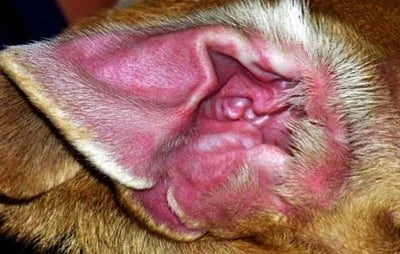
Besides the itching, and as a result of scratching, the skin becomes inflamed, small bumps similar to pimples appear, the fur eventually falls out, and there can even be scabs and skin infection. In chronic cases, the skin thickens and darkens. There are typical areas that get affected, which are where the most fleas concentrate.
These are the rump and tail base, along with the groin and abdominal area. Treatment is based on preventing the dog's contact with fleas. For this, it's necessary to establish a proper deworming schedule adapted to the dog's circumstances. Depending on the clinical picture, antibiotics may be prescribed if there's infection, or drugs to control itching.
Atopic Dermatitis, or Canine Atopy
This type of allergy has a hereditary basis. It's more common in dogs one to three years old. The breeds most prone to it are the Golden Retriever, Labrador, West Highland White Terrier, Poodle, Boxer, or Bulldog. It starts out seasonal because it's linked to certain pollens. But eventually it ends up being triggered by more pollens and other allergens.
This means the symptoms stay present all year round. Besides itching, we'll see sneezing, nasal and eye discharge, skin wounds, hair loss, scabs, infections, thickened, hyperpigmented skin, or bouts of otitis. A very typical sign is continuous licking of the feet, which causes brown stains to form in the area.
These dogs also tend to be allergic to fleas. Treatment focuses on controlling symptoms, since it's not possible to completely avoid contact with the allergens. Nowadays, immunotherapy is being used with the goal of achieving hyposensitization, meaning making the reaction to the allergen progressively smaller.

Food Allergy
A food allergy can appear in dogs of any age. It's triggered by numerous foods. For example, meat, milk, egg, fish, grains, potatoes, or soy. The reaction occurs after one or several exposures. So, it can show up as soon as we offer a new food. But also in a dog that's eaten the same thing for years.
There's intense itching and small red bumps, especially on the ears, feet, the back of the legs, and the lower part of the body. To diagnose and treat this problem, a specific hypoallergenic diet is prescribed for that dog. Ideally, it should have few ingredients, made up of foods the dog has never eaten.
Although kibble with these characteristics is made, a homemade diet is usually chosen instead, at least at the start of treatment. If there's improvement, that confirms the diagnosis. But for this, the new menu needs to be offered for about ten weeks. Other foods can be introduced gradually, so it's possible to identify whether any is responsible for the reaction.
Bibliography Carlson and Giffin. 2002. Manual práctico de veterinaria canina. Madrid. Editorial el Drac.
IMPORTANT: This article is for informational purposes only and does not constitute veterinary, nutritional or behavioural advice. Every dog is different, and only your trusted vet can advise you on its specific needs.