 Care
Care
Myiasis in Dogs - Symptoms and Treatment
Myiasis is probably one of the most unpleasant conditions we can see in a dog. That's why, since it can be painful and will get worse if left untreated, it's worth focusing our efforts on prevention.
Myiasis is a parasitic disease in which the larvae of certain fly species infect the tissue of an animal or person. Special attention should be paid to pets living outdoors, especially in hot, humid conditions. Let's see how it happens and how to prevent it.
What is myiasis?
Myiasis is a parasitic infestation caused by fly larvae, generally from the order Diptera. Infestation by dipteran fly larvae is triggered when adult flies lay their eggs on the dog's body. These develop into larvae, which feed mainly on tissue such as the skin and the layer beneath it, to support their development inside the host.
The areas chosen for egg-laying tend to be "warm and moist," which are the best conditions for larvae to develop and feed. These areas are usually skin folds, spots that stay damp often, and so on. Generally, adult flies will lay their eggs in areas the dog has a harder time reaching.
These are usually wounds or fistulas — that is, tracts open to the outside — which adult flies see as an ideal spot to lay their eggs. So, for the larvae to feed and release enzymes, an entry point such as these wounds is usually needed in most cases.
It's worth noting that this parasitic infestation is more typical of subtropical and tropical countries, as well as rural areas. It's rare to find it in cities in non-tropical countries, or in dogs that receive routine health care from their owner and vet.
Possible locations for myiasis
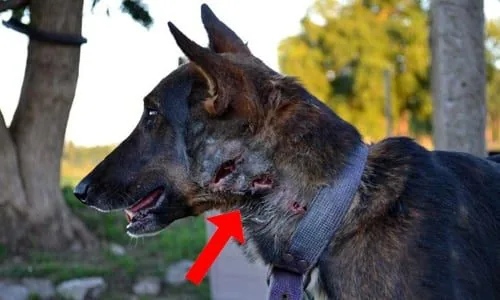
There are several possible locations for myiasis, all falling under cutaneous myiasis, since, as mentioned, it's usually in skin wounds (or, less commonly, deeper ones) that these ectoparasites' larvae settle. As they burrow deeper, they'll affect more tissue, such as the layer beneath the skin or muscle. That said, we can see it in various external areas.
- Myiasis in the ear: flies can lay eggs inside the ear, since it's a spot that stays consistently humid and has less hair than other areas.
- Myiasis in the limbs: since they're in contact with the ground, flies take advantage of the lower part of the legs to lay their eggs there.
- Myiasis in the anus, penis, or testicles: it's not unusual to find cases of myiasis even in the reproductive tract or anus of a dog. If eggs are laid in these areas, they can be hard to spot and can progress, worsening the condition. The same happens with the eye sockets, where eggs can also be laid.
These are some of the possible locations, but the truth is they can settle wherever there's a wound, and the harder it is for the animal to reach, the better for these ectoparasites.
When does myiasis occur?
In this case, we're dealing with a problem that tends to be seasonal, coinciding with the time of year when flies are most common. This usually lines up with the warm months and summer season. That said, the exact dates will depend on where we live.
Symptoms of myiasis in dogs
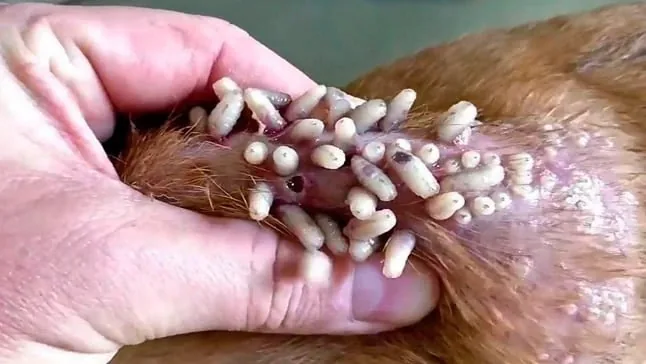
Because of how the larvae act on the skin and tissue, lesions are easy to notice. These look like rounded, "bullet-hole"-shaped openings — these are the tracks the larvae leave as they burrow through the tissue. The eggs hatch three days after being laid. Over the following weeks, the larvae grow, releasing an enzyme through their saliva that's able to break down tissue.
This mechanism is what causes the holes we'll notice, which get bigger over time. The condition can very likely be complicated, if untreated, by a bacterial infection, made worse by the animal constantly licking the area due to the itching these larvae cause.
A very severe infestation can cause anaphylactic shock due to the enzymes produced by the larvae and the weakened immunity that can result. In these cases, it would be a veterinary emergency. So, the main symptoms we'll see are:
- Formation of holes or tracts in the skin.
- Whitish larvae appearing.
- Skin wounds that won't heal.
- Intense, uncomfortable itching around the anus.
Treatment for curing myiasis
This condition needs to be treated by a vet. The main step is removing every larva possible, which can be done with tweezers and gloves. In addition, all affected tissue also needs to be removed. The area needs to be thoroughly disinfected with, for example, chlorhexidine. It's common to clip the fur all around the area to prevent additional infections. Care needs to be taken to avoid rupturing the larvae during removal.
Broad-spectrum oral antibiotics such as amoxicillin-clavulanic acid or cephalosporins will be given, along with anti-inflammatories such as meloxicam, and daily wound care with an antiseptic like cristalmina twice a day. Topical spot-on treatments or other antiparasitics may also be used. Of course, these medications can only be prescribed by the vet.
Myiasis can't be treated at home on our own — there are no home remedies. What's more, if the infestation is severe enough to cause shock, the vet will need to stabilize the dog. In these cases, the prognosis is guarded.
Dermatitis from fly bites
Flies don't only harm our dog by laying eggs inside them — they can also bite dogs, causing dermatitis. The areas affected will be external skin areas, such as the ears.
In these cases, bites can be seen along the folds of the ears. If we look closely, we'll notice crusty lesions. What's more, these lesions are painful for the dog.
Because of this, we'll notice them uncomfortable, trying to scratch with their paws, and shaking their head. This can easily lead to bleeding, which can complicate things further. When bacterial infections appear, they need to be treated with antibiotic ointments prescribed by the vet, or systemic antibiotics, along with anti-inflammatories.
How to prevent myiasis
For dogs who've already had myiasis and are recovering, it's best for them to stay indoors until the lesions have fully healed. To protect them going forward, we can ask the vet about an insect repellent to keep flies away from them.
We'll use external antiparasitics year-round, but this will be especially important during the summer months, spring and summer. It's essential that, if we see a wound on the animal, we treat it and don't leave our pet outdoors with it during the warm months. Hygiene is also essential. Wound areas should be kept as clean and dry as possible.
Is myiasis contagious?
Yes, myiasis can spread to other animals and even to humans. These larvae will develop into adults over time, and these adults can lay many eggs. It's also contagious if larvae move from one animal to another, but since these parasites are so large, they're very easy to spot. So transmission isn't as easy as it would be with smaller parasites.
IMPORTANT: This article is for informational purposes only and does not constitute veterinary, nutritional or behavioural advice. Every dog is different, and only your trusted vet can advise you on its specific needs.