 Breeds
Newfoundland
The Newfoundland isn't just a dog of colossal size; it's an aquatic athlete shaped by centuries of work in the icy waters of the North Atlantic. Its imposing frame hides a gentle heart and a rescue instinct so deeply ingrained it doesn't need commands to dive in and save someone. Let's take a look at this giant's reality, from its lifeguard-built anatomy to the care its noble nature demands.
Anatomy of a Lifeguard
The official American Kennel Club (AKC) standard describes a powerfully built dog where every trait serves a purpose. Males reach a height at the withers of 71 cm and a weight ranging from 59 to 68 kg, while females measure around 66 cm and weigh 45 to 54 kg. This size isn't dead weight — it's the foundation of a towing power capable of dragging an unconscious person to shore.
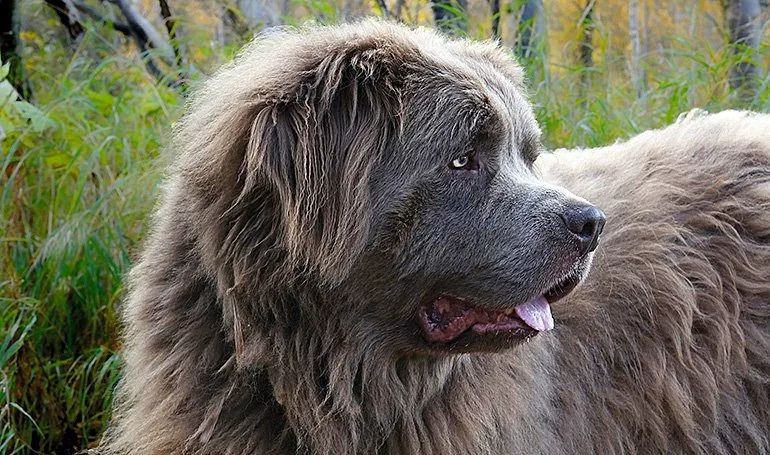
Its most visible trademark is its double coat: a long, straight, slightly oily outer coat that repels water, and a dense, woolly undercoat that traps body heat even in freezing water. Accepted colors are black, brown, gray, and the black-and-white combination (known as Landseer in Europe). Beneath the coat lies a deep rib cage housing exceptional lung capacity, giving it superior aerobic endurance for swimming over long periods. Its large paws, finished with webbing between the toes, spread out when pushing through water, maximizing every stroke. These giants' life expectancy runs between 9 and 10 years, a typical lifespan for giant breeds.
An Origin Forged at Sea
The myth placing its origin among Viking dogs lacks any archaeological or historical evidence. Norse settlements on the island were far too short-lived to leave a canine legacy. The reality is more practical and maritime: the breed was forged between the 16th and 18th centuries by English, Irish, and Portuguese fishermen working the Grand Banks.
These sailors brought along mastiff-type working dogs and European water dogs. On the island of Newfoundland, those animals crossbred with native dogs kept by Indigenous tribes, producing a hybrid exceptionally resistant to cold and built for swimming. It wasn't a companion animal, but an essential working tool: it hauled nets loaded with fish, carried loads between boats, and retrieved anything that fell overboard. Over time, the largest dogs with the strongest rescue instinct were selected for water rescue work. In fact, the Newfoundland shares a common ancestry with the Saint Bernard; both descend from molosser-type dogs, but while one specialized in alpine snow, the other perfected its trade along wave-battered coastlines.
A Giant With a Gentle Heart
Beneath its imposing presence beats an exceptionally sweet, balanced temperament. The Newfoundland is patient to its core, with a tolerance that's earned it the classic nickname "nanny dog." Its devotion to family is absolute, and its protective instinct shows up calmly, without unnecessary aggression.
It has an innate rescue instinct that doesn't need training to kick in: if someone's in trouble in the water, the Newfoundland will dive in after them immediately. This blend of strength and gentleness makes it ideal for homes with children, where it watches over and accompanies them with unshakeable calm. Its intelligence and eagerness to please make training easier, though it needs a handler who understands its sensitivity; harsh methods backfire with this breed.
Traits Only It Has
Few breeds can boast webbed feet like a duck's. The Newfoundland's webbing between the toes is an evolutionary adaptation that lets it propel itself through water with astonishing efficiency, reaching swimming speeds faster than many trained humans.
Its coat also hides secrets. According to a scientific study from Cardiff University, historical analysis of its coat-color genetics reveals how breeder preferences and geographic isolation shaped the distribution of black, brown, and Landseer coloring over the centuries. Another quirk is its oversized lung capacity, which lets it dive and hold its breath underwater longer than other breeds. Its rescue instinct also runs so deep that documented cases exist of Newfoundlands saving people without ever having received a command to do so.
Essential Health and Care
Like any giant breed, the Newfoundland is prone to certain conditions. The most common are hip and elbow dysplasia, bloat (a life-threatening risk that calls for splitting meals and avoiding intense exercise after eating), and heart problems like aortic stenosis. Cataracts and other hereditary eye conditions can also appear.
Its dense coat demands frequent brushing, at least two or three times a week, to prevent tangles and remove dead hair, especially during seasonal shedding. Exercise should be moderate but consistent; swimming is the ideal sport for keeping its muscles toned without straining its joints. It's crucial to protect it from extreme heat, since its double coat predisposes it to heatstroke. With regular vet check-ups, a controlled diet, and plenty of affection, this gentle giant can enjoy a full, healthy life.
IMPORTANT: This article is for informational purposes only and does not constitute veterinary, nutritional or behavioural advice. Every dog is different, and only your trusted vet can advise you on its specific needs.