 Breeds
Old English Sheepdog
Beneath its unmistakable shaggy coat lives a dog with centuries of herding work behind it. The Old English Sheepdog, also known as the Bobtail, has an imposing presence that contrasts with a gentle temperament and unwavering loyalty to its own. It's more than just an advertising icon: it's a tireless worker that traded pastures for living rooms without ever losing its essence.
A Square, Double-Coated Stuffed Toy
The Bobtail's silhouette follows one golden rule: a square body, where the length of the torso nearly equals the height at the withers. Males stand between 61 and 66 cm and weigh 36 to 46 kg; females fall in a range of 56 to 61 cm and 30 to 40 kg, according to the official American Kennel Club standard. That compact build, with a deep chest and well-developed muscle, gives it an elastic gait with a wide stride, a direct legacy of its past driving flocks.
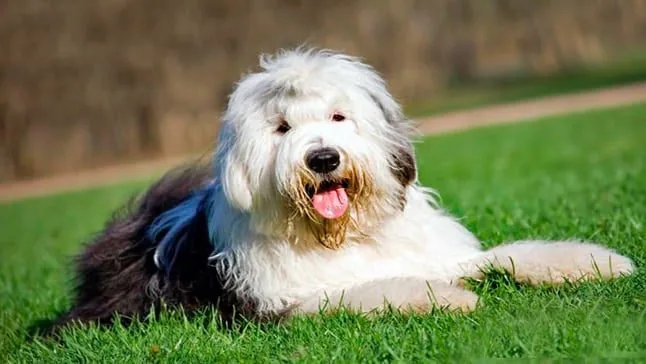
Its coat is its most striking trademark. It has a double layer: an outer coat of long, coarse, slightly wavy hair — never curly — and a dense, waterproof undercoat that shields it from the elements. Accepted colors span the whole gray, blue, blue merle, and grizzle range, with or without white markings on the head, neck, chest, and legs. The head is voluminous, with a marked stop, small close-set ears, and lively dark eyes. The tail, naturally short or absent, rounds out a look that's hard to miss. Its life expectancy runs between 10 and 12 years.
The Dog That Dodged Taxes
The Old English Sheepdog emerged in the rural areas of western England during the 18th century, developed as a working tool for driving sheep and cattle along long roads to market. Its stamina and reliability made it the go-to ally for shepherds and farmers, who valued both its driving ability and its protective instinct against predators.
The breed's characteristic docked tail has a tax-related explanation that's as curious as it is well documented: working dogs were exempt from taxes, and a short tail — whether natural or docked — served as proof for tax collectors. European breeds with thick coats, such as the Briard and the now-extinct Russian Owtchar, are believed to have contributed to its development. With the arrival of Victorian dog shows, the Bobtail made the leap into British aristocratic circles as a companion dog, but it never lost its temperament as a tireless guardian.
Pastoral Composure in a Family Package
The Bobtail is, above all, a dog with a calm temperament, deeply attached to its family. Its herding heritage gave it an innate calm at home: it prefers the quiet company of its people over reacting to every outside stimulus. It's not a nervous or reactive dog, and that emotional balance makes it an exceptional household companion.
With children it shows almost endless patience and a gentle, never possessive watchfulness. It tends to supervise children's games and even "gather" scattered family members with body nudges, a behavior inherited from herding. Although its size calls for supervision to prevent accidental trips, its gentleness is legendary. It's not naturally barky, but it knows how to alert firmly if it senses something out of the ordinary, showing its side as a discreet, effective watchdog.
The Bobtail's Best-Kept Secrets
Few people know the Bobtail's short tail wasn't always an aesthetic choice. The tax exemption for working dogs turned the absence of a tail into a legal marker, and over time genetic selection fixed dogs born naturally tailless or with a stub. Another fun fact is its iconic association with the paint brand Dulux, which since the 1960s has made it one of the most recognizable dog faces in the world.
From a scientific standpoint, the Bobtail is mentioned in a scientific study from Washington State University on the breed distribution of the ABCB1-1Delta polymorphism, responsible for multidrug sensitivity. The research found that this breed is among those with a significant frequency of the mutation, requiring extra caution with certain medications commonly used in veterinary practice. Its characteristic deep, resonant bark also sets it apart from other herding breeds, and its rolling gait recalls that of a small bear when it moves freely.
Care and Health of the Old English Sheepdog
The Bobtail's coat demands constant dedication. To prevent tangles and dirt buildup, it needs full brushing at least three times a week, plus baths every six to eight weeks and periodic trims for owners who prefer more practical upkeep. During shedding season, brushing should be stepped up to manage undercoat loss. This isn't a dog for anyone looking for minimal grooming.
On the health front, the priorities are clear. The breed has a predisposition to hip dysplasia, cataracts, and progressive retinal atrophy, making regular eye exams and X-rays essential. The MDR1 mutation, documented in genetic studies, means drugs like ivermectin should be avoided without prior testing. It's also worth preventing bloat by splitting meals and avoiding intense exercise after eating. As for activity, it's not a hyperactive dog, but it does need quality daily walks and play sessions that stimulate its mind and keep its muscles in shape.
IMPORTANT: This article is for informational purposes only and does not constitute veterinary, nutritional or behavioural advice. Every dog is different, and only your trusted vet can advise you on its specific needs.