 Care
Care
Canine Otitis Externa - Symptoms and Treatment
Otitis externa is an acute or chronic inflammation of the external ear canal, and given how it presents, it's the most common ear condition seen in daily veterinary practice. The discomfort can range from mild to severe, which also affects treatment.
It's essential to see the vet at the first symptom, since otherwise the problem could get worse, affecting the middle or inner ear structures, increasing pain, and potentially leading to complications such as damage to the eardrum.
Definition of otitis externa and other types
Otitis externa is the most common type of ear infection seen in the clinic. It accounts for roughly ¼ of dermatology visits in dogs and 1/6 in cats.
So we'll focus mainly on this part of the ear. Otitis externa, then, is inflammation of the lining of the external ear canal. It can affect one or both ears.
The ear is divided into the external ear canal, middle ear, and inner ear. Otitis externa progressing and affecting the integrity of the eardrum usually leads to middle and inner ear infections. Let's look at those.
Otitis media (middle ear infection)
This affects the middle ear and is usually the result of otitis externa that has progressed. The symptoms are similar in both cases, though here there's much more pain, since the eardrum will have been affected. This usually happens in animals with chronic ear infections that don't clear up after several months (around nine) or even years on and off.
In these cases, a culture will be needed after an ear flush under general anesthesia. Treatment will take two months. Neutrophils and rod-shaped bacteria will be seen together under the microscope.
Otitis interna (inner ear infection)
With this type, the infection or inflammation has progressed to the inner ear. It's not common, but it's a serious condition, so things should never be allowed to reach this point. The notable feature is that it also affects the vestibular (balance) system.
Because of this, dogs adopt an abnormal posture, tilt their head (usually toward the affected side), become dizzy, show poor coordination, and walk in circles.
Causes of otitis externa
Its origin is multifactorial and complex, since several causes often coexist at once. The causes can be grouped into four categories.
- Predisposing factors: make an episode of otitis externa more likely, but on their own can't trigger it. This includes breeds with floppy ears, excess moisture in the canal (baths without drying the ears afterward, for example), and canal obstruction, as happens in brachycephalic breeds due to their anatomy.
- Primary causes: these can trigger otitis on their own. Examples include trauma, grass awns, tumors, parasites, and, most commonly, hypersensitivity reactions (atopy, flea allergy dermatitis).
- Secondary causes: these worsen the condition but can only take hold or spread once a primary cause is already present. These include bacteria (Staphylococcus, Streptococcus, and Enterococcus) and fungi (Malassezia, Candida).
Symptoms of otitis externa in a dog
In the early stages, the clinical signs of otitis externa can go unnoticed by the owner. However, as the inflammation progresses, more noticeable symptoms will appear, making it easy to spot. Our dog will show one or more of the following symptoms:
- Excessive head shaking, flapping their ears.
- Itching and frequent scratching at the ears with their paws.
- Redness and swelling of the outer ear. The affected ear tends to change shape, appearing droopier in erect-eared dogs or asymmetrical in floppy-eared ones.
- Abundant, often foul-smelling discharge.
- Possible irritability in our dog due to the pain.
Diagnosing otitis externa
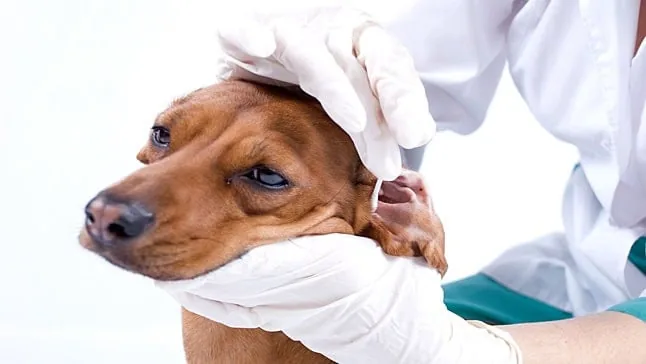
After taking a history and doing a general physical exam of the animal, the vet will go on to examine the dog's ear. It's best to first check the healthy ear (if there is one) for comparison. After examining the healthy one, the vet will use an otoscope to examine the affected ear.
If the outer ear is very swollen and inflamed, the vet may prescribe corticosteroids to reduce the swelling so they can see what's going on. If the otoscope exam is possible, the first thing they'll check for is a foreign object (grass awns in summer), the level of discharge, and the integrity of the eardrum. This exam may not be possible without sedating the animal.
Next, a swab (a kind of large cotton swab) needs to be inserted to collect a sample of the ear discharge. This is placed on a slide to examine under a microscope what type of cells or bacteria are present in the infection (if any). Finally, the vet will decide whether to take a culture with a sterile swab and send the sample to the lab in a preservation medium.
In cases where the amount of discharge makes it hard to properly see the ear canal, an ear flush under anesthesia with non-ototoxic products (warmed saline) may be recommended. This will also be done in cases of middle ear infections or chronic otitis externa.
Treating otitis externa in dogs
As a pre-treatment or complementary step to ear drops, it's always recommended to use cleaning solutions, which have functions such as: drying effect, pH modification (creating a hostile environment for microorganisms), boosting antibiotics, and acting as an antiseptic.
The first step should always be to thoroughly clean the ear, since this ensures the medication we apply can actually penetrate the canal and be effective. After that, at home we should give the prescribed treatment based on the cause.
Treatment should be focused exclusively on the cause behind the ear infection. The downside of some veterinary treatments is that they combine several substances — antibiotics, antifungals, corticosteroids. So the most suitable one needs to be chosen for each case, since treatment will also vary depending on whether the eardrum is intact or not.
How to apply medication in the ear
To treat an ear infection, it's essential that the prescribed medication effectively reaches the whole canal. To do this, we should apply the product deep into the ear canal and then gently massage the base of the ear to spread it evenly.
We'll hold the dog's head still to keep them from shaking before the medication has had time to penetrate the canal. Afterward, we'll wipe away any excess discharge left on the outer ear.
Preventing ear problems
It won't always be possible to prevent an ear infection, but we can follow some recommendations to keep ears healthy. The first step is to see the vet at any sign of an ear problem, to prevent complications. Other useful tips include:
- Avoid moisture in the ear canal. To do this, we can put cotton balls in the ears when bathing the dog, since, as explained above, water in the canal is a predisposing factor. If the dog swims, we need to thoroughly dry their ears afterward.
- We shouldn't use any product inside the ear unless prescribed by the vet. If the eardrum were perforated, this could cause serious damage to the hearing structures and labyrinthitis.
- It's a good idea to check the ears after walks in dry areas, especially in spring and summer. Grass awns are a foreign object that frequently gets into our pet's ear. We'll notice them shaking and tilting their head. Sedation may be needed in some cases.
- Hair shouldn't be plucked from the ear canal. Although this practice is very common and aims to prevent ear infections, it's been shown to have the opposite effect, causing inflammation. It may be done in cases where an ear infection is already present, to prevent it from mixing with any discharge.
Ears can be cleaned routinely, say every two weeks (this depends on many factors), with gauze and an ear-cleaning solution without antibiotics, corticosteroids, or other substances. This way we'll do as much as possible to prevent ear infections, or at least stay alert for one.
Bibliography Information provided in the medical pathology course, otitis externa section. Taught at Universidad Alfonso X el Sabio. Compared with the seminar "Canine otitis externa: a comprehensive approach" taught by César Yotti Álvarez.
IMPORTANT: This article is for informational purposes only and does not constitute veterinary, nutritional or behavioural advice. Every dog is different, and only your trusted vet can advise you on its specific needs.