 Breeds
Papillon: Everything About the Butterfly Dog, Care and Temperament
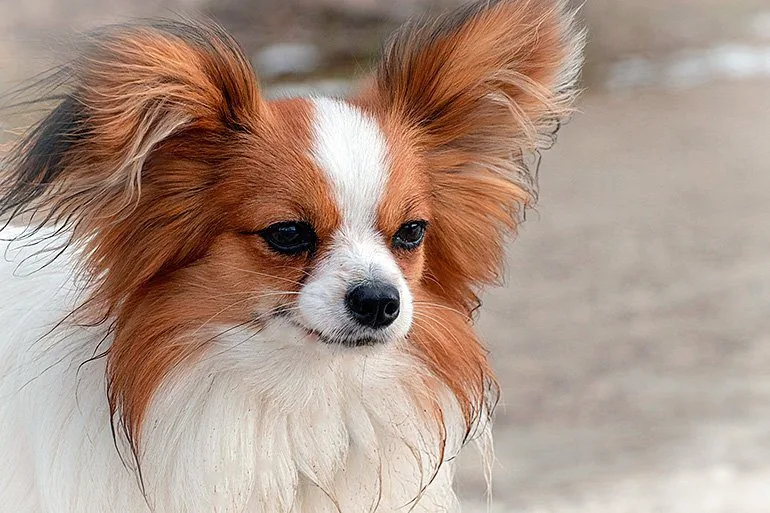
The Papillon's ears — open like butterfly wings — are his most recognisable trademark. This dog has centuries of history behind him: he was a regular at European courts in the 16th and 17th centuries. Few people realise the FCI groups him together with the Phalène, his drop-eared relative, under a single official standard.
From the laps of princesses to bourgeois drawing rooms: the Papillon's origins
Titian's and Rubens's paintings don't lie. In some of their portraits there appears, almost hidden among the folds of a lady's dress or by the feet of a princess, a small drop-eared dog we now recognise as the Épagneul Nain Continental, the Papillon's direct ancestor. That he ended up the favourite of European nobility is easy to understand. Modest size, striking presence and a temperament docile enough to survive among silks and court protocol. The name we know him by today comes from the French — papillon means butterfly, referring to those erect, fringed ears resembling butterfly wings — though some theories place Spain at the root of it all. Some suggest the first individuals reached the courts of central Europe through royal marriages and diplomatic contacts between the 16th and 17th centuries. This select group of companion dogs followed, embassy by embassy, the trail of continental power.
Where the breed really settled was in the France of Louis XIV. Two varieties existed there — the erect-eared one and the drop-eared one, known today as the Phalène, meaning moth in French — and for generations they shared kennels and standard with nobody too concerned about telling them apart. 19th-century British dog fancying changed things. It began favouring erect ears and started marking a distinction between the two types. The FCI still keeps them today under a single standard, No. 77, without splitting them into separate breeds — a way of preserving these small spaniels' shared history.
The French Revolution shook everything up, and these dogs were no exception. With the aristocracy scattered or guillotined, many of these dogs ended up with wealthy families who took them in without the ceremony of court life. His size was a practical advantage; his lively, adaptable character did the rest. Today's Papillon still carries that distinguished air he can't help — centuries among palaces leave a mark — but he's just as active and curious as he's always been.
Physical characteristics of the Papillon
The Papillon has a small but well-balanced build, standing 20 to 28 cm at the withers with an ideal weight of 2.5 to 4.5 kg. His silhouette conveys lightness without fragility: the chest is moderately deep, the topline straight and the croup slightly rounded. Overall proportions draw a dog slightly longer than tall, giving him an elegant, flowing stride, quite different from the bouncy movement of other miniature breeds.
The head is one of his most distinctive traits. The skull, medium-sized, has a well-marked stop and a muzzle shorter than the skull, tapering toward the nose without becoming pointed. The eyes, almond-shaped and dark, convey an alert, intelligent expression. But what really defines the breed's image are the large, high-set ears with abundant fringing: in the Papillon variety they stay erect and open like butterfly wings, while in the Phalène they fall completely to the sides. The coat is long, silky and without a dense undercoat, forming a ruff around the neck and a characteristic plume on the tail, which arches over the back.
Wondering exactly what this dog is like, it's worth noting his alert expression and light gait. He isn't an inactive toy dog: under that silky coat lies lean muscle and fine-boned but sturdy legs, ready to keep up with his owner agilely all day.
Papillon colours accepted by the FCI and Spain's RSCE
FCI standard No. 77 leaves little room for interpretation. The base is always white. On top of that, patches of practically any shade are distributed, with one single exception: liver, which isn't allowed. White dominates the body and legs, while the head carries a coloured mask running from the ears to the eyes and muzzle, split by a central white blaze that show judges pay close attention to.
The most common patch colours are black, red in any of its shades, and sable, which is red with black tips. Tricolour (black and red on white), lemon patches, chestnut and any other combination avoiding liver are also acceptable. Nose, lip and eyelid pigmentation follows the patch colour: black in dogs with dark markings, somewhat lighter in those with red or lemon patches, always in keeping with the coat.
Something worth clarifying if you're comparing the Papillon variety with the Phalène: in colours they're identical, no difference at all. Patch distribution doesn't follow a fixed pattern either, so each dog wears his own, a detail that says nothing about his health or suitability as a companion dog.
The Papillon doesn't fit the lapdog stereotype. He's curious, intelligent and self-assured, and when faced with something unfamiliar he doesn't freeze: he watches, weighs it up and acts. His origin as a companion dog hasn't erased his watchdog instinct, and it shows. He announces visitors firmly, without becoming a nuisance with barking, provided socialisation during puppyhood was handled properly.
Day to day, his personality is markedly participatory. If you're cooking, he's in the kitchen. If you're working, he shows up beside you. And don't be fooled by the size: in agility, competitive obedience and scent games he performs at a level that's disconcerting. He learns complex routines in a few sessions, provided training uses positive reinforcement and avoids falling into monotony. Punishment doesn't work with him, and neither does boredom.
With children and other dogs, the attitude is usually good. Living with cats or other pets goes smoothly if introductions are handled calmly and gradually. Watch out for this, because under that fragile appearance lies a fairly tenacious character. If the owner gives in to his whims, the Papillon takes note and makes the most of it. Setting boundaries from the start, without drama but with consistency, saves a lot of problems later.
The Papillon's coat is long, but lacks a woolly undercoat, and that makes a difference in maintenance. Two or three weekly brushings with a metal-pin comb are enough to remove dead hair and keep tangles at bay, which tend to form behind the ears, in the leg fringing and in the ruff. When seasonal shedding hits, switch to daily brushing. Bathing, every four to six weeks with a gentle shampoo that preserves the coat's silky texture. Never shaved or trimmed, except to keep the perianal area and between the toes hygienic.
The mouth deserves special attention. Papillons build up tartar easily, so brushing with dog-specific products — daily if possible — combined with regular vet check-ups is the best way to prevent problems. Nails grow fast and need regular trimming so they don't interfere with walking.
Diet needs to match his life stage and exercise level, with high-quality kibble formulated for small breeds. Portion control matters more than it seems: his joints are fine and excess weight punishes them. To stay fit, two or three walks of 20 to 30 minutes a day plus some interactive play at home are more than enough.
Living with a Papillon in Spain: adapting to flats, exercise and the Mediterranean climate
Living in a flat with a Papillon works perfectly. They're small dogs, needing no more space than any modern human with their six feet of height, and as long as they have their corner with a bed and a full bowl, they're fine. That said, staying home all day isn't an option for this breed. He needs at least three outings, one first thing in the morning, another at midday and the last as evening falls. That covers exercise, street sniffing and socialisation. Without that rhythm, he'll redecorate the flat his own way.
Summer is another matter. In July or August, midday asphalt can burn the pads, so walks need to move to first thing or after the sun goes down. The Papillon handles heat better than a Bulldog or a Pug, but that doesn't mean you can leave him in the car for ten minutes while you run an errand. No. At home he seeks out cool spots by instinct — tiled floors, shade — but it helps to have a cooling mat handy. And a water bottle on summer walks isn't optional.
With no undercoat, cold gets to him easily. In inland cities, or when a biting wind blows, a light coat suits him well and isn't any kind of indulgence. On the Mediterranean coast he doesn't suffer as much, but watch for draughts at home. Crowded dog parks, on the other hand, are another matter. He generally gets on well with other dogs and has a temperament that doesn't stir up conflict, but putting him in a park full of Labradors and German Shepherds running unsupervised is asking for trouble. An accidental knock from a thirty-kilo dog can genuinely hurt him, even with no bad intention involved.
Common Papillon health conditions
The Papillon has his weak points, like any breed. On the eye front, a frameshift mutation has been found in the CNGB1 gene causing progressive retinal atrophy in both Papillon and Phalène individuals ‘A CNGB1 frameshift mutation in Papillon and Phalène dogs with progressive…’ (2013). Vision loss progresses with no way to reverse it, but genetic tests can detect it before the dog starts stumbling, with enough time to adapt the environment. One Papillon family has also shown an abnormal negative electroretinographic response of hereditary character pointing to additional retinal alterations still under investigation ‘An unusual inherited electroretinogram feature with an exaggerated negative…’ (2022).
The nervous system also has its scares. Neuroaxonal dystrophy and cerebellar cortical abiotrophy present with hind-limb ataxia, intention tremor, head tremor and hypermetria, and the condition progresses over time, so the sooner the animal reaches a specialist, the better ‘Clinicopathological features of canine neuroaxonal dystrophy and cerebellar cortical…’ (2007). On the cardiovascular side, a 10-year-old Papillon presented with lethargy, loss of appetite, rapid breathing and difficulty breathing, and the diagnosis was pericardial hemangiosarcoma, an aggressive cancer making clear that any sudden change in an older dog's energy or breathing should never be ignored ‘Pericardial Hemangiosarcoma in a 10-Year-Old Papillon’ (2018).
The list doesn't end there. Medial patellar luxation, tracheal collapse and advanced periodontal disease are conditions also showing up fairly often in the breed. Lameness that comes and goes, a cough that won't clear up, persistently bad breath or a behaviour change with no obvious cause deserve a vet assessment, without waiting to see if it passes on its own. The sooner a problem gets a name, the more options are on the table.
Anyone living with one of these toy spaniels — standing 20 to 28 cm and with an ideal weight of 2.5 to 4.5 kg — has a lot going for them if they take the dog for a baseline eye and neurological check-up once he reaches maturity. That first thorough exam establishes a clinical baseline that makes it easier to catch any later change.
The key to making life together work well lies more in mental stimulation than in racking up walking distance. A couple of daily sessions with scent games or short routes with changes of direction are enough for the dog to burn off energy without straining his joints. Watch out too for jumps off the sofa or similar heights, since his bone structure is light and repeated impact eventually takes a toll. If the dog limps or shows signs of pain, see the vet without delay, keeping in mind that each individual has his own limits.
IMPORTANT: This article is for informational purposes only and does not constitute veterinary, nutritional or behavioural advice. Every dog is different, and only your trusted vet can advise you on its specific needs.