 Care
Care
My Dog Has Been Stung by a Scorpion — What Do I Do?
Depending on where you live and the time of year, arthropods or insects may be more or less common in the environment. That's normal, since they're essential for the balance of the ecosystem and environment.
The downside is that our pet can get stung by a scorpion if it feels threatened. This will result in clinical signs that depend both on the pet affected and the arthropod that stung it. Let's look at how to recognize and treat a scorpion sting.
Scorpions
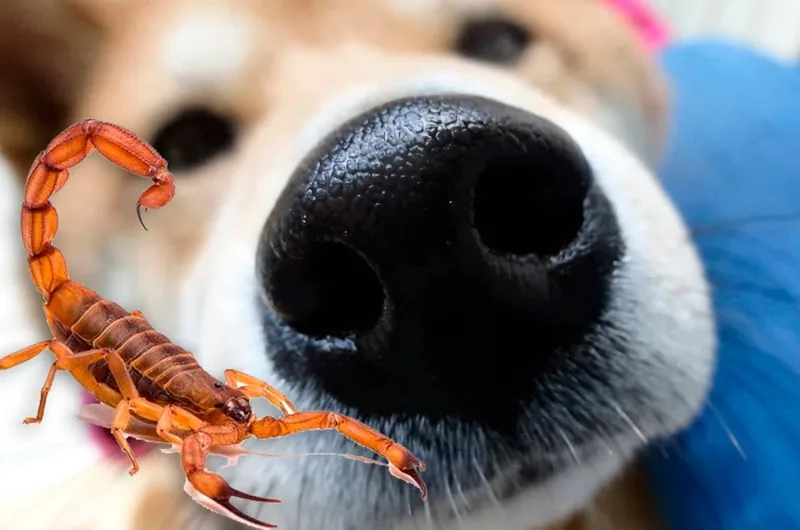
Scorpions, as we all know, are characterized by having a pair of grasping pincers and a narrow, segmented tail forming a forward curve ending in a stinger.
Scorpions date back about 435 million years, and are believed to be the earliest arachnids to have existed on our planet, giving them a considerable evolutionary history. They mainly live in deserts, but have adapted to a wide range of environmental conditions and are currently found on every continent except Antarctica.
So, there are several hundred species around the world with different levels of toxicity. In Spain there are six species. Scorpion stings in dogs in Spain can be considered low prevalence. Their severity varies, and can be complicated in immunocompromised animals or puppies.
That said, in Spain, in both humans and adult animals with a well-developed immune system, they cause hardly any serious symptoms, unlike what's been assumed throughout history, which has given them a bad reputation built on false myths and legends.
These incidents mostly happen during the summer and hot months, generally from April to October (this is when the most arthropods and ectoparasites are around). They're also more common in rural areas or places with at least some amount of nature.
Scorpion Species in Spain
In Spain, excluding Ceuta and Melilla, six species and one subspecies of scorpion are found. These are: Buthus occitanus (Amoreux, 1789), Isometrus maculatus (De Geer, 1778), Centruroides gracilis (Latreille, 1804), Euscorpius flavicaudis (De Geer, 1778), Euscorpius carpathicus (Linnaeus, 1767), Euscorpius carpathicus balearicus (Caporiacco, 1950), and Belisarius xambeui (Simon, 1879).
The first species named (Buthus occitanus) is the most prevalent on the Iberian Peninsula. Buthus occitanus, among the six species, is the most common.
Symptoms After a Scorpion Sting
A dog's reaction to a scorpion sting will depend on the amount of venom injected by that particular arthropod, its species, and the dog's size. Large breeds tend to have fewer or less severe symptoms than small breeds, due to their size.
Besides this, in severe cases such as puppies or immunocompromised animals, how quickly we act will also make a difference. In these cases, taking the dog to the vet right after the incident isn't the same as waiting a few hours. Not all symptoms will necessarily appear at once, but these are the most common:
- Swelling and erythema, or redness, of the affected area.
- Possible limping in the affected limb.
- Possible nausea and/or vomiting.
- Tremors, drooling, tachycardia, and nervousness.
- Pain and tingling in the area, possibly expressed as whimpering.
- Generalized allergic reaction.
Depending on the amount of venom and the specific species, an allergic reaction may be observed. This can show up as facial swelling, as if stung by a wasp. This is the most urgent case, since the glottis or throat could swell and narrow due to this reaction, making breathing difficult and putting our pet's life at serious risk.
What to Do If a Scorpion Stings Your Dog
If you're sure a scorpion has stung your dog, the smart thing to do is take a photo to show the vet, to identify it in case you saw it. If you lost sight of it or suspect your pet has been stung by a scorpion, diagnosis will be based on suspicion and symptoms. Either way, seeing a vet is mandatory if you want the symptoms and reaction to be controlled.
Diagnosis will therefore rely on identifying the species, as well as a detailed history we can give the vet about the incident. Every detail matters. After this, the vet will perform a full physical exam, followed by an exam of the specific injury caused by the scorpion.
If we managed to catch the scorpion in a container to show the vet, we should then release it somewhere with plenty of vegetation nearby. We shouldn't kill the insect, since, as mentioned, we share the same habitat, and as noted earlier, they're essential to the environment and only defend themselves if attacked.
Treatment
There's no specific treatment or antidote for the species found in Spain, so treatment must be symptomatic and supportive.
Each symptom is treated separately, commonly including pain management (with opioids such as buprenorphine), inflammation (with NSAIDs such as meloxicam), muscle tremors (with benzodiazepines such as midazolam), and antihistamines (such as diphenhydramine).
If shock is severe, corticosteroids such as dexamethasone can be used instead of NSAIDs. Depending on the case, hospitalization and intravenous fluid therapy may be needed.
As you can see, these treatments need to be given by a specialist. There are no home tricks available, and the bare minimum is contacting the vet, since your dog could be experiencing a lot of pain associated with the scorpion sting.
IMPORTANT: This article is for informational purposes only and does not constitute veterinary, nutritional or behavioural advice. Every dog is different, and only your trusted vet can advise you on its specific needs.