 Care
Care
Types of Canine Seborrhea, Symptoms, and Treatment
Seborrhea is a condition characterized by the presence of scales on the dog's body. These can be dry or oily. In addition, a distinction is made between primary and secondary seborrhea.
Primary seborrhea can't be cured, but a treatment can be prescribed to keep it under control. Secondary seborrhea occurs as a symptom of another disease, which will need to be treated for it to go away. Want to know more details about seborrhea in dogs? Let's get to it.
What Is Seborrhea?
Seborrhea is a pathological increase in secretion from the skin's sebaceous glands. The epidermis, the outermost layer of skin, and the hair follicles, which produce hair, give rise to what we know, by their appearance, as scales. Scales can be dry, and gray or whitish, similar to dandruff. But greasy or oily-textured, yellowish scales also occur.
In this case, they're due to excess sebum produced by the sebaceous glands. They give off a bad smell. Dry scales, precisely because of this characteristic, come off the dog's body fairly easily. Oily ones, on the contrary, come off with difficulty because they stay stuck to the fur.
In addition, with oily seborrhea, the hair follicles can become clogged, which, in some cases, ends up causing an infection. This is called folliculitis. If the buildup is located in the ear canals, it results in ceruminous otitis. We're talking about two different conditions here: primary and secondary seborrhea.
Is Canine Seborrhea Contagious?
Seborrhea isn't contagious, neither between dogs nor between animals of other species, such as from a dog to a human. However, it can be hereditary, meaning if a dog has primary seborrhea, its puppies may also develop it.
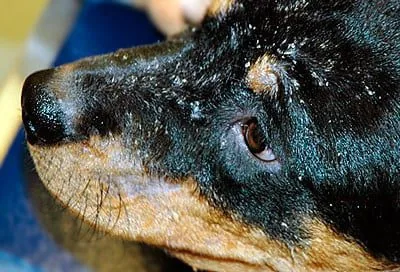
Primary Seborrhea
This is a fairly common condition. It's even more common in young dogs and in certain breeds such as the American Cocker Spaniel, Springer Spaniel, West Highland White Terrier, Basset Hound, Irish Setter, German Shepherd, Labrador, or Shar Pei.
In affected dogs, we'll observe the characteristic scales. These can be dry, oily, or both types at once. It's more common to notice the scales in areas such as the elbows, hocks, the front of the neck down to the chest, or the ears.
What Is the Treatment for Primary Seborrhea?
Unfortunately, primary seborrhea is an incurable disorder. But it can be treated, and the goal is controlling scale production. Treatment involves applying shampoos or lotions. Different products with anti-seborrheic effect are sold. The vet will tell us which is most suitable and the application schedule needed.
When the flaking is dry and mild, treatment focuses on moisturizing the skin. Humectant, hypoallergenic shampoos or lotions without additives are used, which guarantee frequent use without problems. In more severe cases, the shampoo needs to include other ingredients, as the vet will tell us.
If the seborrhea is oily, shampoos are also used, but their formula should include active ingredients such as benzoyl peroxide. These help remove the stuck-on scales. If folliculitis or another skin infection is found, it's treated with oral antibiotics. If there's scratching, corticosteroids may be needed.
Secondary Seborrhea
In this case, seborrhea is linked to the presence of another disease with skin symptoms that's causing it. Among the conditions linked to secondary seborrhea, the following stand out:
- Sarcoptic mange.
- Demodectic mange.
- Canine atopy.
- Dermatitis caused by food hypersensitivity.
- Flea allergy dermatitis (FAD).
- Hypothyroidism.
- Hormone-related skin diseases.
- Pemphigus foliaceus.
What Is the Treatment for Secondary Seborrhea?
The guidelines given to fight or control primary seborrhea can also be followed in cases of secondary seborrhea. But it's essential for the vet to identify the underlying cause that triggered it.
This means finding the disease behind the scale production. By treating it, the secondary seborrhea should go away. If it doesn't, we could actually be dealing with primary seborrhea.
Applying Therapeutic Shampoos
By therapeutic shampoos, we mean those that show activity against some condition. In the case of seborrhea, the shampoos recommended for treatment need to be applied across the dog's whole body. They're left to work for at least fifteen minutes.
Beforehand, the dog can be bathed with its usual shampoo and warm water. We'll rinse it completely before using the anti-seborrheic shampoo. Afterward, thorough rinsing and drying are important.
Dietary Supplements
As a complement to seborrhea treatment, adding certain supplements to the food seems to have a beneficial effect. Specifically, those containing essential fatty acids derived from fish oil are used. Always based on veterinary recommendation.
Bibliography Carlson and Giffin. 2002. Manual práctico de veterinaria canina. Madrid. Editorial el Drac. Rejas, Juan. Seborrea canina. dermatologiaveterinaria.unileon.es
IMPORTANT: This article is for informational purposes only and does not constitute veterinary, nutritional or behavioural advice. Every dog is different, and only your trusted vet can advise you on its specific needs.