 Breeds
Spanish Greyhound
Few breeds sum up such a fascinating contrast as the Spanish Greyhound (Galgo Español): an elite sprinter that tops 60 km/h in open country, and at the same time a couch companion that barely makes itself noticed. Its slender body, its history tied to traditional hunting, and its extreme sensitivity make it a unique dog, but also one that demands understanding before sharing your life with it.
Silhouette and Numbers of the Iberian Sighthound
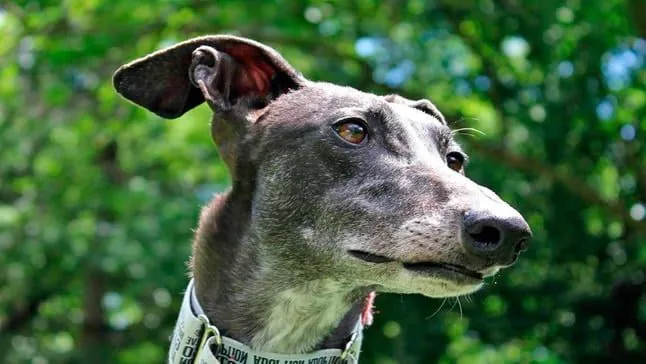
The Spanish Greyhound follows the classic sighthound pattern: a body built for speed, with elongated lines, a deep chest, and fine but powerful legs. Under the official Fédération Cynologique Internationale (FCI) standard, males stand between 62 and 70 cm at the withers and weigh 25 to 30 kg, while females fall between 60 and 68 cm with a weight of 20 to 25 kg. Its musculature is lean and perfectly defined, with no trace of subcutaneous fat, heightening the sense of pure aerodynamics.
The coat is short, smooth, and close to the body, with a silky texture and no undercoat at all. The accepted color palette is broad: black, brindle, cinnamon, yellow, red, white, and pied, along with combinations like dark brindle over a black base, highly valued by hunters for its natural camouflage. The head is long and narrow, with ears folded back at rest that rise when alert, and the tail, thick at the base and thin at the tip, is never carried above the topline. With good care, its life expectancy reaches 12 to 14 years.
A Legacy Forged on the Plains
The Spanish Greyhound is a native breed of the Iberian Peninsula, shaped over centuries to hunt hares across open, arid terrain. Its origin traces back to sighthounds already appearing in medieval and Renaissance iconography, but the modern standard was mainly shaped by hunters in Andalusia and Extremadura, who wanted a dog combining top speed, long-distance stamina, and maneuverability on uneven ground.
That functional selection, focused solely on hunting performance, shaped an animal with a wide stride, great lung capacity, and a chase instinct triggered by movement. Unlike other European sighthounds, the Spanish Greyhound developed without interference from aesthetic show breeding, which explains why it retains a more rustic, variable phenotype than its English relative, the Greyhound. Today two lines coexist: the racetrack competition line and the hunting line, with the latter preserving the oldest genetic stock.
The Galgo's Temperament at Home
Anyone who's only seen the Spanish Greyhound in action would have a hard time picturing its behavior at home. Indoors it's a dog that's calm to the point of laziness, spending endless hours sleeping on soft surfaces and rarely demanding activity. This contrast between explosive outdoor performance and domestic calm is one of its trademarks and the reason many families choose it as a companion animal.
Its temperament is sensitive and deeply affectionate, without being clingy. It forms intense bonds with its owners and reacts strongly to tone of voice and the emotional atmosphere around it. Unlike the Greyhound, the Spanish Greyhound shows a more alert, protective attitude toward the home, alerting to strangers without a trace of aggression. That sensitivity makes it a receptive student for positive training, but also a dog vulnerable to stress if routines break down or the environment turns tense.
Unique Traits of the Spanish Sighthound
One anatomical quirk of the Spanish Greyhound is its extremely thin, elastic skin, which slides easily over the body. Combined with the near-total absence of subcutaneous fat, this makes it prone to cuts and scrapes, but also gives it that unmistakable streamlined silhouette. Another curiosity is its asymmetrical galloping stride: at top speed, all four legs leave the ground simultaneously in two separate phases, a mechanism it shares with the English Greyhound that optimizes propulsion.
It's also one of the few breeds that maintains strong functional sexual dimorphism: females tend to have more stamina over long distances, while males excel at explosive starts. Finally, its ability to regulate body temperature during intense exercise is exceptional, thanks to a cooling system based on peripheral vasodilation and skin evaporation, something uncommon in other sighthounds.
Essential Health and Care
The Spanish Greyhound is generally a healthy breed, but its build predisposes it to certain problems. Musculoskeletal injuries, such as fractures of the metatarsus and hip dislocations, are common in dogs that race without proper conditioning. It's also prone to bloat, so it's recommended to split meals into two portions and avoid intense exercise right after eating. Its thin skin calls for vigilance against cuts and sunburn, especially in light-coated dogs.
As for parasitic diseases, one relevant risk is heartworm disease. In fact, a scientific study from Vytautas Magnus University documented the first case of Dirofilaria immitis infection in a dog imported to Lithuania, underscoring the importance of screening tests and rigorous parasite prevention in greyhounds that travel or are adopted in other countries. Daily exercise should be controlled: they need free runs in safe areas, but at home they appreciate calm and a good mattress to rest their joints on.
IMPORTANT: This article is for informational purposes only and does not constitute veterinary, nutritional or behavioural advice. Every dog is different, and only your trusted vet can advise you on its specific needs.