 Care
Care
Stomach Torsion in Dogs: Causes, Treatment, and Prevention
Stomach torsion is a much more common problem in dogs than one might think — so much so that our dog could go through it at some point. That's why it's very important to know what it involves, what its symptoms are, and, of course, how to prevent it.
It's a condition that's very easy to spot, and acting quickly if it occurs can be the difference between saving its life or not. Let's take a simple look at the characteristics of stomach torsion.
What Is Stomach Torsion in Dogs?
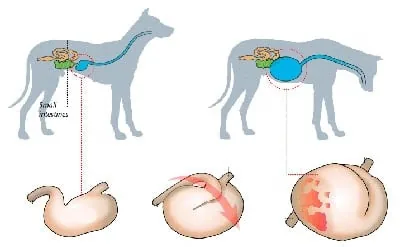
When a dog's stomach fills up with too much food or gas, it naturally distends, just as happens with humans. It's not clear whether distension precedes the torsion or the other way around.
Either way, when this happens, the dog's stomach can end up in unnatural positions, twisting so much that its contents can't pass into the intestine or be vomited up. Likewise, blood flow to this organ and the ones next to it can be compromised, depending on how quickly we respond.
Symptoms of Canine Stomach Torsion
Luckily for us, detecting a stomach/gastric torsion is very simple. And if we act quickly, we can greatly increase our dog's chances of survival. These are the main symptoms we'll be able to notice:
- Swelling in the stomach area (left side of the abdomen).
- Unproductive retching (nothing comes up), excess salivation, coughing, foam at the mouth…
- Excessive panting, nervousness, excessive excitement, anxiety.
My Dog Has Symptoms of Stomach Torsion — What Do I Do?
If you notice one or more of the symptoms mentioned above, you need to see a vet immediately. Acting quickly is an essential factor that can make the difference between our dog surviving or dying.
There are no home remedies, nor absolutely anything we can do ourselves — we need to see a vet without fail, or our dog will die. There are vet clinics open (or on call) 24 hours a day, every day of the year.
In cases where there's some time to spare, the vet may consider taking an abdominal X-ray to see the degree of distension/torsion.
In urgent cases, the vet will immediately place an IV line on our dog to hydrate it, insert a needle through the skin into the stomach to try to decompress it, and pass a tube down its throat, after intubation, to try to undo the torsion and empty the stomach's contents. If there's no way to enter the stomach, surgery will be needed to resolve the torsion manually.
If surgery is decided on, the vet will "anchor" the stomach to the abdominal wall with sutures to prevent future torsions. Even if the surgery goes correctly, if there's been vascular compromise to the organs, the prognosis will be guarded. So the first 48 hours will be crucial. If we follow the guidelines below, our dog can have a healthy, happy, completely normal life.
How to Prevent Stomach Torsion?
Gastric torsion mainly occurs in large and giant breeds. There are some simple tips we should follow to prevent our dog from suffering it.
In reality, these are tips we should all follow, regardless of whether our dog is more or less likely to develop it, since they're common-sense tips.
- The most important thing (especially for large and giant breeds) will be to split the daily food amount into at least three meals a day. This way, we'll prevent overeating and reduce the chances of stomach distension/torsion.
- Wait an hour before feeding our dog if it's been running or doing intense physical exercise. Likewise, don't take it out to exercise after eating.
- Wait until our dog is completely relaxed before feeding it, avoiding giving it food if it's excessively active.
- Prevent it from drinking a lot of water continuously, for example if it comes back thirsty after exercising with us. We'll give it water, but if we see it's excessive, we'll take it away and give it little by little.
Although not scientifically proven, some studies suggest that placing the food bowl at a mid-height between the ground and its head somewhat helps prevent torsion.
After a Stomach Torsion... Will They Have a Normal Life?
Of course, a stomach torsion can be resolved with surgery (if the vascular compromise wasn't too severe and we caught it in time), which, although lengthy and complex, saves the lives of many dogs every year.
Our vet will tell us everything we need to know to prevent it from happening again. But realistically, there will always be a risk of it recurring, so we need to closely follow the guidelines mentioned.
They can lead a normal life, full of play and affection, just like they always have. We simply need to keep in mind the recommendations and precautions mentioned above to try to prevent it from happening.
IMPORTANT: This article is for informational purposes only and does not constitute veterinary, nutritional or behavioural advice. Every dog is different, and only your trusted vet can advise you on its specific needs.