 Care
Care
The Smell in My Dog's Paws
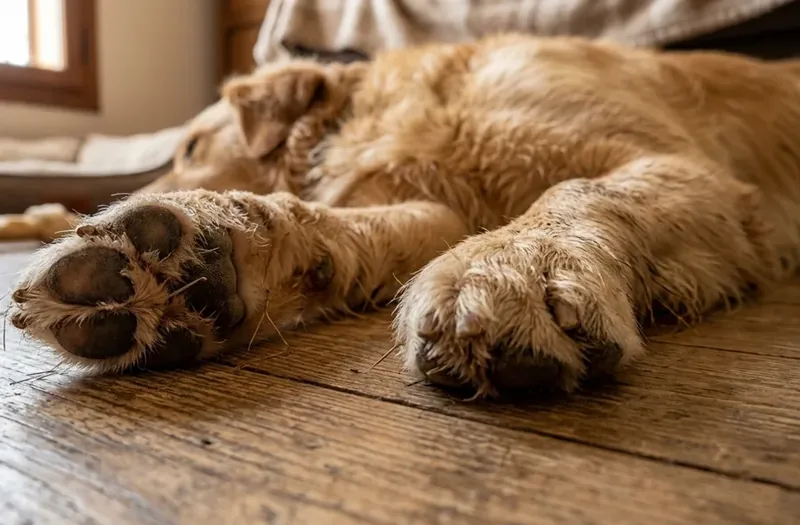
If we pay attention, we'll notice our dog's paws, specifically its paw pads, give off a particular smell that many find quite hard to describe. Some say they smell like cheese, others mention popular salty snacks, etc.
Either way, so you don't worry, you should know this is its natural smell, and therefore physiological and healthy. In this article, we'll explain what causes it and how to manage and care for the paw pads to keep them healthy throughout the dog's life.
What Are Dogs' Paw Pads Like?
The paw pads' smell is very different from the rest of the dog's body. This is explained by their specific characteristics, which are linked to their important functions. Paw pads are made up of a thick layer of keratin, the protein present in horny tissue. Under this layer there's fat and an elastic tissue.
That's why, when we touch the paw pads, we get the feeling it's like a kind of cushioned pillow. In addition, they're very sensitive, richly supplied with blood vessels, and have a good number of nerve endings. This is why they bleed abundantly and can explain why many dogs refuse to have this part of their anatomy touched.
Although, just as happens with human feet, they don't usually get the attention they deserve given their importance, the truth is paw pads need specific care and regular check-ups so they can keep performing their important functions under any circumstance. These are the following:
- Being the dog's points of support.
- Cushioning the impacts that occur while walking, jumping, running, etc.
- Moving across all types of terrain, whether sand, dirt, rocks, asphalt, ice, etc.
- Distributing the dog's weight evenly across its four legs.
- Insulating from the ground.
- Sweating, since the dog's sweat glands are found in the paw pads.
- Marking — with every step or when scratching the ground, the animal leaves its own unique, particular scent.
Why Do Dogs' Paws Smell?
The origin of dogs' paw pads' special smell is due to the different substances and elements that can be found on them. So, this smell is the result of a mix between the sweat produced by the sweat glands, the microorganisms that make up the normal flora of that area, and any material the dog has been stepping on.
This particular, hard-to-define smell isn't pathological. On the contrary, it's a sign the paw pads are healthy and in good condition. If, on the other hand, we notice any change in this smell, we could be facing a health problem, such as an infection, that would need to be diagnosed and treated, always seeing the vet as soon as possible.
How to Care for a Dog's Paw Pads
To prevent any disorder in this very important part of canine anatomy, we said they need regular check-ups. Especially as dogs get older, since paw pads become more delicate. But also when they've walked on rough terrain or in adverse weather conditions, such as ice.
It's recommended to periodically examine them and check the condition of the interdigital spaces, where dirt, foreign bodies, or parasites like ticks can build up. In dogs with very long fur between the toes, it can be trimmed, always very carefully. It's also recommended to dry the paw pads when they get wet.
In specific situations, such as rocky terrain, very hot ground, or snow, we can prevent injuries by applying a specific cream or spray. Even, if needed and the dog tolerates it, there are shoes specially designed for them. These don't just prevent injuries — they can help protect existing ones, supporting recovery.
Problems in a Dog's Paw Pads
Paw pads wear down over time. They gradually lose elasticity and dry out, which can end up causing painful cracks and even become complicated by secondary infections. Lesions in the paw pads won't always change their smell. But when we notice a change in it, there's likely some problem.
If we look closely, we may detect wounds, frequent licking, darkening of the interdigital fur, swelling, pain, or limping. Unless we're dealing with a superficial wound we can clean at home, every other situation needs to be assessed by the vet. Abrasions, wounds, or the presence of foreign bodies are relatively common.
Any of these lesions, as well as excess moisture in the area, can lead to an infection, normally caused by bacteria or fungi. That's when pus can form and we may notice an unpleasant smell, very different from the usual one.
Bibliography
Carlson and Giffin. 2002 Manual práctico de veterinaria canina. Madrid. Editorial el Drac.
IMPORTANT: This article is for informational purposes only and does not constitute veterinary, nutritional or behavioural advice. Every dog is different, and only your trusted vet can advise you on its specific needs.